
A Mississippi bill of sale is a written record of a sale that names the seller, the buyer, the item and the price. For a vehicle, a copy of the bill of sale must go with the application for a first certificate of title unless the vehicle is new.[3.2] This page has the free Mississippi vehicle bill of sale form, plus templates for boats, firearms and other property.
Last Updated: October 2026. This guide is reviewed and updated regularly to reflect current Mississippi law. If you notice an error or outdated information, please contact us.
Build Your Document
Answer a few simple questions to make your document in minutes
Save and Print
Save progress and finish on any device, download and print anytime
Sign and Use
Your valid, lawyer-approved document is ready
| Document Name | Mississippi Vehicle Bill of Sale Form |
| Other Names | Mississippi Car Bill of Sale, Mississippi Automobile Bill of Sale |
| DMV | Mississippi Department of Revenue |
| Bill of Sale Required? | Yes, for a first certificate of title on a vehicle that is not new[3.2] |
| Avg. Time to Fill Out | 15 minutes |
| # of Fillable Fields | 64 |
FormsPal offers four Mississippi bill of sale templates: one for a motor vehicle, one for a boat, one for a firearm and one for general personal property. Each template is free to download and easy to print. Pick the one that matches what you are selling, then check the details for each below.
Mississippi vehicle bill of sale records who sold the vehicle, who bought it and which vehicle it was. A copy goes with the application for a first certificate of title on a vehicle that is not new.[3.2]
| Alternative Name | Car Bill of Sale |
| Seller’s Signature | Signature line on the form |
| Buyer’s Signature | Signature line on the form |
| Notarization | No Mississippi statute requires it |
| Download | PDF Template |

Mississippi boat bill of sale form records the sale of a boat between a seller and a buyer.
| Alternative Name | Vessel Bill of Sale |
| Seller’s Signature | Signature line on the form |
| Buyer’s Signature | Signature line on the form |
| Notarization | Not covered here |
| Download | PDF Template |

A firearm bill of sale in Mississippi records the sale of a gun between a seller and a buyer.
| Alternative Name | Gun Bill of Sale |
| Seller’s Signature | Signature line on the form |
| Buyer’s Signature | Signature line on the form |
| Notarization | Not covered here |
| Download | PDF Template |

A general bill of sale records the sale of personal property, such as furniture or equipment, between a seller and a buyer.
| Alternative Name | Generic Bill of Sale |
| Seller’s Signature | Signature line on the form |
| Buyer’s Signature | Signature line on the form |
| Notarization | Not covered here |
| Download | PDF Template |
Mississippi law asks for a bill of sale when you apply for a first certificate of title on a vehicle that is not new. Under Section 63-21-15(6)(a) of the Miss. Code Ann., the application must come with a copy of the bill of sale that shows how the applicant claims title.[3.2]
The law asks for a bill of sale in place of the manufacturer's statement of origin, the paper that comes with a new vehicle. This is the rule the law quotes below.
If the application is for a first certificate of title on a vehicle, manufactured home or mobile home other than a new vehicle, manufactured home or mobile home, then the application shall conform with the requirements of this section except that in lieu of the manufacturer's statement of origin, the application shall be accompanied by a copy of the bill of sale of said motor vehicle, manufactured home or mobile home whereby the applicant claims title
Mississippi has no statute that requires a bill of sale to be notarized. It also has no statute that sets out what a bill of sale must contain. The form on this page still has an acknowledgment page for a notary if you want one.
The same filing also lists who you bought from. Under Section 63-21-15(1)(c) of the Miss. Code Ann., it must state the following.[3.1]
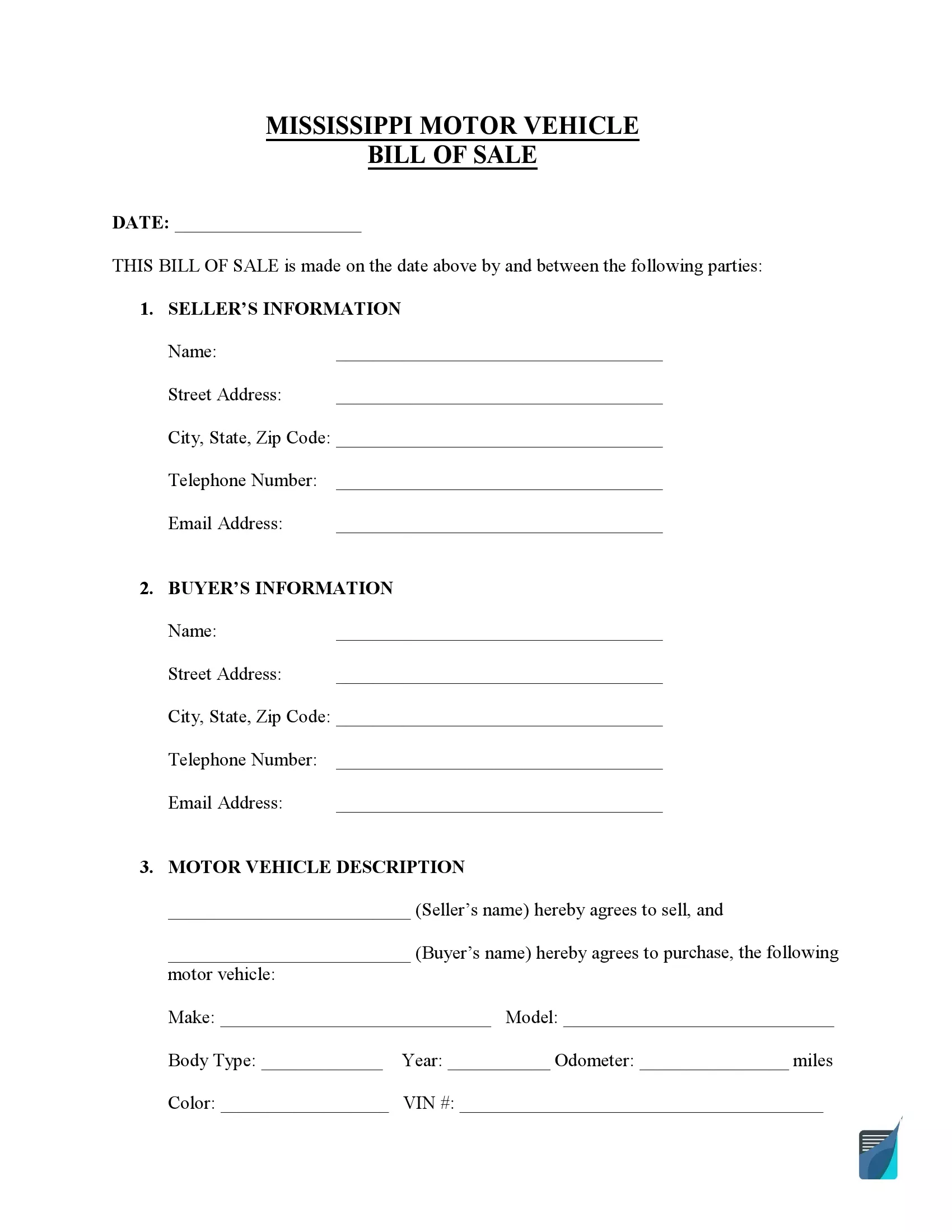
To fill out the Mississippi motor vehicle bill of sale, work through the numbered parts of the form in order. The form has four pages, with spaces for the seller, the buyer, the vehicle, the price and payment method, and the signatures. Follow the seven steps below, then keep a copy of the signed form.
Step 1: Write the date on the DATE line
Write the date of the bill of sale on the DATE line at the top of page 1. Fill in the form on the day of the sale so the dates agree.

Step 2: Complete 1. Seller’s Information
Enter the seller’s details in part 1 of the form:

Step 3: Complete 2. Buyer’s Information
Part 2 asks for the same details about the buyer: full name, address, phone number and email address.

Step 4: Complete 3. Motor Vehicle Description
In part 3, write the seller’s name and the buyer’s name in the agreement line. Then describe the vehicle in the fields below it:

Step 5: Complete 4. Purchase Date, Purchase Price and Method
Part 4 is on page 2. Write the purchase date and the total price. Then tick one way the price is paid:
Next, tick how the price is paid: cash, check (with the check number), cashier’s check or money order. Last, tick whether taxes are included in the price or not.

Step 6: Read 5. Miscellaneous Provisions and sign under 6. Signatures
Part 5 on page 3 has nothing to fill in, so read it before you sign. In it, the seller states that they own the vehicle and that it has no liens, and both sides agree to an as-is sale.
Under 6. Signatures, the seller and the buyer each sign, print their name and date their line. The form also has a Witness line with its own signature, date and printed name.

Step 7: Complete the Acknowledgment on page 4
Page 4 is an acknowledgment for a notary. Use it only if you want the signatures notarized. It has spaces for the county, the date, the officer’s name and title, and the name of the person appearing. The notary then signs and seals it.

Since 1969, Mississippi has required all motor vehicles to be titled. As of 1999, trailers over 5,000 pounds gross vehicle weight (GVW) and manufactured homes must also be titled. The title records who owns the vehicle. The bill of sale records the sale itself. Titling a vehicle is not the same as registering it, so ask the Mississippi Department of Revenue what to bring to register it.[1]
Under Section 63-21-31(1) of the Miss. Code Ann., the seller must sign an assignment and warranty of title to the buyer when the vehicle is delivered. The signature goes in the space provided on the certificate. The seller must then mail or deliver the certificate and assignment to the buyer.[3.3]
To title the vehicle in your name, you need the following:
If you have a bill of sale but no title, read our guide on how to get a vehicle title with a bill of sale.
A vehicle of 10,000 pounds GVW or less is registered at the county Tax Collector’s office in the county where it is kept, and a newly bought vehicle must be registered within 30 business days of the purchase date. If you bought it outside your home county, you have 48 hours to bring it to your residence or place of business.[4.1]
These two questions cover what a seller must hand over and when a bill of sale is needed. Each short answer cites the Mississippi source it comes from, so you can check it yourself.
The seller needs the original title, signed by the owner or owners shown on its front.[2] When the car is delivered, the seller signs the assignment and warranty of title to the buyer on the certificate. The seller then mails or delivers the certificate to the buyer.[3.3]
Yes, for a first certificate of title on a vehicle that is not new. A copy of the bill of sale must come with the paperwork.[3.2]
Mississippi Odometer Disclosure Statement

Form 78-013-18-8-1-000 or Affidavit of Ownership of Motor Vehicle is used to prove the ownership of the vehicle in case the certificate of title is unavailable due to a specific reason.

Mississippi Motor Boat Registration Application

Use an Application for Concealed Carry Firearm Permit (with instructions) if you want to get a firearm permit in Mississippi.


Other Mississippi Forms
General information, not legal or tax advice.
