
A mobile home bill of sale is a written record that a mobile home changed hands. It names the buyer and the seller, describes the home, and shows the price and the date of the sale. Both sides keep a signed copy as proof of the deal, and it helps with taxes and accounting later. Use the free template below to create yours online or download it as a PDF or Word file.
Last Updated: October 2026. This guide is reviewed and updated regularly to reflect current law. If you notice an error or outdated information, please contact us.
Build Your Document
Answer a few simple questions to make your document in minutes
Save and Print
Save progress and finish on any device, download and print anytime
Sign and Use
Your valid, lawyer-approved document is ready
A mobile home bill of sale is a signed record that a seller passed a mobile home to a buyer. It lists who the parties are, which unit changed hands, the price and the date. Think of it as the receipt. For example, it can say that one named seller handed a specific model with a given serial number to one named buyer for an agreed price.
This document protects both sides of the deal. It is the written proof that the seller sold the home and the buyer paid for it. Without it, each side has only memory and receipts to settle a dispute later.
For the seller, the document does three things:
After the transaction is cleared, it is highly advised to have a notary public put their signature on the document.
For the buyer, the document is evidence that the seller transferred the title and that the buyer is now the rightful owner. It also shows that the buyer accepted responsibility for the home.
It can record the condition the seller promised, which helps if a dispute comes up later.
| Document Name | Mobile Home Bill of Sale Form |
| Other Name | Manufactured Home Bill of Sale |
| Avg. Time to Fill Out | 10 minutes |
| # of Fillable Fields | 60 |
| Available Formats | Adobe PDF; Microsoft Word |
State rules differ, so the paper can matter more in one state than in another. Every count below is out of the 48 states FormsPal's verified state data covers. Use the counts to see which points matter most, then check the rules in your own state.
The rules ask for different details depending on the state:
A title transfer is part of the rules in 26 of the 48 states covered, so keep the bill of sale with your title paperwork.
A lien release from the lender is required in 20 of the 48 states covered when the home has a lien.
Some states also set a deadline to apply for the new title. That deadline appears in 6 of the 48 states covered.
Where the rule counts days, it runs from 15 to 30 days, depending on the state. Where it counts calendar days, it runs from 20 to 30 calendar days. Count the days with our deadline calculator.
Just like all legal documents, a sales contract of a manufactured home might be too intricate and complicated to create by yourself. That is why we ensure you with the specially-manufactured bill of sale forms that you can easily download at our site to compose your own mobile home purchase agreement.
All variations of such a form are available for free download in the formats supported by Microsoft Word and PDF readers.
By using a template of such a legal paper, you can specify your own rules and conditions without being confused by the elaborate language of juridical documents. Once you added all of the information you want into the form, fill out the required spaces and print it out for further use. You can also fill in the downloaded PDF with our online PDF editor.
There are two other ways to get the document:
In case you are planning to sell your manufactured home but you don’t know where to start or what resources to use for its advertisement, use our comprehensive instruction below.
Step 1. Discuss the Terms and Conditions

The parties will have to reach an agreement, mainly agreeing on a price for the motor home. The seller will typically come up with a purchase price based on the type of home being sold (e.g., single wide, double wide, etc.), coupled with any land that might be a part of the deal. However, if there is land involved in the deal, it is recommended to use the residential premise bill of sale form.
Not sure what price to ask? Compare similar mobile homes for sale online. Match the manufacturer, model, size, location and other key details.
Step 2. Let the Buyer Inspect Your Vehicle

In the prevailing majority of cases, the buyer will insist that the sale of the manufactured home hinges upon its passing a thorough examination by a certified inspector. Most reports have to take no longer than two days from the time the inspection was conducted. They should cover the facilities available in the motor home and their condition (plumbing, heating system, roof, etc.), as well as any design features of the mobile home.
Step 3. Settle on a Closing Date

As soon as both buyer and seller negotiate the final payment amount, the closing date of the transaction should take place. At the closing of the deal, the trader will transfer the title of the mobile home by removing their personal belongings and vacating the premises. It is vital to keep in mind the obligations of the parties:
Step 4. Attend the Conclusion of the Deal

The buyer and seller will be required to authorize the mobile home sales agreement along with the seller of the mobile home passing on the title to the buyer. In the meantime, the purchaser will have to endow the dealer with negotiated payment for their manufactured home. The buyer can then take over the motor home and move the residence to the desired location.
Step 5. Fill Out a Mobile Home Bill of Sale Form

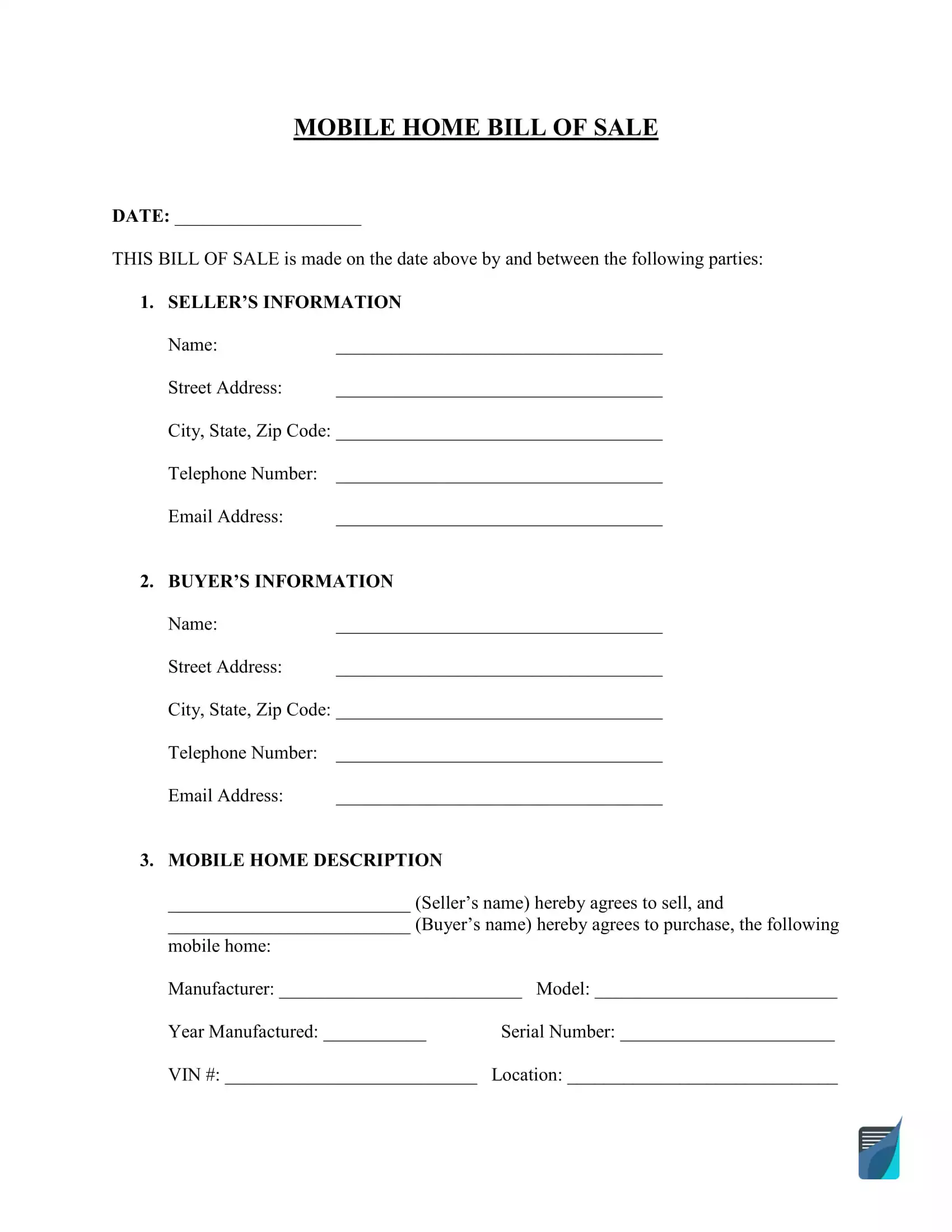
When completing such a sales contract form, make sure to include the following information in this legal document:
Step 6. Notify the Government of Your Acquisition and Register It

Once every document is signed, the customer will need to visit the DMV (Department of Motor Vehicles) and register the acquired means of conveyance in their name. In case the mobile home didn’t come with any land, it will be regarded as any other transferable or removable property.
In the overwhelming number of cases, the buyer will have to provide the title, registration, proof of insurance, motor home bill of sale form, and state-issued identity card.
Depending on the State, registration fees will also be charged based on the price of a mobile home in addition to the tax from sales.
Down below, you’ll see the directions compiled by drawing upon the mobile home form developed by our specialists. We highly suggest using your local official document if possible. Fill in each part in order and check every name, number and date before you sign.
Step 1: Indicate the date when document is created and filled out.

Step 2: Type in the details of both sides (purchaser and seller):

Step 3: Fill in the details concerning the mobile home that you’re selling:

Step 4: Indicate the transaction method and price.
This part also involves providing the exact date of the transaction and the overall sum approved by both parties of the transfer. After that, select one selling method:
After that, pick one payment method:
Finally, check whether the purchase cost includes all applicable taxes.

Step 5: Look at miscellaneous provisions.
The seller confirms that they own the mobile home described in the document and have the right to sell it at the price in the form. The seller also confirms that there are no liens on the home. They confirm that the information in the Bill of Sale is true, accurate and complete to the best of their knowledge.
This part generally has the “as-is” provision that implies the object is sold without a warranty.

Step 6: Now, the form has to be signed.
The buyer’s signature is generally not needed. But, you are more protected against legal troubles if all sides sign the bill of sale form. You could also have one or several witnesses confirm the deal.

Step 7: Use the services of a notary public
Although notarization is rarely necessary, it may serve as another way to guard against legal problems.
The original document copy has to be given to the purchaser as they are going to need it to get a title to their new car. As a seller, you could either make a copy and keep it or have two identical forms signed and filled out by both sides.

A few simple slips can cause problems for the buyer or the seller later on. Read through the list below before you sign, and keep a copy of the final document for your records.
These answers cover the questions people ask most often before they sign. Each count is out of the 48 states FormsPal's verified state data covers, so check the rules in your own state too.
It depends on your state:
Even where it is optional, a signed copy gives both sides proof of the sale.
Notarization is required in 9 of the 48 states covered. In 13 of the 48 states covered, the rules say it is not required, and 30 of the 48 states covered have no statute on notarization. If you are unsure, a notary's stamp adds another layer of proof.
A signature is required in 22 of the 48 states covered. In 7 of the 48 states covered, the rules also say who must sign. Have both the seller and the buyer sign, and keep a signed copy each. A signed copy protects both sides if a question comes up later.
A handwritten document or a form of your own is acceptable in 13 of the 48 states covered. A free FormsPal template is an easier start, because it already has fields for the parties, the home, the price and the date.
General information, not legal or tax advice.
