
Updated:
A mobile home purchase agreement is a written sales contract. It names both parties, describes the home and included items, and sets the price and closing date. Buyers and sellers of a used mobile home need this contract, especially in a private sale.
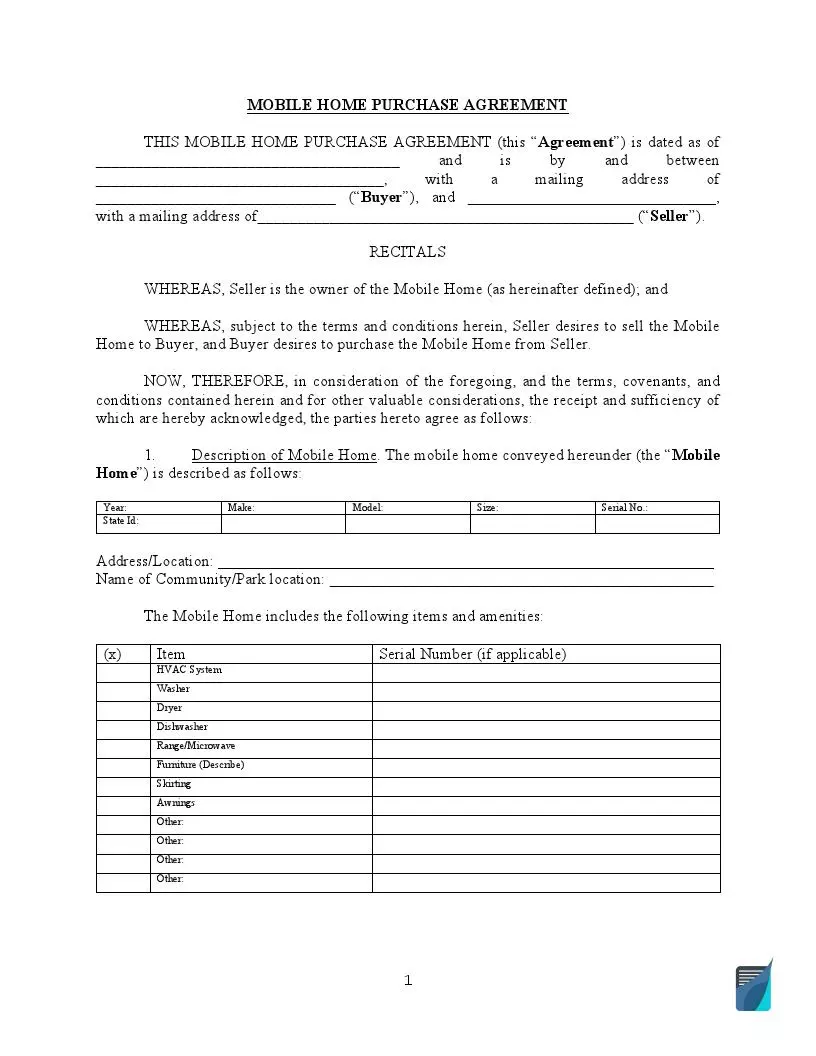
Use the template below to create yours online or download it as a PDF or Word file. The steps further down show each part of the form filled in with sample entries.
Build Your Document
Answer a few simple questions to make your document in minutes
Save and Print
Save progress and finish on any device, download and print anytime
Sign and Use
Your valid, lawyer-approved document is ready
You need a mobile home purchase agreement whenever a mobile home changes hands and the buyer and seller want the price, the included items and the closing date in writing before the sale closes. It fits a home on private land and a home in a park alike.
If the sale also includes the land under the home, use a real estate purchase agreement instead, because this form has no lines for a legal description of the land or a deed. The agreement covers the time between the handshake and the closing. If the sale is already done and you only need proof that the home was sold and paid for, a bill of sale is the simpler document; the comparison further down shows the difference.
This form covers the buyer and seller, a full description of the home, the items that come with it, the price and deposit, the closing date, any extra terms and both signatures. Go through each point with the other party before you sign.
A sale that includes land can need more in the contract itself where it counts as residential real property: the bold-faced special taxing district statement of Colo. Rev. Stat. § 38-35.7-101, the credit term of Conn. Gen. Stat. § 20-327c(a) for a seller who fails to furnish a required report, or the signed disclosure statement that N.Y. Real Prop. Law § 462 has attached to the contract. When the Sale Includes Land gives the conditions of each.
The agreement lists the full name and mailing address of the buyer and of the seller. Contact details let either side reach the other after signing, for example if a question about the title comes up.
The home description identifies the exact home being sold: its year, make, model, size and serial number, and where it sits. Note any damage, structural changes or added extras, so the buyer knows exactly what they are receiving.
The items list shows what stays with the home, such as the HVAC system, washer, dryer, dishwasher, range, microwave, furniture, skirting and awnings. List built-in items too, even when they are fixed to the home, and add each item's serial number.
Anything not on the list is open to dispute later. Outside features such as lighting fixtures, steps or a shed belong on the list when they go with the home.
The price section shows the full purchase price in words and in numbers, plus any deposit the buyer pays when signing. Writing the price both ways prevents a misread figure from changing the deal.
The closing date is the date the buyer and seller meet to complete the sale. At closing the buyer pays the balance and the seller hands over the title and the keys.
The additional terms lines hold anything else the buyer and seller agree on. Examples are a sale that depends on a satisfactory inspection, what happens to the deposit if the sale falls through, and repairs the seller makes before closing.
To fill out the agreement, work through the template from the first page to the last: parties, home description, included items, price and deposit, closing date, extra terms and signatures. Every step has a screenshot of the matching part of the form, so you can follow along on your own copy of the form.
Download the PDF and fill it in with our online PDF editor, or print it and write in the blanks by hand. Have these details ready before you start: the year, make, model, size and serial number of the home, its address or community name, both parties' names and mailing addresses, the price and deposit, the closing date and the list of included items.
The screenshots under each step show the FormsPal Mobile Home Purchase and Sales Agreement template filled with sample entries in blue, so you can see where each answer goes. The names, addresses, dates and amounts are examples only.
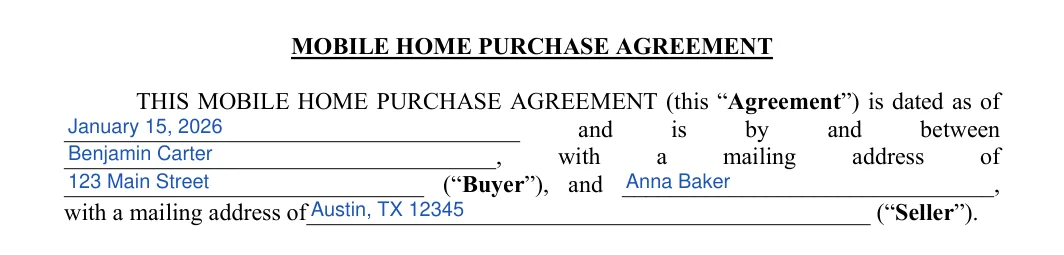
Date and parties. In the first section, you will need to write the names and mailing addresses of the buyer and seller. Enter the date of the agreement in the opening line, too.
Year of the mobile home. In the description of the mobile home on the first page, enter the year of the home on the Year line.

Make, model, size, serial number and location. Still in the description, fill in the make, model, size and serial number. Then add the State Id, the address or location of the home and the name of the community or park.

Items and amenities included. In the items table, mark each item that comes with the home, such as the HVAC system, washer, dryer, dishwasher, range or microwave, furniture, skirting and awnings. Add a serial number next to an item when it has one.
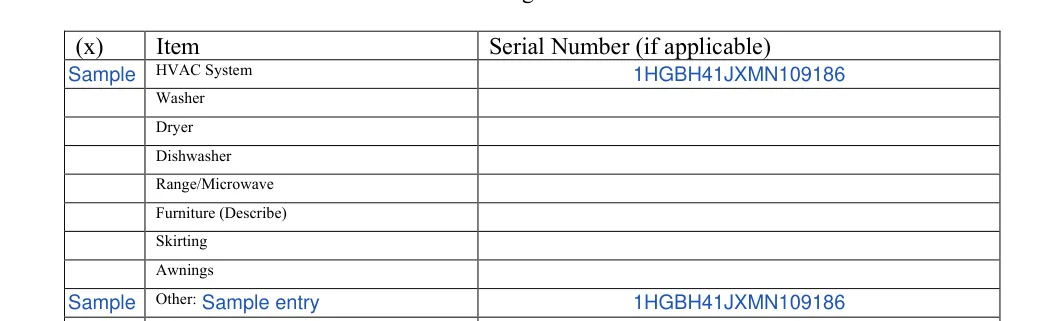
Other item, first line. Use the first Other line for an included item that the table does not list. Add its serial number if it has one.

Other item, second line. Add another extra item on the next Other line, with its serial number if it has one.

Other item, third line. Use the third Other line for one more extra item and its serial number if it has one, or leave the line blank.

Other item, fourth line. Use the last Other line for a final extra item and its serial number if it has one, or leave the line blank.

Purchase price and deposit. In the purchase price section on the second page, write the price in words and in numbers. Then enter the amount of the deposit.

Closing date. In the closing section on the second page, enter the date that the buyer and seller have agreed on for the closing.

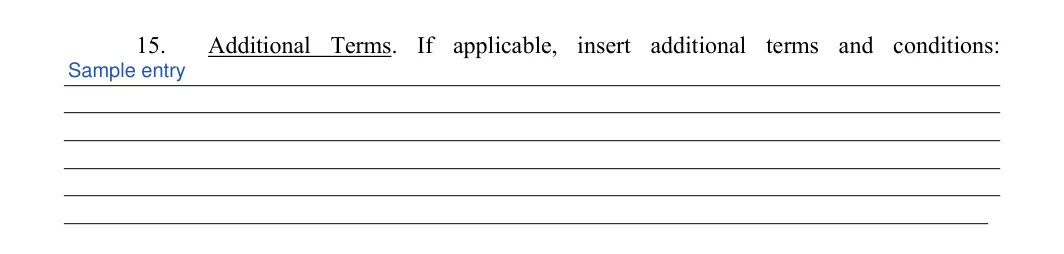
Additional terms and conditions. Use the lines on the third page for any extra terms that the buyer and seller have agreed on. If there are none, leave the lines blank.
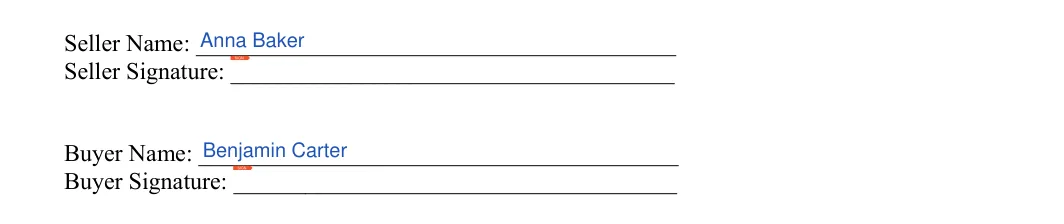
Names and signatures. On the last page, print the seller's name and sign on the seller line. Then do the same for the buyer. Each side keeps a signed copy of the agreement.
The buyer and the seller sign the agreement once they agree on the home, the price and the closing date, and it then guides the sale through to closing. Take these steps in order.
See the home in person. Walk through the home before you agree to anything. Compare the serial number and description in the seller's paperwork with the home in front of you, and check whether land, a park lot or neither comes with it.
If land is included, get the seller's disclosure first. A seller of residential real property owes the buyer a written disclosure before signing under 765 ILCS 77/20 and Minn. Stat. § 513.55, and before the buyer's written offer under Alaska Stat. § 34.70.010. None of these sections names mobile homes, and When the Sale Includes Land gives their conditions.
Agree on the price and terms. Get a value estimate for a similar home before you negotiate, so both sides start from a realistic number. Settle the deposit, the closing date and the included items at the same time.
Have the home inspected. Ask an inspector to check the siding, electrical, plumbing, heating, hot water tank and foundation, and to look for leaks and other structural defects.
Fill in and review the agreement. Complete the template together, read every page and fix any wrong detail before anyone signs.
Sign and close. Both parties sign the agreement. At closing, the buyer pays and the seller hands over the title.
Keep the paperwork together. Store the signed agreement with the title paperwork and the inspection report, so everything about the sale stays together.
If the home stays in a park, ask the park manager before closing what a new resident needs to do to move in.
A mobile home purchase agreement and a mobile home sales contract name the same kind of document: the contract that sets the terms of the sale before closing. A bill of sale is a different document that shows the sale has taken place.
| Document | What it does | When you use it |
|---|---|---|
| Mobile home purchase agreement (sales contract) | Sets the price, deposit, included items, closing date and extra terms | Before closing, once the buyer and seller agree on the deal |
| Bill of sale | Shows that the seller sold and the buyer bought the home for a stated price | At closing, when the money and the home change hands |
| Real estate purchase agreement | Sets the terms for buying a house and the land it stands on | For a site-built house, or for any sale that includes the land |
A sale can use both documents: the purchase agreement first, then a bill of sale signed at closing.
When the buyer also buys the land under the mobile home, the contract is also a contract for the sale of land. This form has no lines for a legal description of the land or a deed, so use a real estate purchase agreement for that sale, and check the choice with a lawyer where the land lies. The table shows what the Alabama, Massachusetts and West Virginia codes say about written contracts for the sale of land; each row keeps the condition the code sets.
| Where | What the code says | Citation |
|---|---|---|
| Alabama | A contract for the sale of land is void unless it, or a note or memorandum of it expressing the consideration, is in writing and signed by the party to be charged or a person that party lawfully authorized in writing. This writing rule does not cover a lease for a term not longer than one year, or a sale where the purchase money or a portion of it is paid and the seller puts the purchaser in possession of the land. | Ala. Code § 8-9-2 |
| Massachusetts | An action upon a contract for the sale of lands or of any interest in them cannot be brought unless the contract, or a memorandum or note of it, is in writing and signed by the party to be charged or a person that party lawfully authorized. | Mass. Gen. Laws ch. 259, § 1 |
| West Virginia | A contract for the sale of land is not enforceable unless the contract, or a note or memorandum of it, is in writing and signed by the party to be charged or that party's agent. | W. Va. Code § 36-1-3 |
These rows speak to land only; none of these sections names mobile homes. For a sale anywhere else, read that place's own code or ask a lawyer.
Where a sale with land counts as residential real property, sections such as Minn. Stat. § 513.55 and Conn. Gen. Stat. § 20-327c(a) can add a seller disclosure or a contract term.
| Where | What the code says | Citation |
|---|---|---|
| Alaska | Before the buyer of an interest in residential real property makes a written offer, the seller must deliver a completed written disclosure statement in the form set under AS 34.70.050. If a disclosure statement or material amendment is delivered after the written offer, the buyer may terminate the offer by written notice within three days after delivery in person or within six days after delivery by mail. The chapter does not apply if the transfer is the first transfer of the property and the property has never been occupied, or if the seller and buyer agree in writing that the transfer will not be covered under it. | Alaska Stat. § 34.70.010, Alaska Stat. § 34.70.020, Alaska Stat. § 34.70.110, Alaska Stat. § 34.70.120 |
| Colorado | Every contract for the purchase and sale of residential real property must contain a clearly legible disclosure statement in bold-faced type about special taxing districts. | Colo. Rev. Stat. § 38-35.7-101 |
| Connecticut | Every agreement to purchase residential real estate for which a written residential condition report is required under section 20-327b must include a term that the seller credits the purchaser five hundred dollars at closing if the seller fails to furnish the report. Section 20-327b applies only to transfers by sale, exchange or lease with option to buy of residential real property of one to four dwelling units, including cooperatives and condominiums. | Conn. Gen. Stat. § 20-327c(a), Conn. Gen. Stat. § 20-327b(c) |
| Illinois | The seller of residential real property must deliver the written disclosure report to the prospective buyer before the signing of a contract. A seller in a transfer listed in 765 ILCS 77/15 is exempt. | 765 ILCS 77/20, 765 ILCS 77/15 |
| Massachusetts | A person selling premises must give the prospective purchaser a copy of the lead hazard form and other materials prepared under subsection (a) before the signing of a purchase and sale agreement. | Mass. Gen. Laws ch. 111, § 197A(b) |
| Minnesota | Before signing an agreement to sell or transfer residential real property, the seller must make a written disclosure to the prospective buyer. The disclosure may be waived if the seller and the prospective buyer agree in writing, but that waiver does not limit a seller disclosure duty under any other law. The requirement does not apply to the transfers listed in Minn. Stat. § 513.54, such as a transfer to a spouse, parent, grandparent, child or grandchild of the seller, or a transfer of newly constructed residential property that has not been inhabited. | Minn. Stat. § 513.55, Minn. Stat. § 513.60, Minn. Stat. § 513.54 |
| New York | Except as section 463 provides, a seller of residential real property under a real estate purchase contract must complete and sign a property condition disclosure statement and have it delivered to the buyer or the buyer's agent before the buyer signs a binding contract of sale. A copy signed by both seller and buyer must be attached to the contract. | N.Y. Real Prop. Law § 462 |
None of these sections names mobile homes, and this table is not a full list. Ask a lawyer or the agency behind the section whether it reaches your sale.
Check the agreement for these errors before anyone signs: each leaves a term of the sale wrong or open.
Yes, you can write your own mobile home purchase agreement, and a template saves you from leaving out a key term. Fill in the parties, the home, the items, the price, the closing date and the signatures, then add any extra terms in your own words.
Yes. Download the PDF form and type into it on screen, or print the form and write in the blanks by hand. You can also use the Create My Document button to build the agreement online.
Yes, for a manufactured home: the form describes the home by year, make, model, size and serial number, which fits any factory-built home sold on its own. For a modular home sold with its lot as a house, a real estate purchase agreement may fit better.
Yes. The form has a line for the name of the community or park, so it fits a home on private land and a home in a park alike.
Give each side a signed copy. Store it with the title paperwork and any inspection report on the property, so everything about the sale is in one place. Before closing, ask the agency that titles mobile homes where the home sits what paperwork transfers the home, and ask the county office too when land is included.
It can help. A lawyer can read the draft with you and answer questions about your own sale before you sign.
General information, not legal or tax advice.
