
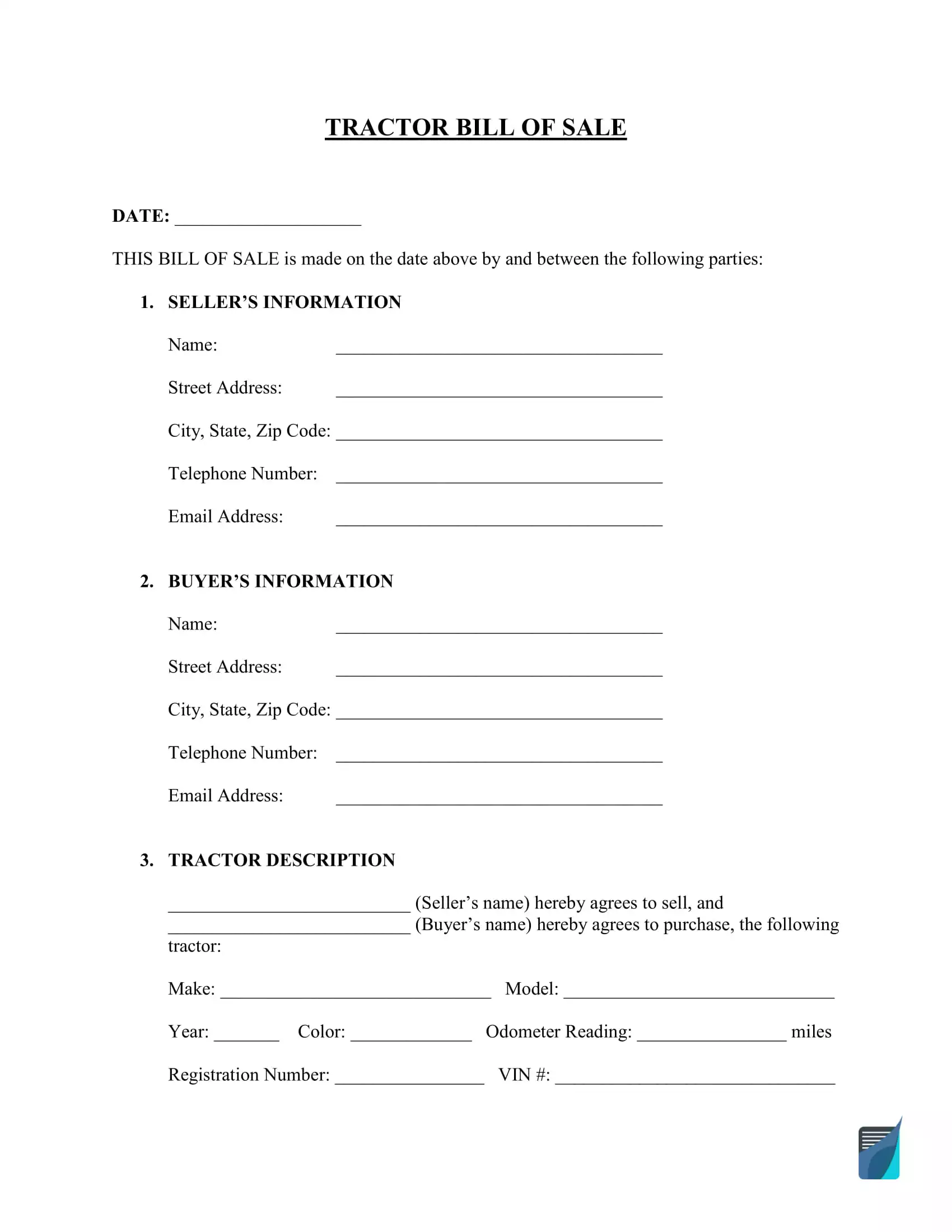
A tractor bill of sale is a written record of the sale of a farm tractor from a seller to a buyer. The purchaser should know that, unless otherwise specified, the equipment will be sold in the “as-is” condition without any other costs or obligations to the previous owner. If the buyer wants the vehicle to get inspected for technical serviceability, they have to make the request for the examination by the appropriate authority before the completion of the sales agreement.
Last Updated: October 2026. This guide is reviewed and updated regularly to reflect current law. If you notice an error or outdated information, please contact us.
A tractor bill of sale is the paper that shows a farm tractor changed hands from one owner to another. Farm equipment is a big purchase, so both sides gain from a clear written record. The document records:
Both sides keep a copy as proof of the sale, and the buyer can bring it along when applying for a title.
Such a legal paper allows passing ownership of a tractor for a negotiated amount of money or as an exchange. The tractor bill of sale works as a legally binding instrument that obliges the customer to pay the agreed purchase price in exchange for a farming vehicle’s title and possession.
In the prevailing number of cases, such a sales agreement is signed once the purchaser has made the payment. Right after this, the tractor will change ownership along with the proprietary right.
By analogy with other sales contracts, tractor bill of sale forms are used to protect the fundamental rights of the buyer and seller in case of any disagreements.
| Document Name | Tractor Bill of Sale Form |
| Other Name | Farm Tractor Bill of Sale |
| Avg. Time to Fill Out | 10 minutes |
| # of Fillable Fields | 61 |
| Available Formats | Adobe PDF; Microsoft Word |
FormsPal's verified state data covers 46 states. The table below shows how many of them have a rule on each detail of the sale paperwork. Your own state may ask for more or less, so use the counts as a guide and check the rule that applies to your sale.
| Detail of the sale | States with a rule (out of 46) |
|---|---|
| Seller details | 21 |
| Buyer details | 22 |
| Vehicle identification, such as the serial number or VIN | 22 |
| Sale price | 22 |
| Date of sale | 14 |
| Signatures | 22 |
| Odometer disclosure | 30 |
Check your own state's rule before you sign. These counts come from FormsPal's verified state data and are a guide, not a rule for your sale.
Yes, you can make a tractor bill of sale online with FormsPal. Answer the questions in our step-by-step builder and your document is ready in minutes. You can also download the free template as a .docx (Microsoft Word), .odt (OpenOffice), or .pdf file and fill it in yourself. Every template on our site is free.
The template lets you add your own terms and conditions in plain words, so you do not need to learn legal terminology. Fill in the fields, then print the final version of the document.
You can also ask a licensed lawyer who knows tractor sales to write the bill of sale for you. Expect to pay a fee for that advice. Prepare before you go to the lawyer's office by gathering the key facts:
If you are new to writing sales contracts, a template is often the faster option.
Farm equipment is a niche market, so a tractor can be harder to sell than a car or a motorboat. A seller who holds out for the asking price may have to wait 3 to 7 months for a buyer. Follow the five steps below to sell your tractor in a private sale as soon as you can.
Step 1. Clean and Repair the Tractor

Make sure the tractor looks good in person and in photos. Clean it inside and out and fix anything that is broken. A tractor that runs well saves the buyer repair costs, which helps you get a higher price.
Step 2. Gather Every Document and Accessory

Collect all available information on your tractor, including the ownership certificate, maintenance records, and registration number.
You will be required to have all of the aforementioned paperwork on you on the day of transaction completion.
If you have accessories or other parts, selling them separately will not bring you a higher income. Keep every part in the best condition.
Depending on the model, selling the attachments with the tractor may pay off. Used accessories for an older model can be rare, and rare parts are worth more.
Step 3. Create an Advertisement and Post It Everywhere

Advertise your tractor on specialized online and offline listings. In your ad, give the make, model, serial number, and asking price. These websites are a good place to start:
Step 4. Agree On the Final Price and Close the Deal

Let each buyer look over the tractor and ask about its make, model, and condition. When the buyer is done, negotiate the price. Once you agree, complete the bill of sale. This document matters to both the buyer and the seller.
Step 5. Fill Out a Tractor Bill of Sale

To make the transaction official, the buyer and purchaser are obliged to resort to the help of the tractor bill of sale. It is worth noting that each side of the trade has to have a copy of this bill of sale form. Both sides should write these details in the document.
Start with the sale and the parties:
Then describe the tractor:
Finish with the signatures:
Follow these steps to fill in the tractor bill of sale template made by our experts. The steps follow the form from top to bottom. If your local authorities offer an official form, use that one instead.
Step 1: Indicate the date when document is created.

Step 2: Type in the particulars of all parties (seller and purchaser):

Step 3: Identify the tractor being sold:

Step 4: Specify the payment method and price.
Enter the sale date and the total price of the tractor. Next, choose one sale method:
And after that, specify how the purchaser is going to pay:
As a final point, specify whether the purchase cost includes all applicable taxes.

Step 5: Read the miscellaneous terms.
The seller confirms that they are the owner of the tractor described in the document and have the right to sell it at the price in the form. The seller also confirms that there are no liens on the tractor. The seller confirms that the information in the bill of sale is true, accurate, and complete to the best of their knowledge.
This part generally has the “as-is” passage that implies the tractor is sold with no warranty.

Step 6: Sign the bill of sale form.
The buyer’s signature is usually not required. But, you will end up more protected against legal troubles if both sides sign the form. You could also have one or several witnesses verify the transaction.

Step 7: Use the assistance of a notary public
With this, you will have more legal protection. Nonetheless, this step is usually completely optional.
Notarization is required in 9 of the 46 states FormsPal's verified state data covers. It is not required in 13 of the 46 states covered. A notary acknowledgment adds the notary's certificate and seal to your signatures.

The title is a separate document from the bill of sale. In 25 of the 46 states FormsPal's verified state data covers, the rules deal with title transfer, the step that moves ownership to the new owner. In 6 of the 46 states covered, the seller must sign over the title and hand it to the buyer.
Some rules set a clock for this step:
Many tractors are sold without a title. In 4 of the 46 states covered, the rules address a bill of sale for a vehicle that has no title. Ask the buyer or the seller to check what your state asks for before the ownership transfer.
Here are quick answers to common questions about a tractor bill of sale. The state counts come from FormsPal's verified state data, which covers 46 states. Check your own state's rule before you rely on a count.
It depends on your state. In 25 of the 46 states covered, a bill of sale is among the documents the rules require. In 9 of the 46 states covered, a bill of sale is not required. In 6 of the 46 states covered, there is no statute on the question.
Take a photo of the signed bill of sale and keep a copy with your tractor records.
Notarization rules differ by state. In 13 of the 46 states covered, notarization is not required. In 9 of the 46 states covered, it is required. In 28 of the 46 states covered, there is no statute on notarization.
In 13 of the 46 states covered, a handwritten bill of sale or your own form is acceptable. A typed document from the template is easier to read, and it keeps every detail in one place.
In 20 of the 46 states covered, the rules call for a lien release. In 3 of the 46 states covered, existing liens must be disclosed. Ask the lender for a written release before the sale closes, so the buyer gets a clear title.
In 30 of the 46 states covered, the rules call for an odometer disclosure. If your state asks for it, add the mileage next to the vehicle details.
No. The bill of sale records the sale, and the title shows who owns the tractor. Keep these papers in one folder:
General information, not legal or tax advice.
