
Updated:
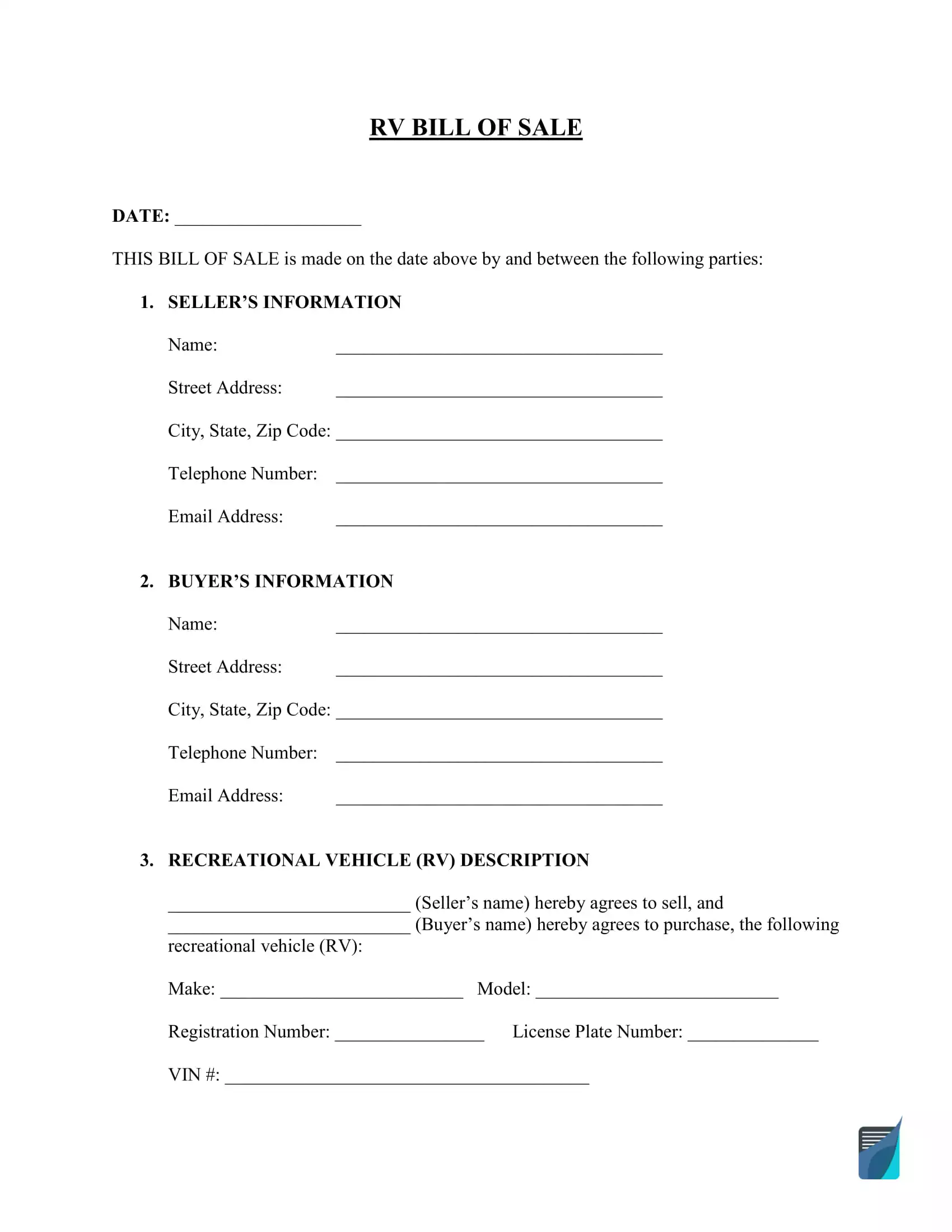
An RV bill of sale is a signed receipt for an RV sale. It names the seller and buyer, the RV's make, model, year and VIN, and the price. Private sellers and buyers use it, especially for a camper or travel trailer sale.
Use our free RV bill of sale template to fill it in online, or download it as a PDF or Word file and print it.
You can use the RV bill of sale form for these types of recreational vehicles:
An RV bill of sale is the paper that shows a recreational vehicle changed hands. It records who sold the RV, who bought it, what was sold, and for how much. Both sides keep a copy as proof of the sale, and the buyer can bring it along when applying for a title.
The bill of sale and the title are two different papers. The bill of sale is the agreement and receipt between buyer and seller. The title is the ownership document that the seller signs over to the buyer.
| Document Name | RV Bill of Sale Form |
| Other Names | Travel Trailer Bill of Sale, Recreational Vehicle Bill of Sale |
| Avg. Time to Fill Out | 13 minutes |
| # of Fillable Fields | 70 |
| Available Formats | Adobe PDF; Microsoft Word |
The same RV bill of sale works for a camper, a travel trailer, a truck camper or a motorhome. Each one is sold with the same core details: the parties, the vehicle, the price and the date. What changes is how you describe the vehicle you are selling.
If the buyer also takes furniture, a generator or other gear, list those items in the description so both sides agree on what the price covers.
You can make an RV bill of sale online with FormsPal, or print a blank camper bill of sale and fill it in by hand. Every template on our site is free.
The template lets you add extra terms and conditions in plain words. Fill in the fields, then print the document to use at the sale. If you want a longer contract, see our vehicle purchase agreement.
You can also ask a lawyer to write the document for you, for a fee. Before that meeting, gather the RV's details, the price you agreed on and the date of the sale.
Selling an RV privately runs from cleaning the vehicle to signing the bill of sale with the buyer. Each step below says what to do and what to bring.
Step 1. Prepare Your House on Wheels

Clean your RV inside and out, and fix anything that is broken. Then take clear photos of the interior and the exterior. A short video of the living area and the hookups helps buyers who live far away.
Step 2. Determine the Value of Your RV

Next, find out what your RV is worth. Look up used RV price guides and compare listings for the same make, model and year. Adjust the asking price for mileage, condition and the gear you include.
Step 3. Advertise Your Recreational Vehicle

Post your ad on RV listing sites, general classified sites and local boards. Give the make, model, year, mileage or length, the asking price and your photos in every ad.
Step 4. Show Your RV to Buyers

Once a few buyers show interest, set a date to show your RV. Let each buyer look inside, test the appliances and, for a motorhome, take a test drive with you on board. If you reach an agreement, set a date to close the sale.
Step 5. Close the Deal

Once you and the buyer agree on the terms, bring the paperwork for the RV: the title, any inspection reports and the warranty papers. The buyer pays you the agreed price.
Step 6. Sign the RV Bill of Sale

Fill out the bill of sale together, and each side brings a photo ID to confirm who they are. The next section walks through the form field by field.
Step 7. Hand Over the Title and the Keys

Sign the title over to the buyer and give them the original bill of sale. Whether a notary takes part depends on the state. In California, a bill of sale is not required to be notarized or witnessed, Cal. DMV VIRP Manual § 1.020 Bill of Sale (VC §1652). In Indiana, the bill of sale is not required to be notarized, Indiana BMV State Form 44237. When a motor vehicle is sold, traded, transferred or delivered in Kentucky, the bill of sale is subscribed and sworn to before any officer authorized to administer an oath, not only a notary, KRS 186.200(1). The FAQ below lists the other cases in our sources, so check your state's rule before the meeting.
To write an RV bill of sale, enter the date, both parties, the RV's details, the price and the payment terms, then sign. The steps follow our template from top to bottom. If your local title office offers its own form, use that one instead.
Step 1: Enter the date the document is created.

Step 2: Enter the seller's and the buyer's details:

Step 3: Enter the particulars of the RV:

Add the model year in the description, and the mileage for a motorhome.
Example description: 2018 Coachmen travel trailer, 26 feet, VIN 1ABCD23E4FG567890, sold with hitch and awning.
Step 4: Enter the purchase date and the total price, then mark the type of sale:
Then mark how the buyer pays:
Last, mark whether the price includes all applicable taxes.

Step 5: Read the standard terms together.
In these terms, the seller confirms they own the RV, have the right to sell it, and know of no liens on it. The seller also confirms that the details in the bill of sale are true and complete to the best of their knowledge. The buyer takes the RV "as is" and is responsible for it once the sale is complete.

Step 6: Sign in the matching fields.
Have both the buyer and the seller sign. When a motor vehicle is sold, traded, transferred or delivered in Kentucky, the bill of sale carries the date and the buyer's and seller's names and post office addresses, KRS 186.200(1).

Step 7: Make copies and hand over the original.
Give the original to the buyer, who will take it to the title office with the signed title. Either sign two identical copies or make a copy for the seller to keep. Kentucky differs. When a motor vehicle is sold, traded, transferred or delivered in Kentucky, the seller makes a bill of sale in quadruplicate at the same time and delivers the original and two copies to the county clerk, KRS 186.200(2).

A motorhome is sold as a motor vehicle and a travel trailer as a trailer, so general vehicle title rules reach both. The table lists the rules in our sources for the places below, each with its condition and the section it comes from.
| State | What the rule asks for | Source |
|---|---|---|
| Florida | A person who buys a motor vehicle or mobile home from its owner, dealer or not, has no marketable title until a certificate of title is issued to them. | Fla. Stat. § 319.22(1) |
| Iowa | On the transfer of a registered vehicle, the owner endorses an assignment and warranty of title on the certificate, with a statement of all liens and encumbrances, except as the chapter provides otherwise. | Iowa Code § 321.45(3) |
| Kentucky | No one sells a motor vehicle without making a bill of sale in quadruplicate at the same time and delivering the original and two copies to the county clerk. | KRS 186.200(2) |
| Kentucky | The bill of sale carries the date, the buyer's and seller's names and post office addresses, and is subscribed and sworn to before an officer authorized to administer an oath. | KRS 186.200(1) |
| Maryland | For a vehicle titled in Maryland, the owner signs an assignment and warranty of title on the certificate, with a statement of each lien, and delivers the certificate when the vehicle is delivered. A transfer to a licensed dealer who holds the vehicle for sale follows 13-113 instead. | Md. Code Ann., Transp. 13-112(a), (b) |
| Maryland | The owner of a vehicle with no Maryland title applies for one. The exemption covers a towed trailer of 2,500 pounds or less, other than a camping trailer; a motor home is not exempt as a class. | Md. Code Ann., Transp. 13-101.1 |
| Nebraska | Only when no certificate of title was issued for the vehicle in the thirty years before the application, the owner may transfer title by giving the buyer a notarized bill of sale with the other papers the section lists. | Neb. Rev. Stat. § 60-142.01(1) |
| South Dakota | If a South Dakota title was issued before for the trailer, the title application comes with that certificate of title, duly assigned. | S.D. Codified Laws § 32-3-18 |
| Virginia | The owner of a trailer registered in Virginia endorses the assignment and warranty of title on the certificate, with a statement of all security interests, and delivers it when the trailer is delivered. | Va. Code § 46.2-628 (How certificate of title transferred) |
If your sale is not covered above, ask the local title office what it wants with the application. The full text of the Kentucky rule is at the Kentucky General Assembly, and the Maryland title rule at the Maryland General Assembly.
The title is a separate document from the bill of sale. After the sale, the buyer takes the signed title and the bill of sale to the title office to put the RV in their own name. The seller keeps a copy of the bill of sale as proof of the date the RV left their hands.
Take a photo of the signed bill of sale and keep a copy with your RV records.
When a motor vehicle is sold, traded, transferred or delivered in Kentucky, the seller makes a bill of sale in quadruplicate at the same time and delivers the original and two copies to the county clerk, KRS 186.200(2).
A signed bill of sale still gives both sides written proof of the sale.
It depends on the state: some ask for a sworn or notarized bill of sale for every vehicle sale, some only in set cases, and many not at all. When a motor vehicle is sold, traded, transferred or delivered in Kentucky, the bill of sale is subscribed and sworn to before any officer authorized to administer an oath, not only a notary, KRS 186.200(1). Louisiana's OMV asks for the original notarized bill of sale or invoice, with the price paid and a full description of the vehicle, Louisiana OMV; Used Title & Registration.
In Nebraska, only when no certificate of title was issued for the vehicle in the thirty years before the application, the owner may transfer title with a notarized bill of sale, Neb. Rev. Stat. § 60-142.01(1). In West Virginia, when a vehicle is bought from an individual below 50% of the current NADA Clean Loan Book value, a notarized bill of sale signed by both parties goes with the title application, West Virginia DMV Titles. Maryland's notarized bill of sale applies only when a used vehicle less than 7 model years old is bought from someone other than a licensed dealer and the excise tax is based on a price $500 or more below book value, and the bill of sale is then on the MVA's own form, signed by the buyer and the seller, with a statement of why the vehicle sold at that price, Md. Code Ann., Transp. 13-809(d)(2).
Many states need no notary for a private sale. In California, a bill of sale is not required to be notarized or witnessed, Cal. DMV VIRP Manual § 1.020 Bill of Sale (VC §1652). In Indiana, it is not required to be notarized or signed under penalties for perjury, Indiana BMV State Form 44237. In Missouri, the signatures on the back of the title do not need to be notarized, Missouri Department of Revenue; Selling a Vehicle. Delaware titles do not require a notary, Delaware DMV title transfer.
A notary acknowledgement adds the notary's certificate and seal to your signatures.
Yes, our template has a signature field for each side. In Missouri, all sellers and purchasers print their names and sign the back of the title in the assignment area, Missouri Department of Revenue; Selling a Vehicle.
Yes, a handwritten RV bill of sale can carry the same details as the template. A typed document from the template is easier to read, and it keeps every detail in one place.
In Virginia, the owner endorses the title with a statement of all security interests on the trailer, Va. Code § 46.2-628 (How certificate of title transferred). In Maryland, the assignment on the title carries a statement of each security interest, lien or other encumbrance on the RV, Md. Code Ann., Transp. 13-112(a). Ask the lender for a written release before the sale closes.
On average it takes about 13 minutes. The template has 70 fillable fields, and you can save your progress and finish on any device.
General information, not legal or tax advice.
