
Updated:
A letter of intent for internship is a short internship application letter. The letter explains why you want the program, what you offer, and what you hope to learn. Students and new graduates send one, especially when a program asks for it.
This page covers what the letter includes, how to write each part, how to send it, a sample letter, and the mistakes that weaken an application.
Key facts
Build Your Document
Answer a few simple questions to make your document in minutes
Save and Print
Save progress and finish on any device, download and print anytime
Sign and Use
Your valid, lawyer-approved document is ready
A letter of intent for an internship is a letter that asks an organization for an internship place and explains who you are, what you hope to learn, and how you can help the team. The reader is usually an internship coordinator who compares many applicants for a few places.
Most internship applicants are students who want hands-on experience in their field of study. Some programs ask for the letter with a resume; others accept it as a first contact before any opening is posted. In both cases the letter does the same job: it connects your goals to the program's work.
A letter of intent is one kind of letter of intent. The school versions cover admission, scholarships, and programs; the internship version focuses on work experience and learning on the job.
A letter of intent shows your interest in an organization or program and explains what you hope to gain and offer, while a cover letter usually goes with a resume for a specific posted role. A cover letter answers the posting; a letter of intent explains your purpose.
Some programs use the names for the same thing, so read the posting and follow the label it uses. When a program asks for a cover letter, the parts below still apply.
An internship letter of intent includes your contact details, the date, the recipient, an opening, a main body, and a closing. The parts below set this letter apart from a general job letter, and each one deserves a clear sentence.
The letter names the exact program, the team or department, and where you found it, such as a career center, a posting, or a professor's suggestion. A named program shows the reader that the letter was written for them.
The purpose statement explains how the internship fits your long-term career goals and why this organization's mission or work draws you. One or two concrete details from the organization's website make the reason believable.
The learning goals tell the coordinator what you expect to gain, such as a skill, a type of project, or contact with a field. Internships exist for learning, so this part carries more weight here than in a job letter.
The background section names your degree program, relevant courses or training, and your expected graduation term. Three skills that fit the role, each with a short example, are stronger than a long list.
The availability line gives the term you can start and whether you can work full time or part time. Coordinators plan intern schedules around school terms, so a clear answer saves an exchange of messages.
The closing lists every document you enclose, such as your resume, a transcript, recommendation letters, or a writing sample. The list tells the reader what to look for in the application.
The letter is written in business letter order, from your contact details to the signature line. The steps below follow that order, one part of the letter at a time.
A letter of intent with no work experience shows the skills you already built at school and outside it. Many internship applicants have never held a paid job, and that is fine: the reader wants to see your potential.
Use the wording from the internship posting where it honestly describes you, so the reader sees the match right away.
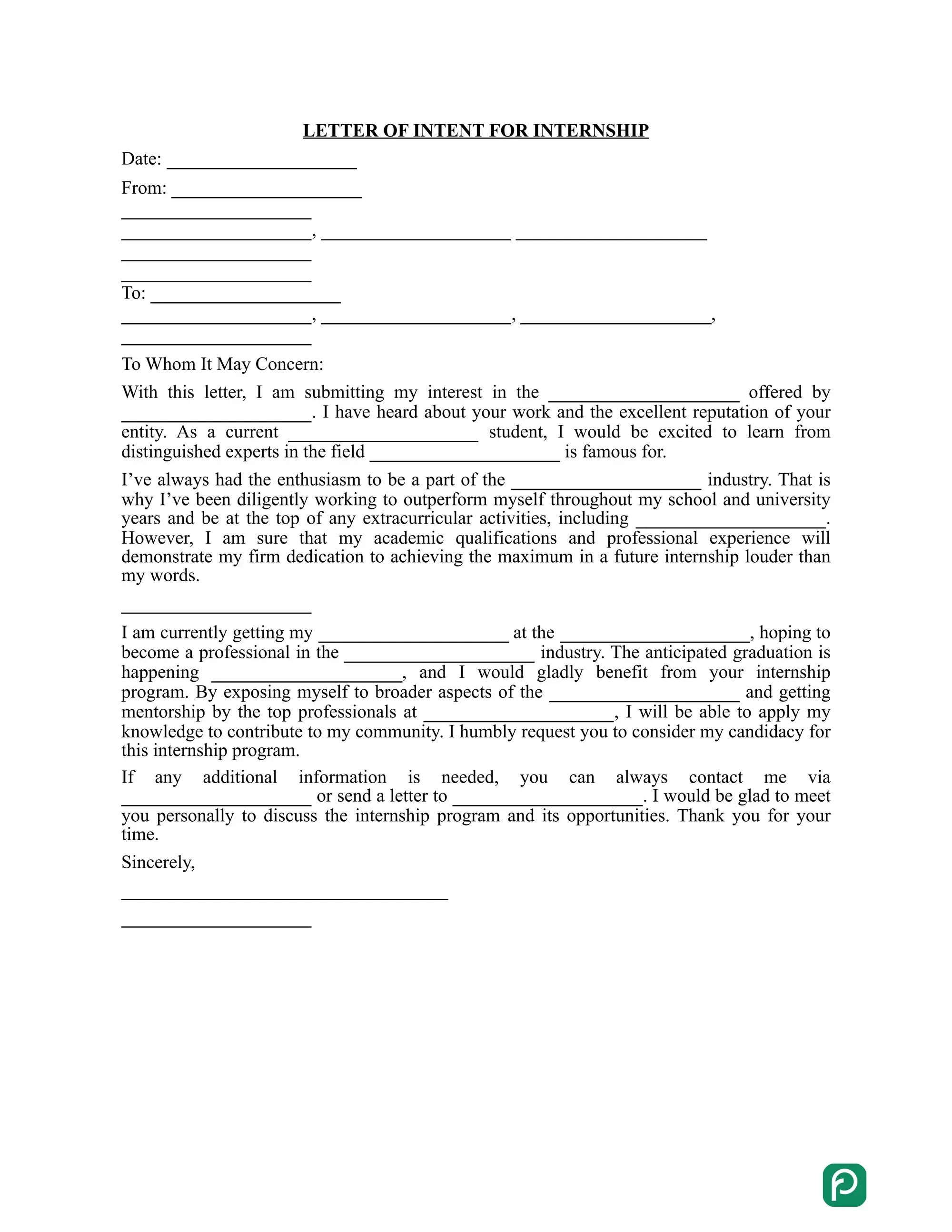
The sample letter below shows a veterinary student applying for a fall internship at a clinic. It states its purpose in the first sentence, names a specific program, mentions the applicant's studies and background, and ends with a clear next step. Adapt the details to your own situation instead of copying the wording.
From: Terry Banks
9125 Del Monte Rd.
Pasadena, TX 77506
April 4, 2021
To: Morgan Rory
Head of the North Texas Veterinary Clinic
Volunteering Program
808 Pilgrim Street
Dallas, TX 75208
Dear Dr. Rory,
With this letter, I am submitting my interest in the Fall Internship Program that was advertised at the Career Centre at The Texas A&M College of Veterinary Medicine & Biomedical Sciences. I have heard about your veterinary work and the great reputation of your clinic. As a current veterinary medicine student, I would be excited to learn from distinguished experts in the field your clinic is famous for.
I am currently getting my Master’s degree, hoping to become a veterinarian. The anticipated graduation is happening in August 2021, and I would gladly benefit from the internship at your clinic.
Since early childhood, I developed a love for animals when I helped my dad take care of sheep and horses at our farm. As a result, my passion for animals made me start pursuing a Bachelor of Veterinary Science degree.
I would be glad to meet you personally to discuss the internship program and its opportunities. I have enclosed recommendation letters from two professors along with my resume. I look forward to getting a call to schedule a meeting with you. Thank you for your time.
Sincerely,
Terry Banks
Here is what this sample does well:
The sample could go further in one place: it does not say what the student hopes to learn at the clinic. A sentence on learning goals would make the letter stronger.
The finished letter is usually sent as a PDF attachment or through the program's application portal. The posting tells you which one the program accepts; follow it over any general advice.
A paper letter by mail suits only a program that asks for one. In that case, print the letter, sign it above your typed name, and include the same attachments.
An internship letter loses its effect through a few small slips that a careful read catches. Check your draft against the list below before you send it.
The letter starts a conversation that a polite follow-up and a clear reply to any offer complete. The steps after sending matter as much as the letter itself.
A follow-up message is a short, polite email that asks whether the coordinator received your application. Send it after the response window the posting gives, or after a reasonable wait if the posting gives none, and thank the reader again.
An internship offer letter is the organization's written offer of a place. It usually names the role, the start and end dates, the schedule, the supervisor, and whether the internship is paid. Read every term before you reply, and ask the coordinator about anything unclear.
An internship offer deserves a prompt reply, though not always an instant yes. If you are waiting on another program, thank the organization and ask by when it needs your answer. Reply in writing either way, so both sides have the same record of the decision.
It is a letter you send to an organization to say you want an internship there. It explains who you are, what you hope to learn, and how you can help the team.
Aim for one page. A short opening, two brief paragraphs about your background and goals, and a short closing is a good shape.
Address it to the person who runs the internship program. Check the organization's website or ask the front desk. If you cannot find a name, write to the internship coordinator.
Yes, many applicants do. Focus on coursework, volunteer work, clubs, and personal projects, and explain what each one taught you.
Apply through the program's posting or portal with the documents it lists, usually a resume and a letter. Where no opening is posted, a letter of interest to the right department asks whether places exist.
No, the two letters travel in opposite directions. You send the letter of intent to ask for a place; the organization sends the offer letter to give you one.
General information, not legal or tax advice.
