
A letter of intent for scholarship applications is a short letter that tells an awarding body what you plan to study and why it matters to you. It also explains how the funding will help you reach your goals. Many colleges and scholarship committees ask students for one with the rest of their paperwork. Use our free fillable school letter of intent to build yours online, or read the steps and the sample below first.
Last Updated: October 2026. This guide is reviewed and updated regularly to reflect current law. If you notice an error or outdated information, please contact us.
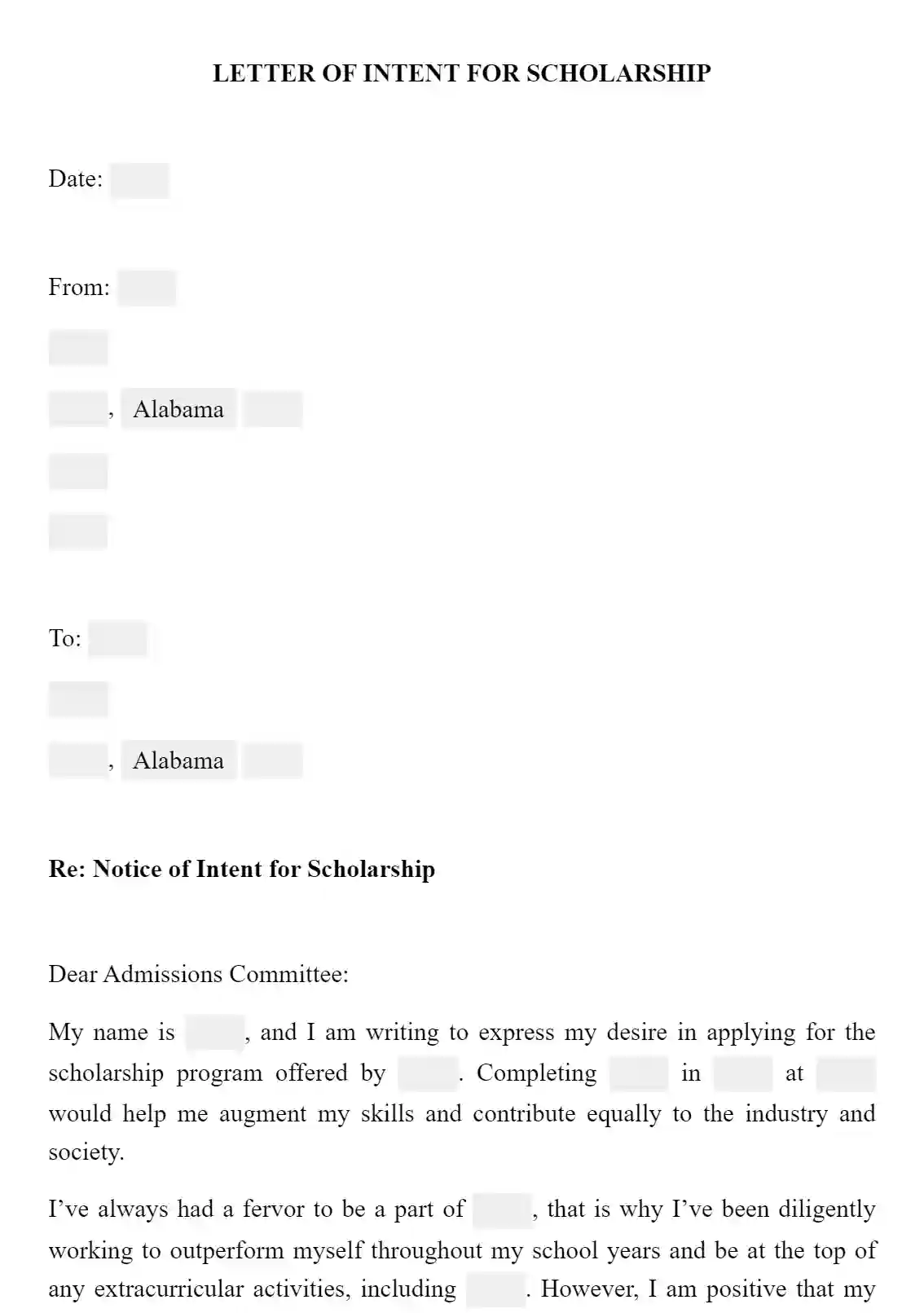
Build Your Document
Answer a few simple questions to make your document in minutes
Save and Print
Save progress and finish on any device, download and print anytime
Sign and Use
Your valid, lawyer-approved document is ready
The strongest ones are specific, short and written for one scholarship committee. Read the instructions from the awarding body first, because they often set the length, the format and the topics to cover. When there are no instructions, a standard business letter layout works well. Whatever the format, every letter of intent template includes the same three parts.
Describe the subject you want to study and how it connects to the career you want after graduation. Awarding bodies like to invest in students who demonstrate a thoughtful plan, so include concrete details.
For instance, you might say that you have always been interested in software engineering and want to learn more at college. After graduation, you plan to continue with a graduate program in Artificial Intelligence and Robotics. You are curious about industrial robots that could ease heavy labor in factories.
Your goal is to show what you want to do at the college or university and how the degree supports your future plans. It also helps to mention faculty members who could be your mentors. That shows you did your research and have a focused plan.
Scholarship committees also look at your earlier degrees and academic achievements. Everything you share should show your dedication to your area of interest. Good items to include are:
Goals make your LOI look purposeful. A short-term goal might be a master’s degree in Artificial Intelligence and Robotics. A long-term goal might be a role as a Machine Learning Research Scientist at a large engineering and robotics company. Say how the scholarship will help you reach both.
Tip: keep it to about one page and use the same details as on your other documents, so the reader can match the two easily.
Follow these four steps to turn your preliminary notes into a polished draft. Use the sample further down as a guide for layout and tone, and keep each paragraph focused on one idea so reviewers can scan it quickly.
This sample comes from a student applying for a full scholarship to an MBA program in Robotics. Use it to see how the parts from the steps above fit together, then replace the example details with your own.
From: Marco McDrive
7 S. Homestead Ave.
Laredo, TX 78043
April 4, 2026
To: Luke Wilson
Head of Scholarship Program
The University of Texas at Austin
Austin, TX 78712
RE: Letter of intent for a scholarship for MBA
Dear Mr. Wilson,
I am sending this letter to apply for the full scholarship at The University of Texas at Austin for MBA in Robotics starting in September. I was selected to join the course at your university, so I am writing this letter to show my interest in applying for the scholarship for this course.
I have been a diligent student throughout my academic life. I have always been at the top of my class and participated in various extracurricular activities such as playing baseball, attending a robotics school and volunteering at animal shelters.
I earned a Bachelor’s degree in Artificial Intelligence and Robotics with distinction. I have always wanted to continue my studies and earn a Master’s degree in the same subject at The University of Texas at Austin. With the help of the scholarship, I will be able to finish my MBA and fulfill my dream.
I humbly request you to consider my application for the full scholarship. Thank you in advance for your time. I look forward to hearing from you at my email or phone number provided at the top of this letter.
Sincerely,
Marco McDrive
This sample works because it is short and specific:
Reviewers often read many applications, and many applicants write the same things. A genuine, well-organized LOI is easy to remember. These tips help students stand out for the right reasons, whether they apply to a high school program, a college, a university or a private scholarship fund.
A cover letter introduces you and your background. A letter of intent goes further and explains what you plan to study and why the program and the award fit your goals. If you are unsure which one is asked for, read the scholarship instructions or ask the scholarship office.
About one page is a good aim. Keep every paragraph focused on one idea, and stay within any length limit the awarding body gives you.
Address it to the person named in the scholarship instructions, such as the head of the scholarship program. If no contact is given, “Dear Scholarship Committee” works well.
You can reuse the outline, but rewrite the opening, your goals and your reasons for choosing each program. That way every reader gets a version written for them.
General information, not legal or tax advice.
