
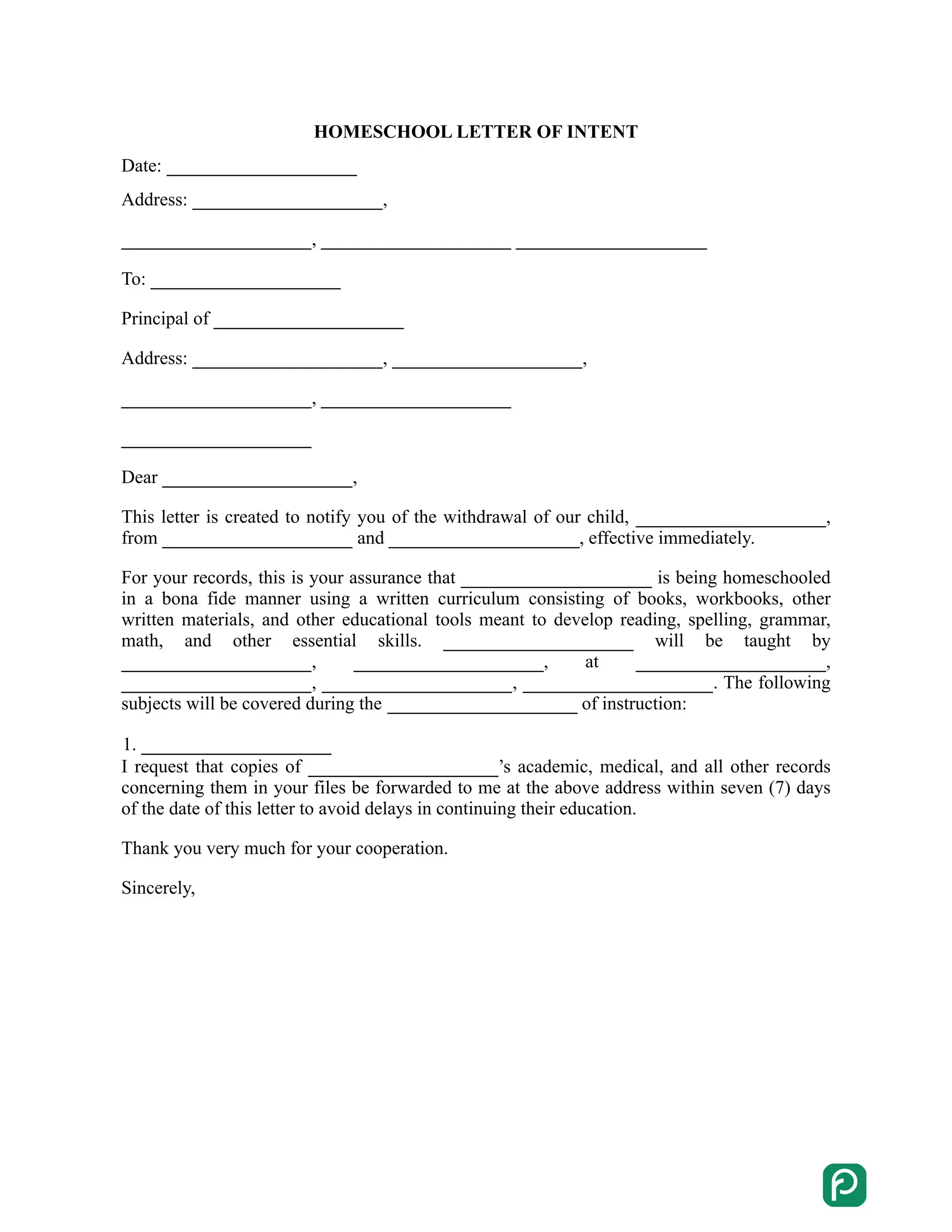
A homeschool letter of intent is a letter that tells the local department of education your child will learn at home instead of at a public, private, or boarding school. A letter of intent is fairly simple in terms of its content and formatting. The template, steps, and sample below show you how to write one.
Last Updated: October 2026. This guide is reviewed and updated regularly to reflect current law. If you notice an error or outdated information, please contact us.
Build Your Document
Answer a few simple questions to make your document in minutes
Save and Print
Save progress and finish on any device, download and print anytime
Sign and Use
Your valid, lawyer-approved document is ready
A parent or legal guardian usually writes the school letter of intent and gives basic details about the child. Keep the letter to one page and include each of the following items:
Nonetheless, each state has different guidelines on what should be included in a letter of intent to homeschool. In fact, some state’s departments of education may have their own specific intent to homeschool forms that you are required to use. Additionally, not all states require such a letter, but normally, it is the initial step to homeschool a child.
Most states require a parent or guardian to have an educational degree or certification that qualifies them to be able to teach in their state. These requirements vary vastly from state to state, and there are several categories of states based on the scope of requirements to homeschooling parents:
It is crucial to check with your state’s department of education about these requirements and the process of homeschooling.
Before you start, gather your child’s full name and date of birth, your home address, and the superintendent’s name. Then work through the seven parts below in order. Each part adds one block to the letter, from the date at the top to the signatures at the bottom.
Start by finding your state in the table below. If your state lists its own form, ask the office that receives your letter whether to submit that form, your homeschool letter, or both. Keep a copy of whatever you submit.
| State | Is a letter of intent required? | Is there a state-approved form? |
| Alabama | No | No |
| Alaska | No | No |
| Arizona | Yes | Affidavit of Intent to Homeschool |
| Arkansas | Yes | No |
| California | No | No |
| Colorado | Yes | No |
| Connecticut | Yes | Notice of intent |
| Delaware | No | No |
| Florida | Yes | No |
| Georgia | Yes | Home Study Program Declaration of Intent Form |
| Hawaii | Yes | OCISS Form 4140 |
| Idaho | No | No |
| Illinois | No | No |
| Indiana | No | No |
| Iowa | No | No |
| Kansas | No | No |
| Kentucky | Yes | No |
| Louisiana | Yes | No |
| Maine | Yes | No |
| Maryland | Yes | State Home Notification |
| Massachusetts | Yes | No |
| Michigan | No | No |
| Minnesota | Yes | No |
| Mississippi | No | Certificate of Enrollment (provided by attendance officers) |
| Missouri | No | No |
| Montana | Yes | No |
| Nebraska | No | No |
| Nevada | Yes | Notice of Intent to Homeschool |
| New Hampshire | Yes | Yes |
| New Jersey | No | No |
| New Mexico | Yes | No |
| New York | Yes | No |
| North Carolina | Yes | No |
| North Dakota | Yes | Statement of Intent Home Education |
| Ohio | Yes | Home Education Notification of Intent |
| Oklahoma | No | No |
| Oregon | Yes | No |
| Pennsylvania | Yes | Affidavit of the Supervisor of a Home Education Program |
| Rhode Island | Yes | No |
| South Carolina | No | No |
| South Dakota | Yes | Notification for Public School Exemption Certificate SDCL 13-27-3 |
| Tennessee | Yes | Notice of Intent to Homeschool |
| Texas | Yes | No |
| Utah | Yes | No |
| Vermont | Yes | Home Study Form A |
| Virginia | Yes | Notice of Intent to Provide Home Instructions |
| Washington | Yes | Declaration of Intent to Provide Home-Based Instruction |
| West Virginia | Yes | No |
| Wisconsin | Yes | PI-1206 Homeschool Enrollment report |
| Wyoming | No | No |
This sample shows how the parts above fit together on one page. The names, addresses, and dates are made up, so replace them with your own before you use the letter. In particular, change these items:
From: Mr. and Mrs. Stevens
1089 Augusta Park
Granbury, TX 76048
April 4, 2021
Terry Michael Cozy
Principal of Oak Woods School
311 Davis Rd, Granbury, TX 76049
Granbury Independent School District
RE: Notification of Student Withdrawal and Assurance of Home-Schooling
Dear Mr. Cozy,
This letter is created to notify you of the withdrawal of our son, Patrick Mario Stevens, from Oak Woods School and the Granbury Independent School District, effective immediately.
For your records, this is your assurance that Patrick Mario Stevens
is being homeschooled in a bona fide manner using a written curriculum consisting of books, workbooks, other written materials, and other educational tools meant to develop reading, spelling, grammar, math, and other essential skills.
I request that copies of Patrick Mario Steven’s academic, medical, and all other records concerning Patrick in your files be forwarded to me at the above address within seven (7) days of the date of this letter to avoid delays in continuing his education.
Thank you very much for your cooperation.
Sincerely,
Lisa Lime Stevens
Mike Brown Stevens
A good homeschool letter of intent is short, polite, and easy to file. Use plain business language and the same spellings that appear on your child’s school records. These habits help the office read your letter once and file it without follow-up questions.
Homeschooling is a way to give a child an education at home instead of following the traditional routes of education. Education from home can be provided by parents and or guardians but this is completely state-dependent as some states will require authorized educators.
According to the National Home Education Research Institute, there are around 4-5 million homeschool students in grades K-12 (from kindergarten to 12th grade) in the United States.
Families choose to homeschool for many reasons. Common ones are disapproval of the local school district, religious or philosophical views, and dissatisfaction with the classic educational methods. It is possible to achieve similar if not better results through homeschooling methods when compared to traditional education.
Address it to the superintendent. If you are not sure of the name, you can usually find it in one of these places, so check each one before you send the letter:
Yes. A template gives you a clear layout, and you add your own details. Our online document builder walks you through each part with simple questions, and you can print and sign the finished letter.
Yes, as a starting point. Replace the names, addresses, and dates with your own and delete any line that does not fit your situation. Then compare the finished letter with the instructions you received before you submit it.
Ask the office how it prefers to receive the letter, such as by mail, by email, or in person. Whichever way you choose to submit it, keep a copy and write down the submission date.
Keep a signed copy, the submission date, and any reply you receive. Store these documents with your other homeschool records so you can find them quickly.
Look for it in the state table above or on your state department of education website. Ask the office whether it wants that form, your letter, or both. Then submit the same details you would put in the letter.
General information, not legal or tax advice.
