Please rate Letter Of Intent Lien

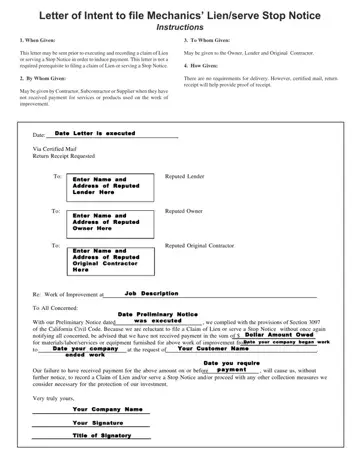
A notice of intent to lien usually gets sent when payments are slow to come in on a construction or improvement project – even if the work is still moving ahead as planned. More often than not, delayed payments are the result of cash flow issues, billing disputes, or change orders.
Sometimes the owner pays the prime contractor, but the sub or supplier never gets paid for their work performed. Other times, the owner disputes the quality or scope of the work and holds back on payment.
The people who usually send the lien notice are contractors or suppliers who've tried to collect payment but have come up empty-handed. Invoices are still sitting unpaid, phone calls go unanswered, and follow-ups fall flat. Timing is everything here – most send this document before filing a mechanics lien claim or serving a stop notice, using it as a dead serious warning. In the construction industry, the recipient sees it as a last chance to pay up before things start affecting the property or the money on the project.
Note - Even if it's not formally required in your state, a contractor who's provided services would do well to send the right form to protect their payment rights and avoid delays.
In particular, owners and lenders tend to get their act together as soon as they see that a lien's going to affect the title, financing, or project completion. So the intent notice usually leads to payment talks or some kind of negotiated resolution.
Also, if payment comes through, you don't need to go ahead with filing the actual lien. At that point, you can opt to send a lien waiver to confirm that no lien rights are attached to the property once you've accepted the payment.
Only certain parties can send this notice, and there are some basic requirements. They have to be someone who hasn't been paid for labor, materials provided, services, or equipment provided to the construction project yet. The usual suspects include:
• Contractors who worked directly for the owner
• Subcontractors who were hired by the prime contractor
• Material suppliers and equipment providers who furnished goods used on the project
Each of these parties relies on the notice as a way to protect their payment rights while still leaving room for resolution.
To be effective, the non-payment notice needs to go to anyone who's got a financial stake in the project. That usually means the property owner, the reputed owner, the construction lender, and the original or general contractor.
You should use registered or certified mail with a return receipt to send it. That way, a lien claimant will have proof that the notice actually arrived at its intended destination. Keep copies of the notice and the delivery records for your records – it's all part of creating a solid paper trail in case you need to take further action later.
| Question | Answer |
|---|---|
| Form Name | Notice Of Intent Lien |
| Form Length | 2 pages |
| Fillable? | Yes |
| Fillable fields | 19 |
| Avg. time to fill out | 15 min |
| Other names | intent to lien letter template, notice of intent to lien, lien letter, sample lien notice |
Letter Of Intent Lien isn’t the one you’re looking for?
Please rate Letter Of Intent Lien