
Updated:
A grant letter of intent (LOI) is a short pitch to funders. Foundations also call it a letter of inquiry and read it before inviting full grant proposals. This page gives nonprofits a free template, a sample letter and step-by-step writing help.
Build Your Document
Answer a few simple questions to make your document in minutes
Save and Print
Save progress and finish on any device, download and print anytime
Sign and Use
Your valid, lawyer-approved document is ready
A grant letter of intent is a short letter in which a nonprofit introduces itself and its project to a foundation, says how much funding it seeks, and asks to be invited to submit a full grant proposal.
Funders use the LOI as a screening step. A short letter lets program staff see quickly whether your project fits their priorities and the kind of support they give. It also saves you from writing a long proposal for a funder that was never a match. Some funders call it a pre-proposal or a concept letter.
Send a grant LOI when a funder's guidelines ask for a letter before any application. You can also use an LOI to introduce your organization to a foundation you have not approached before, as long as its guidelines accept unsolicited inquiries. When a funder says it does not accept unsolicited letters, respect that and watch for its open application cycle instead.
A grant LOI is a kind of letter of intent. For business deals, leases and other uses, see our letter of intent templates.
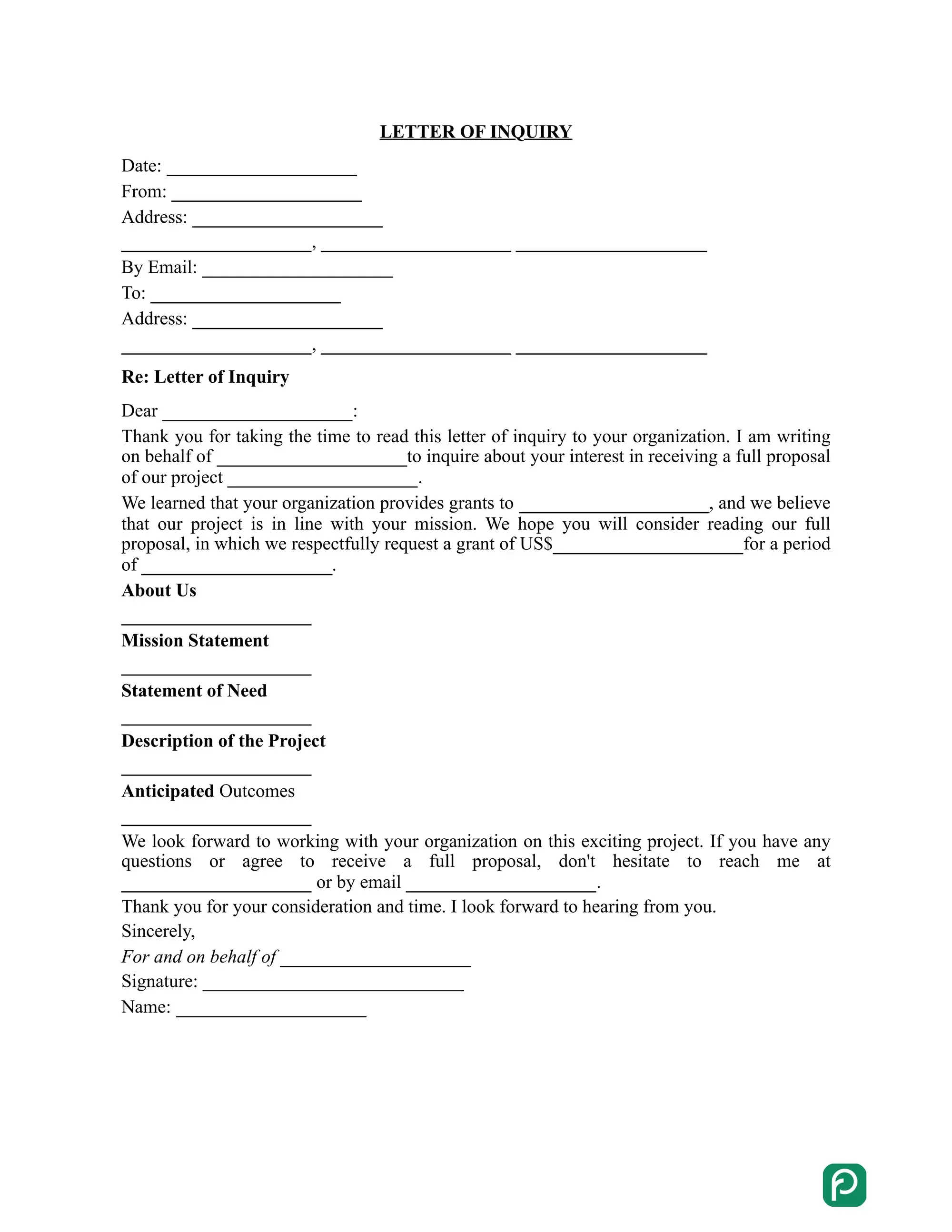
This sample letter of inquiry for a grant follows the usual order of the request, the need, the project, the budget and a follow-up plan, so you can copy the structure and swap in your own details.
This grant LOI template marks each part of the letter in brackets, so you can replace the bracketed text with your organization's details and delete any part the funder's guidelines do not ask for.
[Your organization's name]
[Street address, city, ZIP code]
[Date]
[Contact's full name and title]
[Foundation name]
[Foundation address]
Subject: Letter of inquiry for [grant program name]
Dear [Mr./Ms./Dr.] [Last name],
[Organization name] requests $[amount] over [period] to support [project name], which will [main result in one line]. We believe this project fits [foundation name]'s priority of [priority quoted from its guidelines].
[The need: who is affected, where, and what local evidence shows the problem.]
[The project: main activities, who leads them, who benefits, and the timeline.]
[Your organization: mission, years of service, and results from similar work.]
[The budget: total project cost, the share you ask the foundation to cover, and other funding sources.]
Thank you for considering this inquiry. We would welcome the chance to submit a full proposal. I will contact you on [date] and can be reached at [phone] or [email].
Sincerely,
[Name]
[Title]
This grant request letter example shows a neighborhood nonprofit asking a private foundation to fund a community playspace, written out in full so you can compare its tone and order with your own draft.
From: Patrick Smith
Chief Executive Officer
PlayLife Foundation
48 Wintergreen St.
El Paso, TX 79915
March 2, 2026
To: Bob Loware
Head of El Paso Private Foundation
El Paso, Texas
Subject: Letter of inquiry for the El Paso Area Community Enhancement Program
Dear Mr. Loware,
We are requesting $10,000 (ten thousand dollars) for a community-built playspace in our neighborhood at 12 Wintergreen St., El Paso, TX 79915. We believe this request fits your El Paso Area Community Enhancement Program because, like your Foundation, we work to make our community a better place to live.
Our mission is to improve the appearance of our neighborhood, make public spaces safer for children, and serve families who have few free places to play. A new, safe and accessible playspace is needed in our community for these reasons:
With this grant, we will build a playspace with around ten (10) play activities that will serve 150 families in the neighborhood. Ten volunteers will build the structure under the guidance of a certified play equipment installer, and S&B Engineers and Constructors has agreed to help with site work.
The total project cost is $18,500. We have raised $8,500 from neighborhood donors and a local business sponsor, and your grant would cover the remaining equipment cost.
Thank you for considering this inquiry. We would be honored to submit a full proposal. I will call you on March 16, 2026, to confirm that you received this letter, and I can be reached at (555) 010-2299 or patrick.smith@example.org.
Sincerely,
Patrick Smith
Each paragraph of the sample does a single job, and the request with its purpose comes first. Replace the names, dates and contact details with your own.
A grant letter of intent includes your organization's mission, the need your project meets, the project itself, how much funding you request and for what period, and the reason the project fits the funder's priorities.
Most letters cover these points:
Add attachments only when the funder's guidelines ask for them. Funders often ask for a line-item project budget, recent financial reports such as a balance sheet, or a copy of your IRS determination letter.
A line-item budget lists project costs by category, such as staff, equipment and supplies. It shows the funder where its money would go and how the grant fits with your other funding.
To write a letter of intent for a grant, read the funder's guidelines, gather your project facts, and then draft the letter in business letter format from the header to the sign-off, giving each paragraph a single job.
Before you name a figure, look at grants the funder has made to projects like yours. Many foundations list past grants on their websites or in annual reports, and that range shows what size of request is realistic.
To skip the formatting, select Create My Document at the top of this page and answer the builder's questions. The builder lays out the header, body and closing of your grant LOI for you to download.
Most grant LOIs run one to three pages, and many writers aim for a single page.
The funder's guidelines come first. When they set a page or word limit, stay inside it. When they use an online form with character limits for each answer, write to those limits and keep the same order of request, need, project and budget.
Use business letter format on your organization's letterhead, with a plain, readable font and short paragraphs. In a longer letter, brief headings for the need, the project and the budget help a busy reader find each part. Send a PDF unless the funder asks for another format.
Cut anything that does not help the reader decide: a long history of your organization, general claims about the problem, or attachments the funder did not ask for.
A grant request letter is weakest when it ignores the funder's priorities or guidelines, leaves the request vague, or buries the ask under background, and each of these faults is easy to fix before you send it.
A strong grant LOI does the reverse. It matches the funder's published goals, names a clear request and period, shows evidence of need, and describes results the funder can picture.
A grant LOI is a short pitch sent before any invitation, while a full grant proposal is the detailed application a funder may invite you to send after it reads your letter.
| Document | What it does | When you send it |
|---|---|---|
| Letter of intent (letter of inquiry) | Introduces the project and the request in brief | Before an application, to ask for an invitation |
| Full grant proposal | Sets out the project, budget and evaluation in detail | After an invitation, or in an open application cycle |
| Proposal cover letter | Summarizes the enclosed proposal for the reader | On top of a full proposal |
| Letter of support | Lets a partner or community group vouch for the project | As an attachment to the proposal |
| Notice of intent to apply | Tells a funder you plan to apply, so it can plan its review | When a program's guidelines ask for it |
Some programs use "letter of intent" for that last kind of notice, which carries only basic facts about your organization and project. Read the funder's description of what it wants before you write.
A letter of support comes from someone else, such as a partner organization, a local leader or a group your project serves. To ask for a letter of support, send the writer a short summary of the project and the points you hope they will confirm, and give them time to write it in their own words.
A grant letter of intent is short, so most questions are about naming, sending and following up. These answers cover the points the sections above do not.
In grant writing, a letter of intent and a letter of inquiry usually mean the same short pitch, and both go by LOI. Use whichever name the funder uses, and follow its description of what the letter covers.
Yes, many applicants send a grant LOI as an email letter, and some funders provide an online application form instead. Send it the way the funder's guidelines ask, and attach the letter as a PDF when you email it.
Follow up on a grant LOI after the response date the funder gives, or after several weeks when it gives none. Keep the message short: confirm the letter arrived and offer to answer questions.
A grant letter of intent reads best in a confident, plain and warm tone, written as a partner offering a project that serves the funder's goals. Use active verbs, avoid jargon, and let specific facts carry the case.
You can reuse the core of a grant LOI for several funders, but tailor each letter to the funder's priorities, contact person, grant program and guidelines. A letter that names the funder's own goals is more convincing than a form letter.
An AI tool such as ChatGPT can help you outline or tighten a grant letter, but you write the facts, figures and project details yourself and check every line. Read the funder's guidelines too, since some funders set their own policies on AI-written applications.
Select Create My Document at the top of this page and answer a few questions to build a grant LOI online. The sample letter above shows how a finished letter can look.
General information, not legal or tax advice.
