
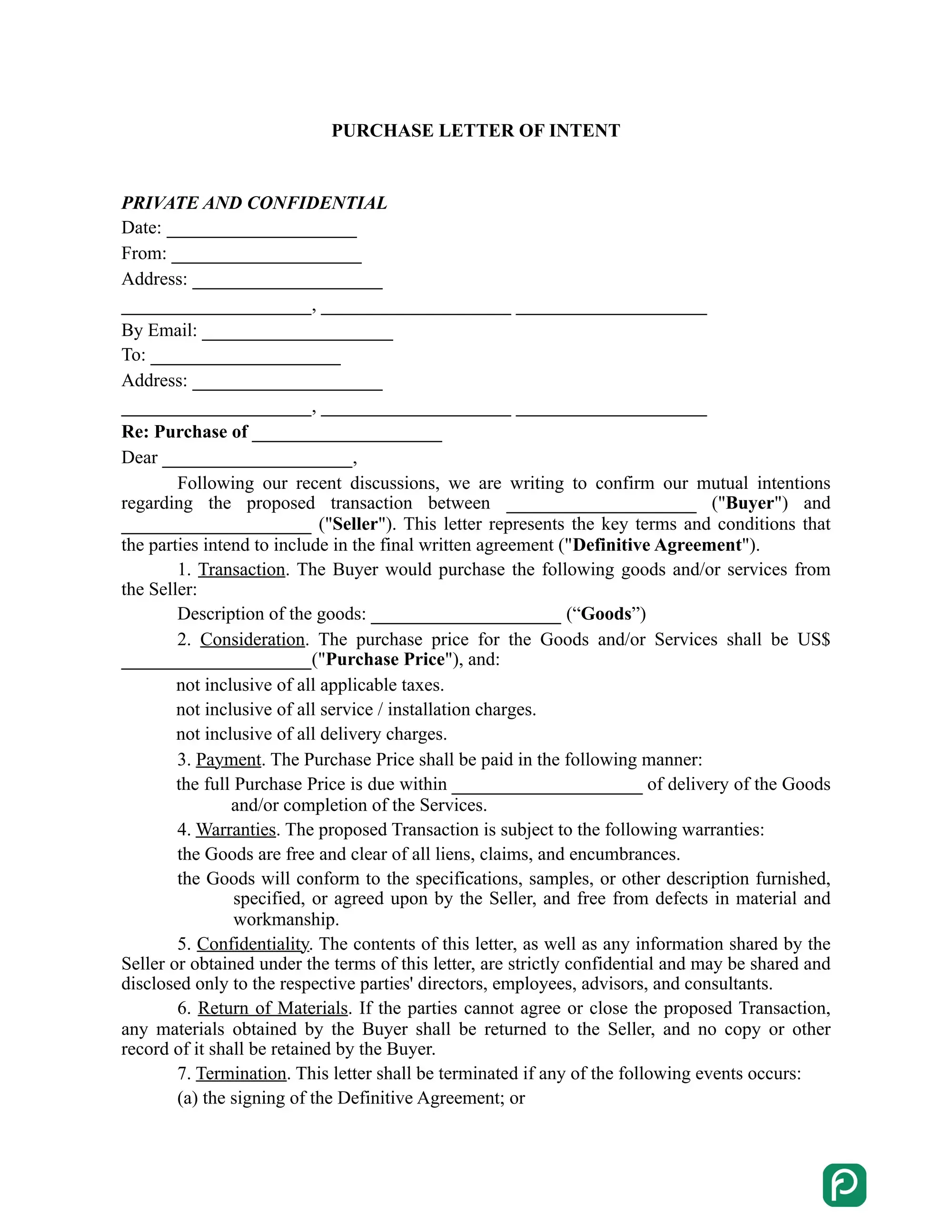
A purchase letter of intent (LOI) is a written statement that a buyer plans to buy a seller’s products or services. It shows the seller that the buyer is serious about the deal. The buyer can also add a date for the seller to accept or decline, so the offer does not stay open for long. Use the builder below to create your own letter in a few minutes.
Last Updated: October 2026. This guide is reviewed and updated regularly to reflect current law. If you notice an error or outdated information, please contact us.
Build Your Document
Answer a few simple questions to make your document in minutes
Save and Print
Save progress and finish on any device, download and print anytime
Sign and Use
Your valid, lawyer-approved document is ready
A purchase LOI changes with what the buyer wants to buy. These are the most common types of letter of intent template for a purchase, from a whole business to a single batch of goods:
The parties might decide to make a letter non-binding with the intention to create a more comprehensive agreement in the future. But if agreed upon by the buyer and seller, the form might be legally binding which will bring it legal force and consequently provide legal protection for the parties. Talk this point through with the other side before you draft, so the letter says what both of you expect.
A purchase order is a form the buyer sends to the selling business to order products or services. It lists the type and number of items the buyer wants. A purchase LOI comes earlier and only outlines the main terms.
The order also gives the buyer’s account details for delivery of the requested items and the terms of payment. When a seller gets a purchase order, they should give approval of the transaction before it becomes a legally binding contract.
A purchase LOI works best as a short document that covers only the main terms of the sale. Before you start, collect the details below so each step goes quickly. Then work through the nine steps in order.
Step 1 – Effective date and subject
Start with the date the letter takes effect. Add a subject line that names the product or products you want to buy.
Step 2 – Purpose
In the first paragraph, write the purpose of the letter. For example, say that it sets out the basic terms of the sale between buyer and seller, and that a formal agreement may follow.
Step 3 – Parties and Product
Add the name of the buyer and the name of the seller. Then name the product or service the buyer wants to buy. Give the quantity and the price per item if the product is countable.
Step 4 – Purchase price and payment method
State the price of the products or service, and the total price after taxes. Then name the payment method the buyer will use, such as a check, money order or cash.
Step 5 – Dependence on financing
Say whether the buyer needs financing to make the purchase. If so, list the conditions that apply to getting that financing.
Step 6 – Binding effect
The purchase letter of intent should indicate whether it is enforceable or not which should be agreed upon by the parties.
If the letter of intent is non-binding, there should be a wording that it is constructed solely for the purpose of agreeing on the main terms of the future legally binding contract. If the letter of intent is binding, there is no need for the buyer and seller to create a purchase agreement.
Step 7 – Currency and governing law
The currency in which the payment will be made and the laws considered governing by the parties should be mentioned.
Step 8 – Acceptance
Near the end of the letter, say how the seller accepts it. Usually, the buyer and the seller both sign the letter, and the seller returns a duplicate copy to the buyer. The section should also provide the date by which the copy should be returned.
Step 9 – Signatures
Finish with the signatures. The buyer and the seller each sign the letter and add their printed names and the date of signing.
Need a purchase LOI fast? Our online document builder asks a few questions and builds a customized letter in minutes. You can then download and print it.
Beyond the nine core steps, buyers often add a few optional terms to the deal. They give both sides a clearer picture of how the sale will move forward. Pick only the ones that fit your situation.
The sample below shows a finished letter from a small art studio to its art supplier. Use it as a model for layout and tone, then swap in your own names, items and dates.
From: Art for Happiness, LLC
689 Manor Ave.
Big Spring, TX 79720
April 4, 2021
To: Texas Art Supply
323 Harvard Road
Odessa, TX 79761
RE: Letter of intent to purchase goods
Dear Sir/Madam,
We take the opportunity to declare our intention to purchase some goods from your company. Our company is duly organized and exists under the laws of the State of Texas, based on its Articles of Incorporation dated April 1, 2021. The principal business address of our company is 689 Manor Ave. Big Spring, TX 79720. Our principal activities include paint-and-sip services for our customers.
In line with the above-stated, we, Art for Happiness, LLC, hereby confirm with all responsibility that we are willing and able to enter into a contract for the purchase of the following items, as specified below:
We understand that this letter of intent is a starting point for further negotiations and operates as a framework under which the transaction can proceed.
We look forward to working with you on the proposal, hopefully beneficial for both entities.
Respectfully,
Owen Marriott
Supply Manager of the Art for Happiness, LLC
A purchase LOI is a short document, so most questions are about what goes in it and how it fits with the final deal. These answers cover the basics before you start your own letter.
A purchase letter of intent is a short letter in which a buyer states the plan to buy products or services from a seller and lists the main terms. It comes before the final agreement or the purchase order.
Most purchase LOIs fit on one or two pages. Cover the main terms and leave the finer details for the final agreement.
A purchase LOI usually covers these points:
Yes. The same layout works for both. Name what you want to buy in the subject line, and add quantities when the purchase is goods.
Select Create My Document at the top of this page and answer a few questions to build a purchase LOI online. The sample letter above shows how a finished letter can look.
General information, not legal or tax advice.
