
Updated:
A notice of intent to vacate is a tenant’s written move-out letter. This page gives an intent to vacate letter template, a sample and a builder. Tenants need it before moving out, especially when a lease sets the notice period.
It gives the landlord a written record of your move-out date and your forwarding address. Learn more about letters of intent in our guide.
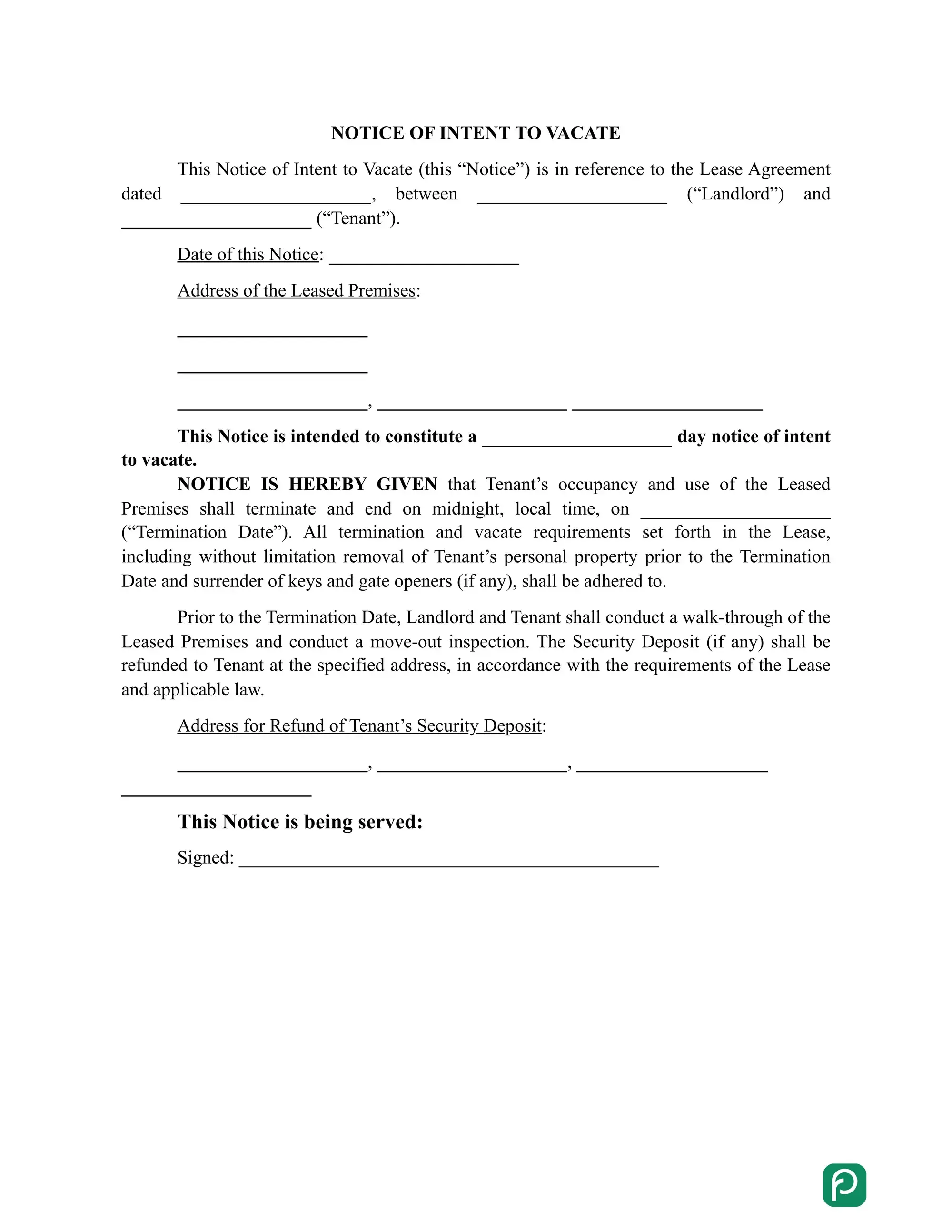
Build Your Document
Answer a few simple questions to make your document in minutes
Save and Print
Save progress and finish on any device, download and print anytime
Sign and Use
Your valid, lawyer-approved document is ready
An intent to vacate letter template names the tenant, the landlord, the rental address, the move-out date and the forwarding address, then ends with your signature. Copy the fill-in version below, or use the document builder on this page to cover the same points. Keep the wording short and polite.
This fill-in letter to vacate is a starting point for an apartment, a house or another rental property: replace each bracket with your own details, and add any wording your lease or state calls for. Delaware Code title 25, § 5106, for one, has a tenant on a set term give notice that the agreement shall terminate upon its expiration date, so the template carries a line for a set term.
[Your full name]
[Rental address and unit number]
[City, state and ZIP code]
[Date of this notice]
To: [Landlord or property manager]
[Landlord’s address from the lease]
Re: Notice of Intent to Vacate
Dear [landlord’s name],
This letter is my written notice that I intend to vacate [rental address] on [move-out date]. My lease is dated [lease date].
[For a lease with a set term, add: My rental agreement will terminate on its expiration date, [date].]
Please tell me the date and time of any move-out inspection so that I can attend.
Please send my security deposit of [amount], or the rest of it with a list of any deductions, to my forwarding address: [new address]. You can reach me at [phone number] or [email address].
Sincerely,
[Signature]
[Printed name]
This sample letter to vacate an apartment shows the order and the tone of a finished notice, with example details in place of your own. All names, addresses and amounts in the sample are made up.
From: Adam Ardis
Apartment Number 36
278 3rd Ave.
Corsicana, TX 75110
January 4, 2027
To: Cool Apartments
278 3rd Ave.
Corsicana, TX 75110
Re: Notice of Intent to Vacate
To whom it may concern,
My name is Adam Ardis, and this letter serves as my written notice of intent to vacate from the rental premises that I currently occupy. I intend to vacate by March 4, 2027. My forwarding address is 8175 Vermont Dr. Kerrville, TX 78028, and if any issues or concerns come up, I can be reached at the phone number +1 (467) 555-1234 or email: adam.a@example.com.
I would like to schedule a move-out walkthrough inspection of the apartment during the week of the move. I believe that the apartment’s condition is satisfactory to receive the return of my full deposit of $1000, as per the lease agreement. The deposit can be sent to my new mailing address provided above.
If you have any questions, please contact me at the phone number or email listed above in this letter.
Sincerely,
Adam Ardis
A notice to vacate email template carries the same facts as the letter in fewer lines, and it fits a lease that accepts email.
Subject: Notice of Intent to Vacate, [rental address]
Dear [landlord’s name],
This email is my written notice that I intend to vacate [rental address] on [move-out date]. Please send my security deposit to [new address], and please confirm by reply that you received this notice.
Sincerely,
[Your full name], [phone number]
A letter of intent to vacate is the tenant’s written notice to the landlord or property owner that the tenant plans to leave a rental on a named date. People also call it an intent to move out letter, a letter to vacate or an apartment vacate letter. Send it once you know your date and can give the full notice period in your lease.
The letter fits these situations:
A different document fits when the landlord is the person ending the rental, or when you want to sign for a new home instead of leaving an old one. A landlord who wants a tenant to leave uses a notice to vacate, and a new rental starts with a lease agreement.
Your notice period comes from your lease and the rules where the rental sits: Delaware Code title 25, § 5106 sets a minimum of 60 days in Delaware, and the New York Attorney General gives one month for month-to-month tenants who are not rent regulated, outside New York City. In named cases, Delaware Code title 25, § 5314 lets a tenant end the tenancy on 30 days’ written notice instead, and the table lists examples. The Texas Attorney General points tenants to the rental agreement first.
| Where | Rental type | Notice from the tenant | Source |
|---|---|---|---|
| Delaware | Month to month | A minimum of 60 days’ written notice, and the 60 days begin on the first day of the month after the day of actual notice | Delaware Code title 25, § 5106 |
| Delaware | Rental agreement with a set term | A minimum of 60 days’ written notice before the term expires, saying that the agreement ends on its expiration date | Delaware Code title 25, § 5106 |
| Delaware | After a landlord’s notice of renewal with changed terms | A minimum of 45 days before the last day of the term to tell the landlord you are ending the agreement; without that notice, the changed terms count as accepted | Delaware Code title 25, § 5107 |
| Delaware | Named cases, such as a job move with your present employer that requires moving your home more than 30 miles, a serious illness or a death in the household that requires a permanent move, entering active military duty after signing, or being a victim of domestic abuse, sexual offenses or stalking | 30 days’ written notice, and the 30 days begin on the first day of the month after the day of actual notice; the deposit can reimburse the landlord’s reasonable renovating and rerenting expenses from the termination, up to 1 month’s rent | Delaware Code title 25, § 5314; Delaware Code title 25, § 5514 |
| New York, outside New York City | Month to month, not rent regulated | One month’s notice | New York Attorney General |
| Texas | Rental agreement | Check whether your rental agreement requires advance notice; many leases require a 30-day notice as a condition of returning your deposit | Texas Attorney General |
The table shows examples, not every place in the country, so a rental elsewhere can follow a different period. Read your lease and look for the notice period and the delivery methods it names. Check your state’s notice period too. For a federally subsidized unit, Delaware Code title 25, § 5106 says federal law, regulations or guidelines control where they conflict with the Delaware Code.
Pick your move-out date, then read how your lease and your state count the period, because the start of the count depends on the rule. Under Delaware Code title 25, § 5106, a month-to-month notice period begins on the first day of the month after actual notice.
To write a letter of intent to vacate, gather your lease and the landlord’s contact details, then work through these points in order, using plain and polite wording. There is no standardized form of a notice of intent to vacate, but certain elements should always be included.
If you need a vacate letter template, use the document builder on this page. It walks you through each point above and gives you a document you can print and sign.
Leave past disputes and repair complaints out of the letter. Raise anything else in a separate message.
Deliver an intent to vacate letter to your landlord by a method your lease names, and prefer one that gives you a receipt or a written reply. Your lease can list a mailing address, an office or an email address for this.
Delaware Code title 25, § 5113 names the methods in Delaware: personal service, leaving a copy with an adult residing at the landlord’s address or with the landlord’s agent for such notices, or registered mail, certified mail or first-class mail with a certificate of mailing to the landlord’s business address, and the address is the one in the lease or one the landlord otherwise provided. Sign the document and keep a copy for your records.
The result depends on your lease and where you rent, and the Texas Attorney General says many leases require a 30-day notice as a condition of returning your deposit. Read the notice clause in your lease before you set a move-out date. If you already missed the period, ask your landlord in writing whether a shorter notice is acceptable, and keep the reply.
Some landlords and property managers write in the lease that an email with the necessary information is enough, but a state’s rules can name other methods. Delaware Code title 25, § 5113, for example, names personal service, leaving a copy and mail, not email. A mailed or hand-delivered copy with proof of delivery gives you a record that the landlord received it.
A notice of intent to vacate comes from the tenant and tells the landlord about a planned move-out. A notice to vacate can also come from a landlord who asks a tenant to leave. A landlord’s eviction notice is a separate document, so check who is sending the notice before you pick a template.
The New York Attorney General says that, for units that are not rent stabilized or rent controlled, the landlord must return the security deposit within 14 days of the tenant moving out. The Texas Attorney General says a Texas landlord must return the deposit, less any amount deducted for damages, within 30 days. Delaware Code title 25, § 5514 gives a Delaware landlord 20 days from the expiration or termination of the rental agreement to remit any deposit the landlord is not entitled to, or to send an itemized list of damages with estimated repair costs and pay the difference. Elsewhere, check your state’s deposit law and your lease. Give your forwarding address in writing, whatever the timing.
Read your lease for an early termination clause first, then ask your landlord in writing, because the answer depends on your lease and on where you rent. The New York Attorney General says individuals entering active duty in the military can end a residential lease by written notice, if they signed it before active duty and they or their dependents have occupied the home. The New York Attorney General, citing NY Military Law § 310, adds that a service member’s termination of a lease requiring monthly payments is not effective until 30 days after the first date on which the next rent is due. Delaware Code title 25, § 5314 lets a tenant end the tenancy on 30 days’ written notice in named cases, including a job move with the present employer that requires moving the home more than 30 miles, a serious illness or a death in the household that requires a permanent move, acceptance into senior or subsidized housing, entering active military duty after signing, and being a victim of domestic abuse, sexual offenses or stalking. Under Delaware Code title 25, § 5314, the 30 days begin on the first day of the month after the day of actual notice. Under Delaware Code title 25, § 5514, the deposit can reimburse the landlord’s reasonable renovating and rerenting expenses from such a termination, up to 1 month’s rent.
After you send the notice, keep your proof of delivery and get ready for the walkthrough, the move and the return of your keys.
Talk to your landlord as soon as you can, ask in writing whether you can stay, and keep the reply. Your lease type, such as month to month or a fixed term, and the landlord’s plans for the unit affect what is possible. Wait for a yes in writing before you change your plans.
General information, not legal or tax advice.
