
Updated:
A letter of intent to marry is a signed promise to wed. 8 U.S.C. § 1184(d)(1) asks K-1 couples for proof of intent to marry within ninety days of arrival. Petitioners usually send the signed letter with Form I-129F as that evidence.
Key facts
Build Your Document
Answer a few simple questions to make your document in minutes
Save and Print
Save progress and finish on any device, download and print anytime
Sign and Use
Your valid, lawyer-approved document is ready
A letter of intent to marry is a one-page signed statement in which an engaged couple declares that they plan to marry each other in the US once the foreign partner arrives on a K-1 fiancé visa. The letter goes into the evidence package of Form I-129F, the Petition for Alien Fiancé(e).
A K-1 visa depends on that petition: under 8 C.F.R. § 214.2(k)(1), an alien must be the beneficiary of an approved visa petition filed on Form I-129F to be classified as a fiancé or fiancée. The letter of intent is one piece of evidence behind that approval.
The letter is also called a statement of intent to marry, an intent to marry letter or a fiancé letter. Some couples search for an affidavit of intent to marry; the letter does the same job in plain letter form, signed by the writer.
The letter states the couple's intention and willingness to marry, in their own words. 8 U.S.C. § 1184(d)(1) approves a fiancé petition only after evidence shows the parties have a bona fide intention to marry, and are legally able and actually willing to conclude a valid marriage in the US within a period of ninety days after the alien's arrival.
The letter answers two of those points directly: the intention to marry and the willingness to marry within ninety days. Other documents in the package show the couple is free to marry, such as proof that any earlier marriage has ended.
A letter of intent to marry comes as one joint letter or one letter from each partner, because 8 U.S.C. § 1184(d)(1) asks for evidence that the parties have a bona fide intention to marry. Each letter states the same plan from its writer's side. The petitioner is the US citizen who files Form I-129F. The beneficiary is the foreign fiancé or fiancée who travels to the US on the K-1 visa.
8 U.S.C. § 1184(d)(1) names the evidence, intent to marry, and sets no format for it. Many couples send one letter from each partner, so each signature sits on its own page; the sample below is a joint letter.
The letter's central sentence is the promise to marry within ninety days of the beneficiary's arrival in the US. That window comes from 8 U.S.C. § 1184(d)(1), which asks for evidence that the couple will conclude a valid marriage within a period of ninety days after the alien's arrival.
The same window matters after the wedding: under 8 C.F.R. § 214.2(k)(6)(ii), upon contracting a valid marriage to the petitioner within 90 days of his or her admission on a K-1 visa, the beneficiary may apply for adjustment of status to lawful permanent resident.
The letter states the window plainly, for example "within ninety days after you arrive in the US on a K-1 visa", so an officer reads the commitment without searching for it.
A letter of intent to marry includes six parts: the recipient and subject, the names and contact details, the statement of intent, the list of attachments, a closing and the signature with a date. The table shows what goes in each part, in the order the letter uses.
| Part | What goes in it |
|---|---|
| Recipient and subject | USCIS, the filing address for the petition and a subject line that names Form I-129F |
| Names and contact details | The full names of the petitioner and the beneficiary as they appear on passports, addresses, a phone number and an email address |
| Statement of intent | A greeting, the writer's name and role, and the commitment to marry in the US within ninety days of the beneficiary's arrival |
| Attachments | A list of the wedding plan evidence sent with the letter |
| Closing | A thank-you and an offer to answer questions about the petition |
| Signature | The writer's signature, the date and the printed name |
The letter fits on one standard sheet of paper. A short paragraph about how the couple met and their wedding plans makes the letter personal and easy to check against the rest of the package.
A letter of intent to marry has no notarization step in the federal texts behind the K-1 petition: 8 U.S.C. § 1184(d)(1) asks for evidence of a bona fide intention to marry, and 8 C.F.R. § 214.2(k) names no notary for it. The writer's own signature and date carry the letter.
A notary stamp does no harm if a couple wants one, but the letter's weight comes from its content: clear names, a dated signature and a direct statement of the plan to marry.
A letter of intent to marry is written in six steps, one for each part of the letter. Follow them in order and the finished page matches the sample below.
The statement reads best in plain, personal words. Each tip below keeps the letter short and easy to check.
The letter of intent sits with other evidence of the couple's plans in the Form I-129F package. Documents that show a wedding in progress support the statement in the letter:
The letter's attachment list names each of these items, and the package holds every item the list names.
The petition also needs proof of an in-person meeting: under 8 C.F.R. § 214.2(k)(2), the petitioner shall establish that the petitioner and K-1 beneficiary have met in person within the two years immediately preceding the filing of the petition.
8 C.F.R. § 214.2(k)(2) lets the director waive the meeting only if compliance would result in extreme hardship to the petitioner or would violate strict and long-established customs of the beneficiary's culture. Photos together, travel tickets and hotel bookings are common proof of the meeting; the letter of intent may mention when and where the couple met.
The letter is signed and dated by each writer, then sent in the same package as Form I-129F.
Keep the signed original as well: under 8 C.F.R. § 214.2(k)(1), the original document shall be submitted if requested by the Service.
A letter of intent to marry most often fails on small details that make it hard to match against the rest of the package. Check the draft for these before signing:
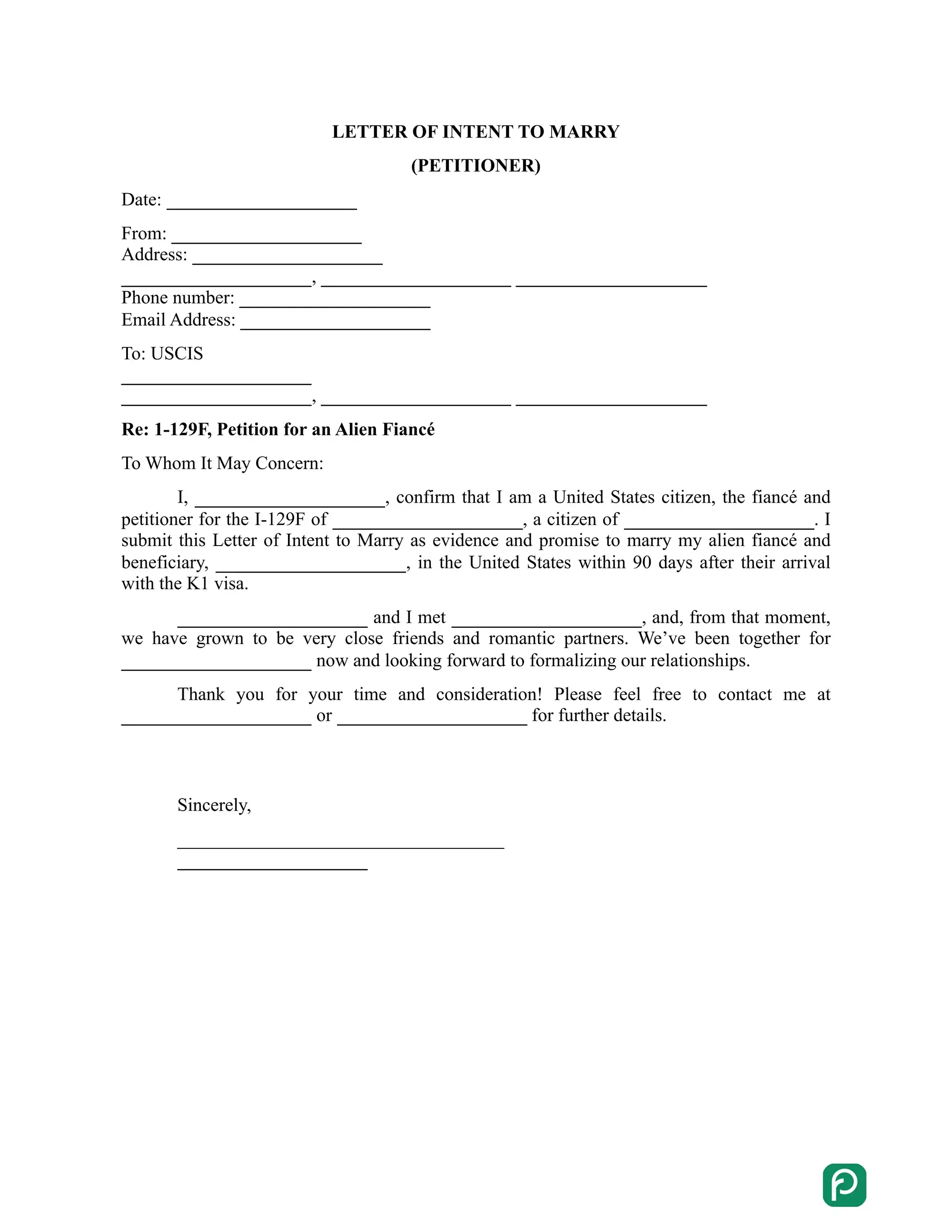
The sample below is a joint letter signed by both partners. It uses made-up names and addresses, so replace every detail with your own. A letter from one partner follows the same order with one name in the statement and one signature, and goes in with a matching letter from the other partner, since 8 U.S.C. § 1184(d)(1) asks for evidence that both parties intend to marry.
From: Mary Taylor Allen
989 Miller St.
League City, TX 77573
Phone number: +1 777 666 432
Email: mary.allen@example.com
To: USCIS
[The filing address for Form I-129F]
RE: I-129F Petition for Alien Fiancé(e)
Dear USCIS Officer,
I am the Petitioner, Mary Taylor Allen. My fiancé, the Beneficiary, Luke Michael, and I submit this Letter of Intent to Marry as evidence of our plan to marry each other in the United States. We are legally able and willing to marry within 90 days after Luke arrives in the United States on a K-1 visa.
As evidence of our plans to marry, we attach:
Thank you for your time. Please contact us with any questions about this petition.
Sincerely,
Mary Taylor Allen, April 4, 2026
Luke Michael, April 4, 2026
Yes, a joint letter with both names and both dated signatures is one common format. 8 U.S.C. § 1184(d)(1) asks for evidence of intent to marry and sets no format; many couples send one letter from each partner instead.
No, the letter is supporting evidence, and Form I-129F is the petition itself. The letter goes in the same package as the form.
Both state the plan to marry; an affidavit is sworn before an official, and a letter is signed by its writer. The federal texts cited on this page describe the evidence as proof of intent to marry, not as an affidavit.
One page is enough. The letter needs the names, the statement of intent with the time frame, the list of attachments and the dated signatures.
Yes, the letter can be typed or written by hand. The signature is the writer's own, and the date sits next to it.
For other letters of intent, see the letter of intent templates.
General information, not legal or tax advice.
