
A Kentucky durable power of attorney is a written document that lets you, the principal, name someone you trust, your agent, to handle your financial affairs. Your agent can handle tasks such as banking, managing real estate, filing taxes, and making investment decisions on your behalf, and you decide how broad or limited that authority is in the power of attorney you create.
Last Updated: September 2026. This guide is reviewed and updated regularly to reflect current Kentucky law. If you notice an error or outdated information, please contact us.
Build Your Document
Answer a few simple questions to make your document in minutes
Save and Print
Save progress and finish on any device, download and print anytime
Sign and Use
Your valid, lawyer-approved document is ready
The word "durable" means the document keeps working even if you become incapacitated, unless you state in the document itself that it ends on your incapacity.[1] Your agent continues to act on your behalf under the same authority you already granted.
This form covers financial and property decisions as part of your estate planning. For medical and health care decisions, use a separate Kentucky power of attorney form instead, since this document does not cover health care choices.
Kentucky’s Uniform Power of Attorney Act, KRS Chapter 457, requires a durable power of attorney to be signed by the principal, or by another person the principal directs to sign in the principal’s conscious presence. If someone else signs this way, the document must state the reason for that method of signing. A signature is presumed genuine when the principal acknowledges it before a notary public or another individual authorized by law to take acknowledgments.[2]
A Kentucky durable power of attorney takes effect as soon as it is signed, unless it states that it becomes effective at:
If you choose to make it effective upon your incapacity, you can name one or more people in the document to confirm in writing that the incapacity has occurred.[5]
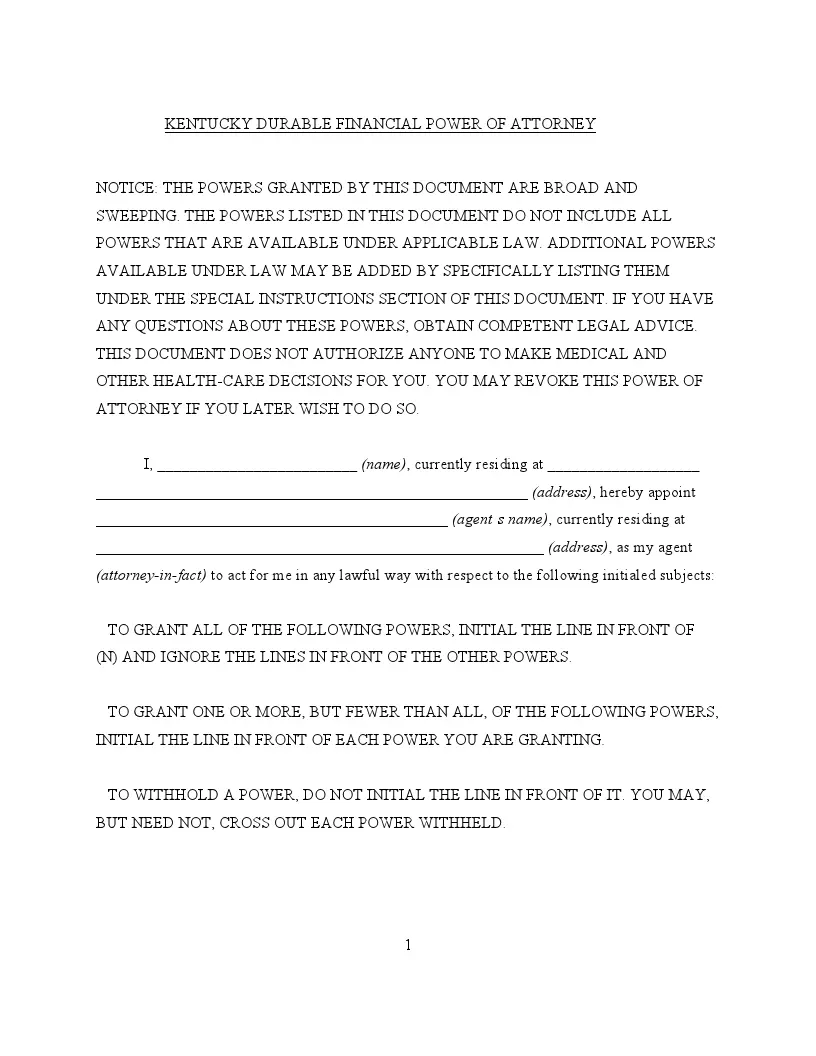
The document stays in effect if you later become incapacitated, unless you state in the power of attorney that it ends on your incapacity.[1] This is what makes it “durable.” Kentucky law also provides an optional statutory form power of attorney with this same legal effect.[4] You are not required to use that specific form. FormsPal’s Kentucky durable power of attorney template below covers the same requirements in a ready-to-use format.
| Document Name | Kentucky Durable Power of Attorney Form |
| Other Names | Kentucky Financial Durable Power of Attorney, KY DPOA |
| Relevant Laws | Kentucky Revised Statutes, Section 457.050 |
| Signing Requirements | Notary Public |
| # of Fillable Fields | 37 |
| Available Formats | Adobe PDF |
Popular Local Durable POA Forms
Durable POA documents are used in each and every state. Take a look at other popular DPOA forms frequently filled out by Americans.
A Kentucky durable power of attorney, and an agent’s authority under it, end automatically in several situations set out in KRS 457.100, including the principal’s death, revocation by the principal, and events tied to the agent’s own ability to serve. Kentucky law also protects an agent or third party who keeps acting in good faith without knowing that termination has already happened.[3]
A power of attorney or an agent’s authority under it terminates when:
“A court appoints a limited conservator, conservator, limited guardian, or guardian of the principal’s estate or other fiduciary charged with the management of some or all of the principal’s property, unless the court specifically provides that the power of attorney shall remain in effect.”
If the power of attorney is not durable, the principal’s incapacity does not revoke or terminate it as to an agent or another person who, without actual knowledge of the incapacity, keeps acting in good faith under it. The same protection applies more broadly. Termination of an agent’s authority or of the power of attorney is not effective against an agent or another person who acts in good faith without actual knowledge or notice that it has ended.[3]
Signing a new power of attorney does not automatically cancel an earlier one. Under Kentucky law, executing a later power of attorney revokes a previous one only if the later document states that the previous power of attorney, or all other powers of attorney, are revoked.[3] If you want to replace an old power of attorney, say so explicitly in the new one.
Follow these steps in order to complete Kentucky’s downloadable durable power of attorney form. The form has 37 fillable fields across five pages, and working through them in order keeps your agent’s authority, special instructions, and effective date consistent with each other.

Download the Kentucky durable power of attorney form below, or use FormsPal’s guided builder above to fill it out online. The builder walks you through the same fields as the PDF, so you can answer a few questions about your financial matters, generate a completed document, and print a signature-ready copy without formatting anything by hand.
Kentucky law does not use the word “notarize” directly. Instead, it says a power of attorney signature is presumed genuine when the principal acknowledges the signature before a notary public or another individual authorized by law to take acknowledgments.[2] In practice, this means a notarized signature protects you and your agent, because banks, county offices, and other third parties can rely on that acknowledgment instead of separately verifying that the signature is genuine.
This page is general information about Kentucky durable power of attorneys, not legal advice. For advice on your situation, talk to a Kentucky attorney.
Unless noted otherwise, the sources below are from the Ky. Rev. Stat..
