
A durable power of attorney in Massachusetts is a written document that lets you, the principal, name an adult agent, also called an attorney-in-fact, to handle financial matters such as banking, property, and taxes on your behalf. Under Massachusetts law, it stays in effect if you later become incapacitated only when the document itself says so. This form covers financial matters only. It does not let your agent make medical or health care decisions, which require a separate health care proxy.
Last Updated: September 2026. This guide is reviewed and updated regularly to reflect current Massachusetts law. If you notice an error or outdated information, please contact us.
Build Your Document
Answer a few simple questions to make your document in minutes
Save and Print
Save progress and finish on any device, download and print anytime
Sign and Use
Your valid, lawyer-approved document is ready
Massachusetts does not publish its own official durable power of attorney form. This document is drafted to meet Massachusetts requirements, but you may also see it called a financial power of attorney or a general durable power of attorney.
Choose an agent you trust completely and who is unlikely to misuse the authority you give them. Do not decide in a hurry. Weigh the responsibilities carefully before you name an agent.
There are several options when designating an agent. An agent can be:
Massachusetts has no statute that sets who must sign a durable power of attorney or requires it to be signed in a particular way. What the law does set out is how the document becomes durable and what that durability means once it takes effect.
A Massachusetts durable power of attorney stays in effect if you later become incapacitated, but only when the document itself includes wording showing that intent, such as the language the statute sets out. The same wording can also make the power of attorney springing, so it takes effect only once you become incapacitated rather than right away.[1]
Once the power of attorney is durable, actions your agent takes while you are incapacitated have the same effect as if you had taken them yourself. They bind you and your successors in interest.[2]
If a court later appoints a conservator or another fiduciary to manage your property after you sign the power of attorney, your agent is accountable to that fiduciary as well as to you.[3.1]
You can also use the document to nominate the conservator or guardian you would want if a court later starts a protective proceeding for your person or estate. The court follows that nomination unless there is good cause or a disqualification.[3.2]
The Massachusetts form lets you initial as many of the following categories as you want, or initial the last line to grant all of them at once:
A few of these categories are worth explaining in plain terms. "Commodity and option transactions" covers trading contracts tied to goods like oil or grain, or the right to buy and sell stock at a set price. "Claims and litigation" lets your agent file an insurance claim, settle a dispute, or represent your interests in a lawsuit on your behalf.
You can give your agent all of these powers or only a limited number of them, and you can add personal instructions to guide how your agent carries out the tasks you assign.
A Massachusetts durable power of attorney ends according to its own terms, such as a stated expiration date or event, in addition to the ways described below.[5] Massachusetts law also protects people who rely on the document in good faith before they learn it has ended.
Revoking a power of attorney, durable or not, does not end the agent's authority toward an agent or other person who acts in good faith without actual knowledge of the revocation. The same protection applies after the principal's death: the agent's actions still bind the principal's successors in interest if the agent did not know the principal had died.[4]
If a power of attorney is not durable, the principal's disability or incapacity does not end it either, for an agent who acts in good faith without actual knowledge of the change. Those actions still bind the principal and the principal's successors in interest.[4]
In practice, people revoke a power of attorney by signing a written revocation and giving copies to their agent and to any bank, doctor, or other institution that may still be relying on the original document. Telling your agent alone is not always enough if a third party never learns about the change.
| Document Name | Massachusetts Durable Power of Attorney Form |
| Other Names | Massachusetts Financial Durable Power of Attorney, MA DPOA |
| Relevant Laws | Massachusetts General Laws, Chapter 190B, Article 5 |
| Signing Requirements | Not specified by statute |
| Avg. Time to Fill Out | 10 minutes |
| # of Fillable Fields | 37 |
| Available Formats | Adobe PDF |
Popular Local Durable POA Forms
POA templates are among the most widely downloaded ones within the US. Take a look at probably the most requested durable POA papers.
Once you are familiar with the requirements above, you can complete the document. The Massachusetts form runs five pages, so it should not take long to fill out. Follow the steps below in the order the form presents them.
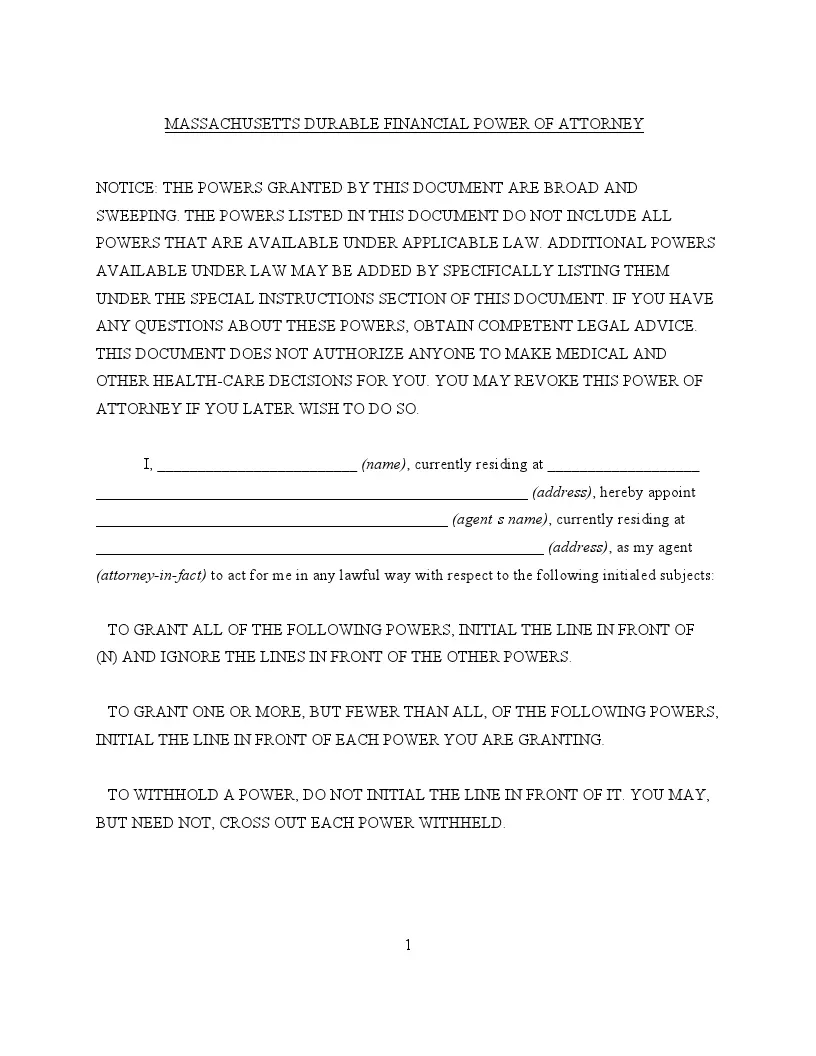
Page 1 opens with a notice explaining that the powers listed are broad and do not cover health care decisions. Below the notice, fill in your name and address as the principal and your agent’s name and address.

Initial one of three options. It can be effective immediately and continue even if you become incapacitated. It can become effective on a specific date you write in. Or it can be springing, meaning it only takes effect once you become incapacitated.

Read the categories listed in the Signing Requirements section above and initial each power you want to give your agent, or initial the last line to grant all of them at once.

The Massachusetts form includes four pre-printed special instructions. Read them; there is nothing to fill in unless you want to add instructions of your own:
You can add instructions of your own in the blank lines below these four paragraphs.

If you name more than one agent, this page lets you say whether they must act together or may each act on their own. It also lets you name a successor agent to serve if your first choice is unable or unwilling to act.
Sign and print your name at the bottom of page 4, and fill in the date you are signing.

Page 5 is an acknowledgment for a notary public or other authorized officer, who fills in the date, county, and their own signature to confirm your identity.

See our full list of Massachusetts power of attorney forms for other types, such as a general or medical power of attorney.

Use the button below to build your Massachusetts durable power of attorney online in a few minutes, or download the blank PDF form directly if you would rather fill it out by hand. Both versions cover the same requirements described above, and you can switch between them at any point before you sign.
These are two questions FormsPal hears most often about a Massachusetts durable power of attorney. Both answers are limited to what Massachusetts law actually says, so you can tell the difference between a real requirement and general practice.
Massachusetts sets a witness requirement in one specific situation: a parent or guardian’s temporary delegation of authority over a child. That delegation must be signed and attested by at least two witnesses who are 18 or older and are not the temporary agent.[6] That requirement applies to that kind of delegation, not to the durable power of attorney form on this page.
Massachusetts has no statute that sets a notarization or acknowledgment requirement for a durable power of attorney.
General information, not legal or tax advice.
Unless noted otherwise, the sources below are from the Mass. Gen. Laws ch. 190B.
