
A New Jersey durable power of attorney is a written legal document. It lets you, the principal, appoint an agent, also called an attorney-in-fact, to manage your finances, property, and business affairs. The word durable means the agent’s authority continues even if you later become incapacitated, instead of ending the moment you cannot make your own decisions.
Last Updated: September 2026. This guide is reviewed and updated regularly to reflect current New Jersey law. If you notice an error or outdated information, please contact us.
Build Your Document
Answer a few simple questions to make your document in minutes
Save and Print
Save progress and finish on any device, download and print anytime
Sign and Use
Your valid, lawyer-approved document is ready
Most people use this form to protect their finances in case they become unable to manage their own affairs due to a sudden illness, accident, or long hospital stay. You may name a professional agent or a family member you trust, and you can revoke the document at any time. It does not cover health care decisions, which New Jersey handles through a separate advance directive.
New Jersey power of attorney forms – learn more about powers of attorney for other assets in the State of New Jersey.
This form is also called a New Jersey general durable power of attorney, financial power of attorney, or NJ DPOA. They are the same document under different names. None of them let your agent make medical decisions for you, since New Jersey handles that through a separate health care directive.
A New Jersey power of attorney is valid once it meets three formalities under state law. It must be in writing and duly signed by the principal. A notary public must then acknowledge it, in the manner set forth in R.S. 46:14-2.1.[1.3]
The DPA form in New Jersey allows a principal to assign a lot of responsibilities to his or her attorney or agent. The list covers the majority of possible operations related to finances. It includes:
And plenty of other actions that one may delegate to another. You may either choose all or opt for a limited number of them.
The DPA form is a vital document that imposes a huge responsibility on the agent or attorney and protects your finances. So, do not rush to complete the form. Read all the statements carefully and think about whether you would like to hire an agent or choose an attorney among your family members or closest people.
| Document Name | New Jersey Durable Power of Attorney Form |
| Other Names | New Jersey Financial Durable Power of Attorney, NJ DPOA |
| Relevant Laws | N.J.S.A. 46:2B-8.2 to 46:2B-8.10[1] |
| Signing Requirements | Notary Public Acknowledgment |
| Avg. Time to Fill Out | 10 minutes |
| # of Fillable Fields | 37 |
| Available Formats | Adobe PDF |
Popular Local Durable POA Forms
Durable POA templates are some of the most commonly used ones within the US. The following are some of the more asked durable power of attorney documents.
Yes. Under New Jersey law, everything an attorney-in-fact does under a power of attorney remains valid. It binds the principal exactly as if the principal were competent, including any period when the principal is under a disability.[1.2] This protection lets your agent keep handling your affairs even if you lose capacity, but only once the document contains the durability wording the statute requires.
New Jersey does not make a power of attorney durable automatically. To keep it in effect through your incapacity, or to make it take effect only once you become incapacitated, the document must include wording like this:
A durable power of attorney is a power of attorney which contains the words "this power of attorney shall not be affected by subsequent disability or incapacity of the principal, or lapse of time," or "this power of attorney shall become effective upon the disability or incapacity of the principal," or similar words showing the intent of the principal that the authority conferred shall be exercisable notwithstanding the principal's subsequent disability or incapacity.
The first phrase keeps the power of attorney in force after incapacity. The second phrase creates a springing power of attorney that only takes effect once you become disabled or incapacitated. Either wording, or similar language showing the same intent, satisfies the statute.
New Jersey law recognizes three ways to revoke a power of attorney. You can physically destroy every signed original, deliver a written revocation to your attorney-in-fact, or sign and acknowledge a written revocation instrument.[1.4] Any of the three ends the agent's authority immediately.
Signing a new power of attorney does not cancel an old one by itself. Unless the new document expressly says it revokes earlier powers of attorney, both can remain valid at the same time.[1.4]
New Jersey does not publish its own mandatory form, so FormsPal’s builder generates a complete New Jersey power of attorney in the order below. Follow these eight steps to fill in, sign, and notarize the document correctly.
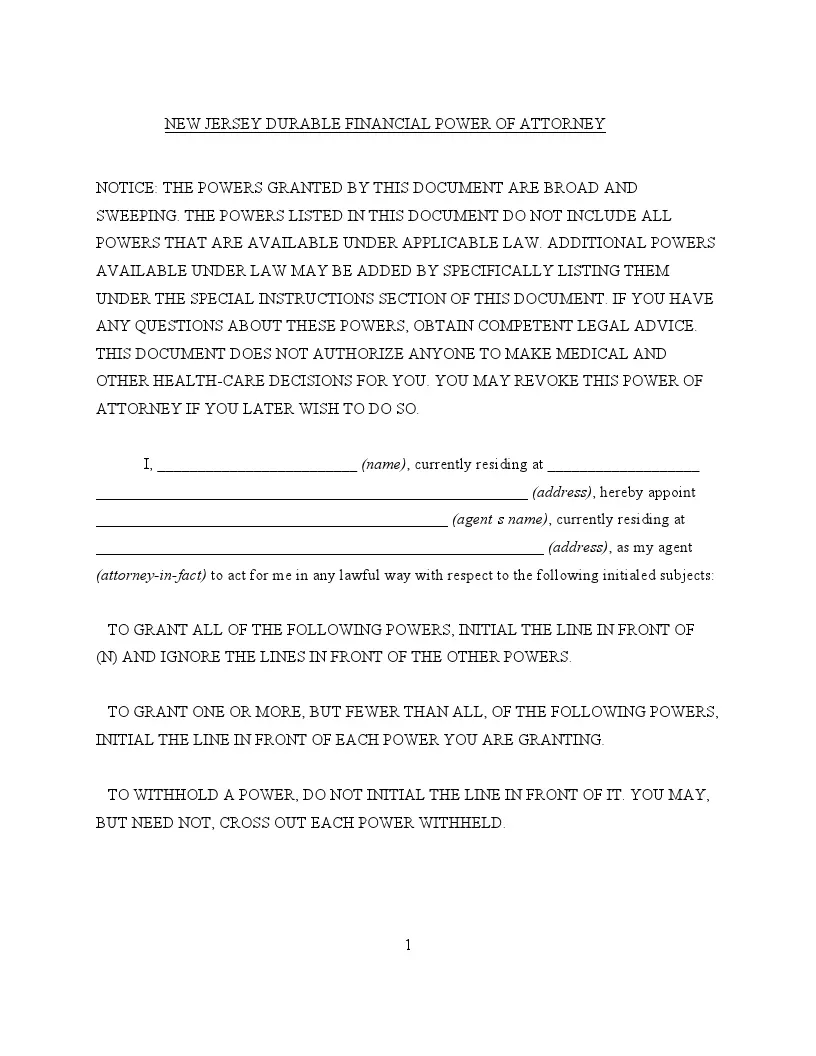
1. Read the Notice
Download the template, then read the notice at the top of page 1. It explains the scope of the powers you are about to grant before you fill in any information. If something stays unclear, ask your lawyer to ensure your understanding.
2. Enter Principal and Agent Information
Under the notice, the form has a paragraph where you, as a principal, should place your full name and address. Also, your attorney or agent’s full name and address are needed further.

3. Initial the Powers You’re Granting
Here, you will meet the list of all the responsibilities regarding financial matters that you can assign to your attorney or agent. In New Jersey, the full list in the DPA form includes:
The last option to choose is “all of the powers.” If you want to designate all of them, put your initials here. When opting for separate powers, place initials to every point of the list.

4. Review the Included Special Instructions
The form includes preprinted special instructions covering health information access, insurance claims, retirement accounts, and digital assets. These apply automatically, so there is nothing to fill in here.

5. Choose the Effective Date
Initial one of the three effective-date options on the form. Choose effective immediately, effective on a date you write in, or effective only if you become incapacitated (a springing power of attorney). See the section above on durability for what each choice means.
6. Name a Successor Agent
In New Jersey, you may add the name of your successor agent to the DPA form. A successor agent is a person that will act instead of your agent or attorney if one is unavailable or has died. A principal can add more than one approved successor agent in the document.

7. Sign and Date the Form
As principal, fill in the day, month, and year, then sign and print your name in the signature block.

8. Sign the Acknowledgment Before a Notary
Below your signature and date is a section for the notary public. Sign in front of the notary, who fills in the county and date and completes the certificate.


Download a free, fillable New Jersey power of attorney template below. The form is a PDF you can fill out on your computer, print, sign, and take to a notary for acknowledgment. Store the signed original with your other estate planning documents.
Yes. New Jersey law requires a power of attorney to be in writing, signed by the principal, and notarized under R.S. 46:14-2.1.[1.3] New Jersey does not recognize an oral power of attorney, only a written, signed, and notarized document meets the statute's requirements.
This page is general information about New Jersey durable power of attorneys, not legal advice. For advice on your situation, talk to a New Jersey attorney.
