
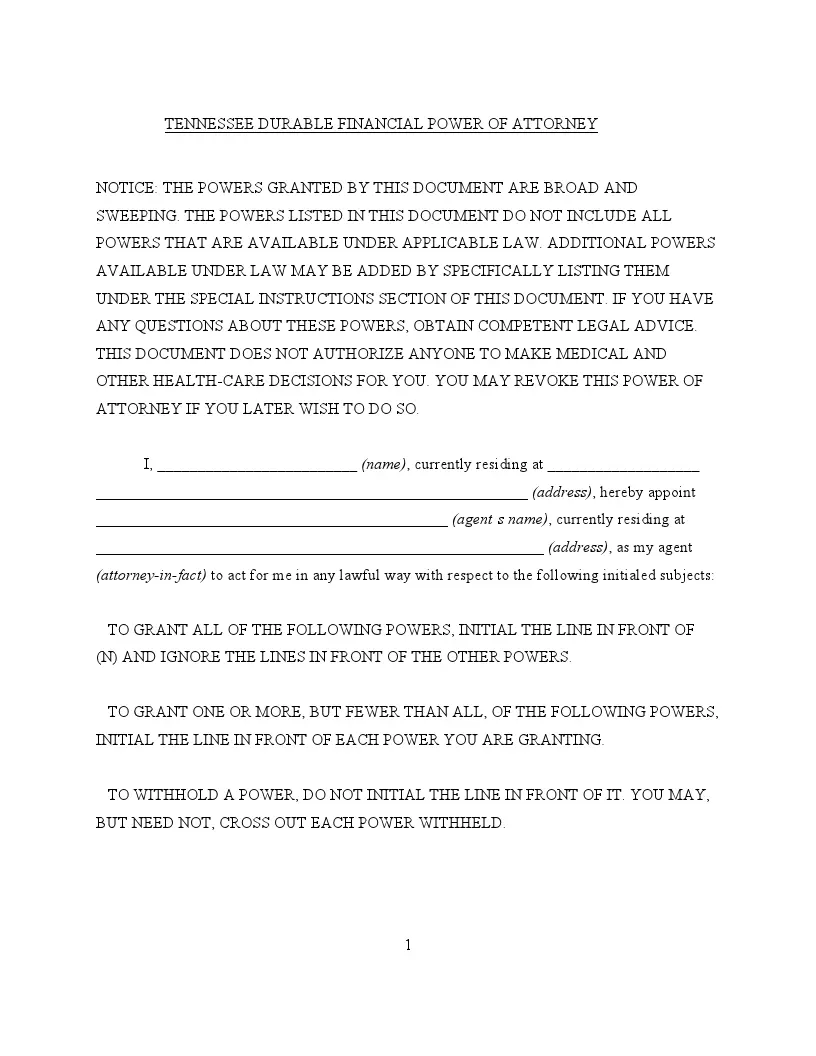
A Tennessee durable power of attorney, also called a TN power of attorney form, is a written document a principal signs to name an agent to handle financial matters. It stays in effect if the principal later becomes incapacitated because the document contains the wording Tennessee law requires.[1.1] It does not cover medical decisions, which need a separate health care power of attorney. Choose an agent you trust completely, since that person can get access to your bank accounts, real estate, and other financial transactions.
Last Updated: September 2026. This guide is reviewed and updated regularly to reflect current Tennessee law. If you notice an error or outdated information, please contact us.
Build Your Document
Answer a few simple questions to make your document in minutes
Save and Print
Save progress and finish on any device, download and print anytime
Sign and Use
Your valid, lawyer-approved document is ready
As an agent, choose someone who fully understands your finances and can be trusted with them, since the agent gets access to your bank accounts, property, and financial records. Creating one is recommended for every adult, regardless of health status, so decisions can still be made without court involvement if you are ever incapacitated. FormsPal's overview of the durable power of attorney explains the role in general terms, and the Tennessee power of attorney forms hub covers the other types available in the state.
Tennessee's rules for a durable power of attorney appear in Title 34, Chapter 6 of the Tennessee Code Annotated. A power of attorney becomes durable only if the document uses specific words from the statute, or similar words. Those words say it survives the principal's incapacity, or that it takes effect only once the principal is incapacitated.[1.1] This document is also known as a durable financial power of attorney. Reading the full chapter before signing is recommended.
According to Tennessee Code Annotated § 34-6-102, here are the key terms used on the form:[1.1]
Tennessee law spells out the exact wording a document needs to qualify as durable:
A durable power of attorney is a power of attorney by which a principal designates another as the principal's attorney in fact in writing and the writing contains the words "this power of attorney shall not be affected by subsequent disability or incapacity of the principal," or "this power of attorney shall become effective upon the disability or incapacity of the principal," or similar words showing the intent of the principal that the authority conferred shall be exercisable, notwithstanding the principal's subsequent disability or incapacity.
A document may take effect immediately when signed, or only once the principal becomes incapacitated, sometimes called a springing power of attorney.[1.1] The form used on this page lets you choose either option when you fill in the effective date section.
Because this form does not cover health care decisions, many Tennessee residents also complete a separate health care power of attorney so both financial and medical matters are covered. If you have a health care power of attorney and later revoke your agent's appointment, that agent's authority under the health care document ends at that point.[3]
If a court later appoints a conservator, guardian of the estate, or another fiduciary to manage some or all of the principal's property, the agent becomes accountable to that fiduciary. This is in addition to the agent's existing duty to the principal.[2]
The principal's death does not automatically cancel a power of attorney, durable or not. If an agent or another person acts in good faith under it without actual knowledge that the principal has died, that action still binds the principal's successors, unless the action would otherwise be invalid or unenforceable.[1.2]
Tennessee extends a similar protection to a power of attorney that is not durable. If the principal becomes incapacitated and an agent or another person acts in good faith under the document without actual knowledge of that incapacity, the action still binds the principal and successors. This holds unless the action would otherwise be invalid or unenforceable.[1.2]
Tennessee has no statute that sets signing formalities, such as requiring witnesses, for this form, and no statute that requires notarization. The form itself includes a section for a notary to complete, and having it notarized can make the document easier to use with banks and other institutions.
Keep the original signed document in a place the agent can reach easily but that stays secure.
| Document Name | Tennessee Durable Power of Attorney Form |
| Other Names | Tennessee Financial Durable Power of Attorney, TN DPOA |
| Relevant Laws | Tennessee Code Annotated §§ 34-6-102, 34-6-104, 34-6-105 |
| Signing Requirements | N/A |
| Avg. Time to Fill Out | 10 minutes |
| # of Fillable Fields | 37 |
| Available Formats | Adobe PDF |
Popular Local Durable POA Forms
DPOA documents are used in each and every state. Check out several other printable Durable POA forms regularly filled out by Americans.
Complete a Tennessee durable financial power of attorney by naming your agent, initialing the powers you want to grant, choosing when the document takes effect, and signing it in front of a notary. Follow the seven steps below in the order the form presents them.


Get this TN power of attorney form as a free, print ready Adobe PDF you can fill out by hand, or build it online step by step and download a completed copy in minutes using FormsPal's online form builder below.
Yes. Tennessee law defines a durable power of attorney as a document by which a principal names an agent in writing, and the writing must contain the specific wording, or similar wording, needed to make it durable.[1.1] A power of attorney that is only spoken is not valid under this statute.
A Tennessee durable power of attorney must be in writing and signed by the principal. It must also include the statute's required wording, or similar wording, stating that it survives the principal's incapacity or takes effect only once the principal is incapacitated.[1.1]
No specific statute in Tennessee requires a witness or notarization for this form. Many Tennessee principals still have it notarized, since banks and title companies often expect to see a notary's acknowledgment before they will accept the document.

General information, not legal or tax advice.
Unless noted otherwise, the sources below are from the Tenn. Code Ann..
