
Updated:
A Georgia durable POA is a written appointment of a financial agent. Under O.C.G.A. § 10-6B-4, the document is durable unless it expressly provides that the principal’s incapacity ends it. Adults planning for incapacity use it; this guide covers signing rules and each form step.
Key facts

Build Your Document
Answer a few simple questions to make your document in minutes
Save and Print
Save progress and finish on any device, download and print anytime
Sign and Use
Your valid, lawyer-approved document is ready
A Georgia durable power of attorney is a financial power of attorney that keeps working if the principal becomes incapacitated, so the agent can still pay bills and manage accounts when the principal no longer can. The principal is the person who signs it; the agent, also called the attorney-in-fact, is the person who acts under it.
The document covers property and money. The FormsPal form lists thirteen kinds of transactions, from real property to tax matters, plus a fourteenth line that grants all of them at once. For a general overview of the document type outside Georgia, see the durable power of attorney form guide.
Looking for a different document? See all Georgia power of attorney forms on FormsPal.
A durable power of attorney stays in force after the principal loses capacity, and a non-durable one ends at that point. In Georgia, a power of attorney created under the Uniform Power of Attorney Act is durable unless it expressly provides that the principal’s incapacity terminates it (O.C.G.A. § 10-6B-4). The FormsPal form contains no such clause, so it is a durable form.
The durable financial power of attorney handles money, and the Georgia advance directive for health care handles medical choices. The two documents follow different signing rules. An advance directive for health care is attested by two witnesses who are of sound mind and at least 18 years of age, and they need not be present together when the declarant signs (O.C.G.A. § 31-32-5(c)(1)). For medical decisions, use a Medical Power Of Attorney form instead.
The agent named in the document gets access to the principal’s bank accounts and financial papers, so the choice of person matters more than any other entry on the form. Pick someone who handles money carefully, lives close enough to act, and is willing to keep records of what they do.
A person named as an agent cannot be either of the two attesters at signing: the competent witness and the second attesting individual both may not be named as an agent in the power of attorney (O.C.G.A. § 10-6B-5(a)(2) and (a)(3)). Plan for a competent witness and for a second attester who can attest under Code Section 44-2-15, as O.C.G.A. § 10-6B-5(a)(3) directs; read that section before choosing the second attester.
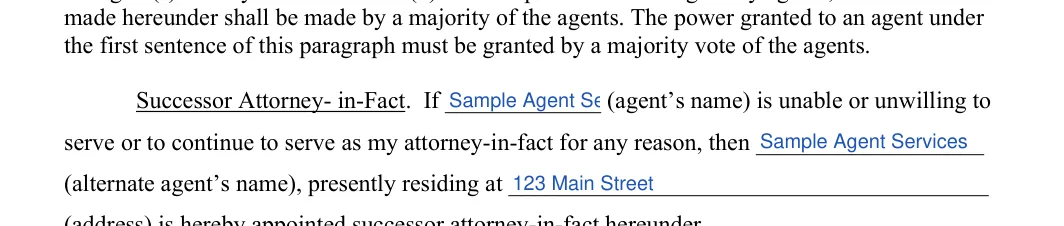
The successor attorney-in-fact section on page 4 names an alternate agent who steps in if the first agent is unable or unwilling to serve. The backup matters because an agent’s authority ends when the agent resigns, becomes incapacitated, or dies (O.C.G.A. § 10-6B-10(b)(1)).
Tip. Have your agent’s full name and address ready before you start, along with an alternate agent’s details if you want to name one. They go on pages 1 and 4 of the template.
A Georgia power of attorney needs the principal’s signature and two separate attestations, all made in the principal’s presence, under O.C.G.A. § 10-6B-5(a)(1) to (a)(3). The table below shows who does each part.
| Part of the signing | Who does it, and on what condition | Source |
|---|---|---|
| Signature | The principal, or another individual signing in the principal’s presence only at the principal’s express direction | O.C.G.A. § 10-6B-5(a)(1) |
| First attestation | A competent witness, in the principal’s presence, only if not also named as an agent | O.C.G.A. § 10-6B-5(a)(2) |
| Second attestation | An individual attesting as set forth in Code Section 44-2-15, in the principal’s presence, only if not the first witness and not named as an agent | O.C.G.A. § 10-6B-5(a)(3) |
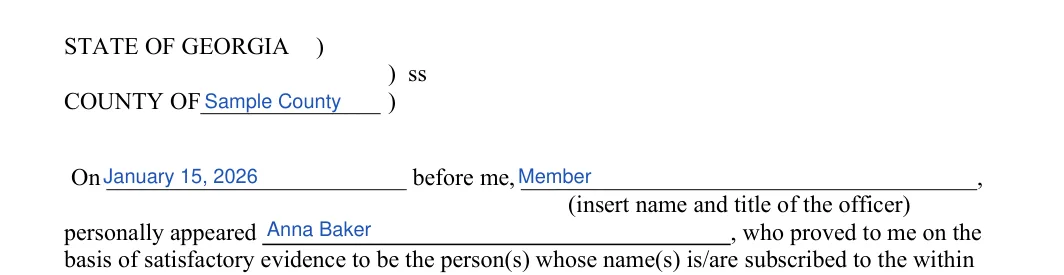
The form’s page 5 holds a notary acknowledgment with lines for the county, the date and the officer. The certificate is worded as an acknowledgment, while O.C.G.A. § 10-6B-5(a)(3) asks for an attestation made as set forth in Code Section 44-2-15; check that section before choosing the second attester. The form prints no line for the competent witness.
Keep the signed original in a safe place that the principal and the agent can both reach, and give the agent a copy.
The details below describe the FormsPal form; the signing row follows O.C.G.A. § 10-6B-5(a)(1) to (a)(3).
| Document Name | Georgia Durable Power of Attorney Form |
| Other Names | Georgia Financial Durable Power of Attorney, GA DPOA |
| Relevant Laws | Georgia Uniform Power of Attorney Act, O.C.G.A. § 10-6B-4, § 10-6B-5, § 10-6B-9 and § 10-6B-10 |
| Signing Requirements | Principal’s signature, one competent witness and a second attesting individual (O.C.G.A. § 10-6B-5(a)(1) to (a)(3)) |
| Avg. Time to Fill Out | 10 minutes |
| # of Fillable Fields | 37 |
| Available Formats | Adobe PDF |
Popular Local Durable POA Forms
POA templates are some of the most commonly downloaded ones in the United States. Listed below are some of the more asked durable power of attorney documents.
A Georgia power of attorney takes effect when executed, unless the principal provides in it that it becomes effective at a future date or upon a future event or contingency (O.C.G.A. § 10-6B-9(a)). The form offers three choices, and the principal initials one:
The form grants only the powers the principal initials, listed from (A) to (N) on page 2. The principal does not have to grant every power for the form to work.
Special instructions 1 to 4 on pages 2 and 3 are printed text. The principal reads them and adds any limits or extra directions where the form allows.
The Georgia DPOA form runs five pages, and each page has its own job. This overview shows what each page holds before you start filling in the fields.
The form asks for names, addresses and a few decisions, so gather these before you begin:
The form is filled in page by page in nine steps, from naming the agent on page 1 through the witness’s attestation to the notary section on page 5.
The screenshots under each step show the FormsPal Georgia Durable Power of Attorney template filled with sample entries in blue, so you can see where each answer goes. The names, addresses, dates and amounts are examples only.
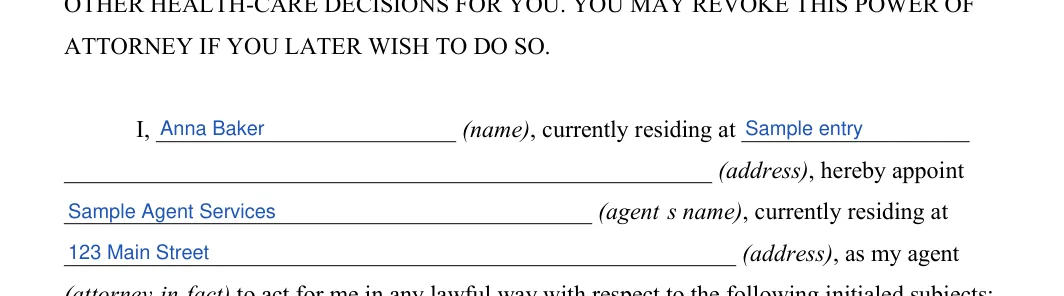
Appointment: principal and agent
Read the notice at the top of page 1, then enter your name and address, and your agent’s name and address, in the appointment paragraph. The notice says the document does not cover medical or other health-care decisions.
Read the rest of page 1, which explains what the agent may do. Ask a lawyer about anything that is unclear before you sign.


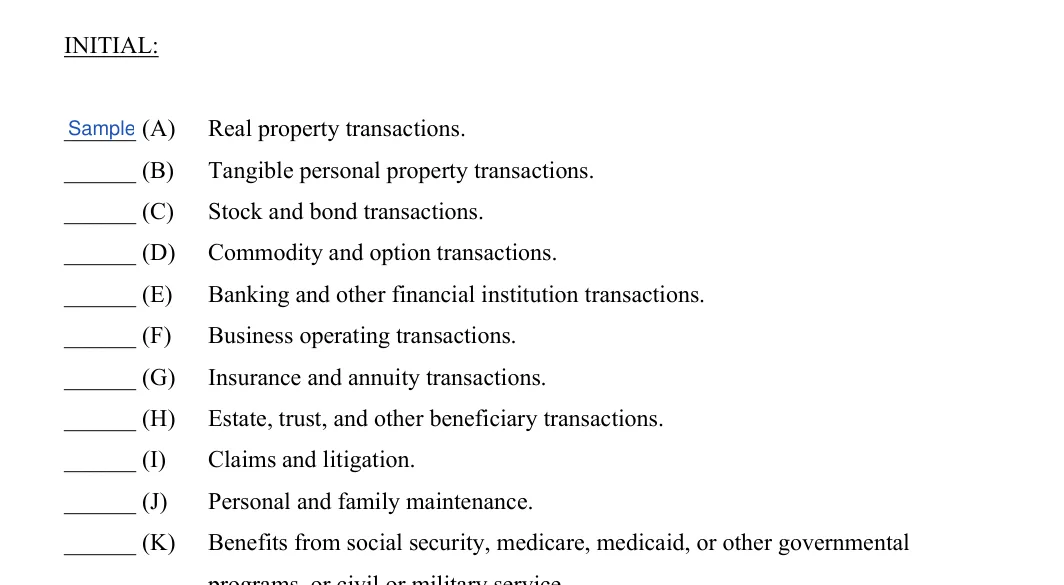
Powers (A) to (K), initial lines
Initial the line in front of each power you are granting, from (A) real property transactions through (K) benefits from social security, medicare, medicaid or other governmental programs. Leave a line blank to withhold that power.

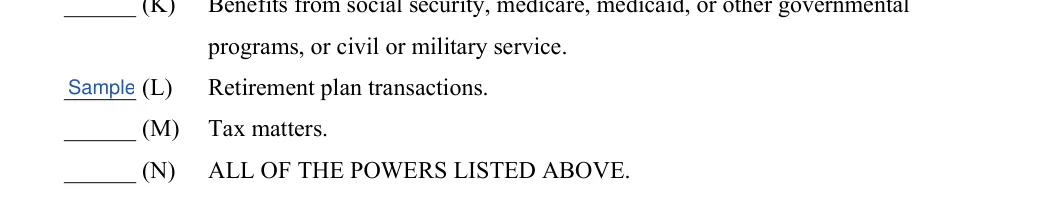
Powers (L), (M) and (N)
Initial (L) retirement plan transactions and (M) tax matters if you want them granted, or initial (N) to grant all powers. Special instructions 1 to 4 on pages 2 and 3 are printed text with no fields to fill in, so you only read them.
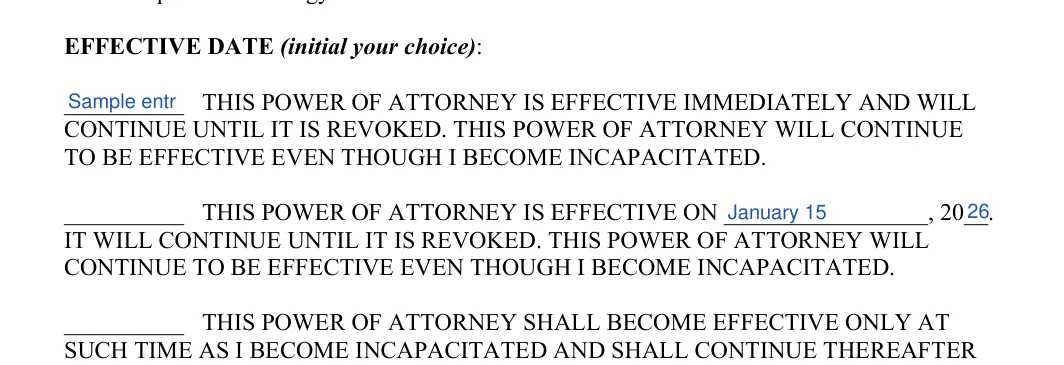
Effective date, initial your choice
Initial one of the three choices: effective immediately, effective on a date you write in the blank, or effective only when you become incapacitated. The definition of incapacitated follows on pages 3 and 4.
Successor attorney-in-fact
Write the name of the agent and the name and address of an alternate agent, who steps in if the first agent is unable or unwilling to serve.
Date and sign
Enter the day, month and year on the “Signed this” line, sign above the signature line and print your name below it.


Witness attestation
Have the competent witness, who is not named as an agent, sign while the principal is present (O.C.G.A. § 10-6B-5(a)(2)). The form prints no witness line, so have the witness write the word “Witness”, then sign and print a name below the principal’s signature.
Acknowledgment: county, date and officer
Page 5 holds the notary acknowledgment, with lines for the county, the date, the officer’s name and title, and the name of the person who appeared.

Notary signature and seal
The notary signs on the Signature line at the foot of page 5 and adds the seal.


Other Durable POA Forms by State
The signing session needs the principal and two attesters in one room, because the principal signs and both attestations happen in the principal’s presence (O.C.G.A. § 10-6B-5(a)(1) to (a)(3)). Follow these steps:
A Georgia durable POA ends at the principal’s death, at revocation, or when its purpose is accomplished, under O.C.G.A. § 10-6B-10(a)(1), (a)(3) and (a)(6). The agent’s own authority ends earlier in a few cases:
A principal who revokes the power of attorney ends it (O.C.G.A. § 10-6B-10(a)(3)). Tell the agent and every bank or office holding a copy: a termination does not bind an agent or another person who acts in good faith without actual knowledge of it (O.C.G.A. § 10-6B-10(d)).
Most errors on the form come from the initial lines and the signing session. A check before signing saves filling in a new copy.
The Georgia DPOA form comes as an Adobe PDF that can be filled in on screen or printed and completed by hand in dark ink.
O.C.G.A. § 10-6B-5(a)(3) asks for a second attestation, made as set forth in Code Section 44-2-15 in the principal’s presence, by a person who is not the witness and is not named as an agent. A competent witness attests as well (O.C.G.A. § 10-6B-5(a)(2)). Read Code Section 44-2-15 to see who may make the second attestation, and have that person attest while the principal is present.
The agent may handle real estate only if the principal initials power (A), real property transactions, or power (N), all powers. A blank line on (A) withholds that power.
Another individual may sign the power of attorney only in the principal’s presence and at the principal’s express direction (O.C.G.A. § 10-6B-5(a)(1)). The two attestations still take place in the principal’s presence.
A spouse can be named as the agent. The spouse’s authority ends when an action is filed for dissolution or annulment of the marriage or for legal separation, unless the power of attorney otherwise provides (O.C.G.A. § 10-6B-10(b)(3)).
No. The notice on page 1 of the template says the document does not cover medical or other health-care decisions.
The principal is the person who names the agent. The agent is the person chosen to handle financial matters on the principal’s behalf.
General information, not legal or tax advice.
