
A Minnesota durable power of attorney is a written document under Minn. Stat. § 523.01. It lets a competent adult, the principal, name someone else, the agent or attorney-in-fact, to handle financial matters on the principal's behalf.[1] Unlike a regular power of attorney, this durable version keeps working if the principal later becomes incapacitated. It must say so in the statute’s wording, or similar words, to qualify.[2]
Last Updated: September 2026. This guide is reviewed and updated regularly to reflect current Minnesota law. If you notice an error or outdated information, please contact us.
Build Your Document
Answer a few simple questions to make your document in minutes
Save and Print
Save progress and finish on any device, download and print anytime
Sign and Use
Your valid, lawyer-approved document is ready
The principal decides how much authority to give the agent. The agent can handle anything from one task to full control over real estate, banking, business dealings, and tax matters. Because the role carries real responsibility, choose an agent you trust, and name a backup in case the first agent cannot serve.
This document covers financial and property matters only. It does not let the agent make health care decisions. Minnesota residents use a separate Minnesota POA form for that.
State law sets specific formation and durability rules for a power of attorney under Chapter 523 of the Minnesota Statutes. The Office of the Revisor of Statutes publishes this chapter. A written power of attorney must be dated and signed by a competent adult principal, or signed on the principal's behalf. It must also be acknowledged by a notary public to be validly executed.[1] The points below cover durability, common statutory rules, and how revocation works.
This power of attorney shall not be affected by incapacity or incompetence of the principal.
This document only covers financial and property decisions. For medical and health care choices, Minnesota residents typically use a separate health care directive to handle those instead of this form.
A Minnesota durable power of attorney must be acknowledged before a notary public, and witnesses are not a substitute (Minn. Stat. § 523.01). Witnesses are an option only for a health care directive under Chapter 145C, not for this financial form.[1]
State law also controls how the document ends. If it is not durable, it terminates automatically once the principal becomes incapacitated, on top of the usual endpoints below.[3] A durable version can be revoked in writing, and the revocation only binds someone once that person actually knows about it.[4]
For more information, see the table below.
| Document Name | Minnesota Durable Power of Attorney Form |
| Other Names | Minnesota Financial Durable Power of Attorney, MN DPOA |
| Relevant Laws | Minnesota Statutes, Chapter 523 |
| Signing Requirements | Notary Public |
| Avg. Time to Fill Out | 10 minutes |
| # of Fillable Fields | 37 |
| Available Formats | Adobe PDF |
Popular Local Durable POA Forms
Durable POA documents are used in each and every state. Take a look at other popular DPOA forms frequently filled out by Americans.
Complete the Minnesota durable power of attorney form in the order below. Each step matches a numbered part of the document, from naming your agent on page 1 through signing before a notary on page 5.
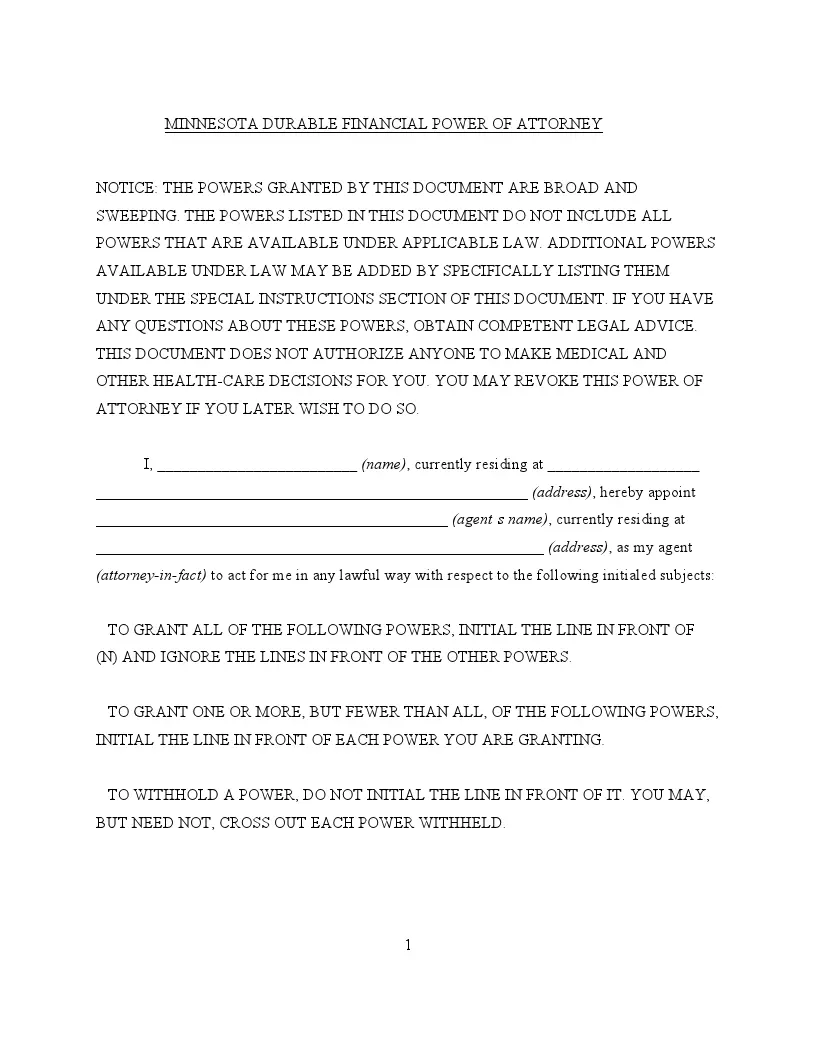
Enter your full name and address as the principal, then your agent's (attorney-in-fact's) full name and address, in the appointment paragraph on page 1.
On page 2, initial the line next to each power you want your agent, or attorney-in-fact, to have. Initial line (N) instead if you want to grant all of them.
The form itself warns that this list does not cover every power the law allows. Get legal advice from a lawyer if you want to add an unlisted power, or are unsure which ones to choose.
Pages 2 and 3 add specific instructions many principals want spelled out in the document itself, instead of leaving them implied. These include the following.
On page 3, initial one of three effective-date options: effective immediately, effective on a future date you choose, or effective only once you become incapacitated. Whichever you pick, the form keeps working after incapacity, which is what makes it "durable" under Minnesota law.[2] The form defines "incapacitated" as a court ruling of incompetence, a court-appointed conservator or guardian, or written certification from two physicians who are not related to you or to each other.
If you name more than one agent, or attorney-in-fact, page 4 explains how they share authority. Any one agent's action can bind you, but decisions the agents make together require a majority vote.
Page 4 also lets you name a backup, sometimes called the successor attorney in fact. This backup takes over if your first choice becomes unable or unwilling to serve.
Sign and date the document on page 4 in front of a notary public. The form also states that a revocation is not effective against someone who relies on a copy of the document before learning it was revoked, matching Minnesota law.[4] Signing this document also revokes any prior general power of attorney you executed. The form has you agree to protect any third party from claims that come from relying on it in good faith.
On page 5, the notary completes the acknowledgment certificate. This step verifies your identity only, not the truthfulness of the document's contents.

Download the Minnesota durable power of attorney form below as a ready-to-use PDF and complete it by hand. Or use FormsPal's guided document builder to answer a few questions and download a version that already matches your answers.
General information, not legal or tax advice.
Unless noted otherwise, the sources below are from the Minn. Stat.
