
The Nebraska durable power of attorney is a formal document. It lets a person designate someone else to oversee their financial matters, property, and other assets, and make decisions for them. The term “durable” indicates that the agent’s power persists even if the principal is incapacitated or loses the ability to make decisions.
Last Updated: September 2026. This guide is reviewed and updated regularly to reflect current Nebraska law. If you notice an error or outdated information, please contact us.
Build Your Document
Answer a few simple questions to make your document in minutes
Save and Print
Save progress and finish on any device, download and print anytime
Sign and Use
Your valid, lawyer-approved document is ready
In Nebraska, like in many other states, the document must say the granted powers are durable. This keeps them effective during the principal’s incapacity. The agent can continue to act on the principal’s behalf without interruption. This holds true even when the principal can no longer express their wishes due to a physical or mental condition.
Creating a durable POA form requires that the principal be mentally capable when signing the document. The scope of authority given to the agent can vary widely or be specifically tailored based on what the principal desires and requires. This authority could cover a range of responsibilities, such as managing financial transactions, overseeing real estate properties, and handling government benefits, among other duties.
This document does not cover health care decisions. For medical decisions, use FormsPal’s Nebraska power of attorney form instead.
Nebraska law requires the principal to sign the durable power of attorney, or to have it marked in a manner consistent with Section 64-105.02. It may also be signed by another person at the principal’s direction and in the principal’s conscious presence. The signature or mark must then be acknowledged before a notary public or another individual authorized by law to take acknowledgments.[2]
Nebraska law also provides an optional statutory form power of attorney under Neb. Rev. Stat. § 30-4041, though using FormsPal’s template does not require following that specific format.[4]
A power of attorney generally becomes effective immediately once it is properly signed and acknowledged. It can also state a future date or a triggering event instead. When the principal’s incapacity is the triggering event and no one is named to assess it, the power of attorney relies on outside proof of incapacity. That proof can be a written evaluation from a physician or psychologist, or a judicial determination.
Terminating a power of attorney or an agent’s authority is governed by Nebraska Revised Statute 30-4010. The document ends with the following:[3]
Similarly, an agent’s authority ceases upon the principal’s revocation, the agent’s death or incapacity, resignation, or significant changes in marital status unless otherwise stated in the power of attorney.[3]
A power of attorney can also end on its own. This happens if the agent’s authority over your property is revoked, or the agent dies, becomes incapacitated, or resigns, and no other agent is named to act. If a dispute arises over any of this, a Nebraska court may be asked to interpret the power of attorney.[3]
Termination does not take effect right away for everyone. An agent or another person who acts in good faith, without actual knowledge of the termination, is still protected. The same protection applies to incapacity. If the power of attorney is not durable, a person who acts in good faith and has no actual knowledge of the principal’s incapacity is not affected by it.[3]
Creating a new power of attorney does not cancel an old one automatically. Under the Nebraska Uniform Power of Attorney Act, signing a new power of attorney does not cancel an earlier one by itself. It only revokes the earlier one if the new document says so, either by name or by revoking all prior powers of attorney.[3]
| Document Name | Nebraska Durable Power of Attorney Form |
| Other Names | Nebraska Financial Durable Power of Attorney, NE DPOA |
| Relevant Laws | Nebraska Revised Statutes, Section 30-4005 |
| Signing Requirements | Notary Public |
| Avg. Time to Fill Out | 10 minutes |
| # of Fillable Fields | 37 |
| Available Formats | Adobe PDF |
Popular Local Durable POA Forms
Durable POA documents are used in each and every state. Take a look at other popular DPOA forms frequently filled out by Americans.
Complete FormsPal’s Nebraska durable power of attorney form section by section, in the order below. This helps the finished document reflect your intentions and meet the signing and notarization rules described above. Each step matches a specific page of the fillable PDF, from naming your agent through the final notarization.
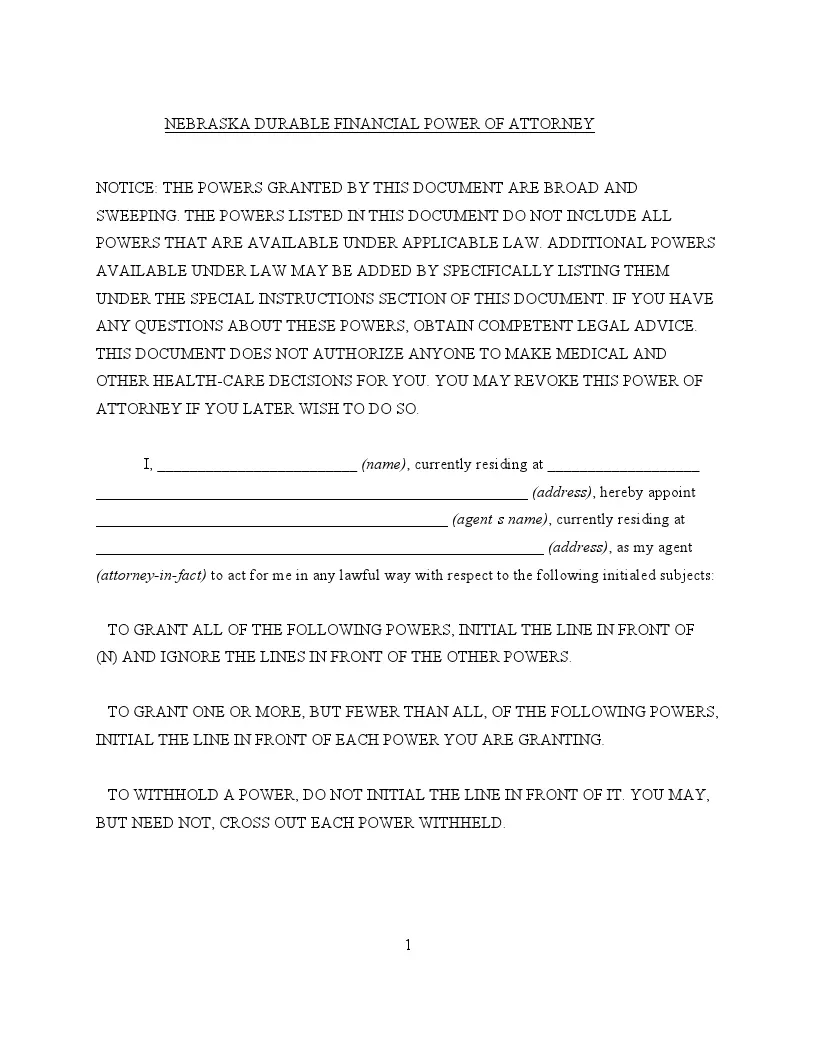
On page 1, enter your full name and address as the principal, then the name and address of the person you are appointing as your agent (also called your attorney-in-fact). Many principals name a family member, though any competent adult can serve. Choose someone you trust, since this section grants that person authority to act for you.
Pages 1 and 2 list the subjects your agent can act on, from your bank accounts to your real property and its title. Initial the line next to each power you want to grant, or initial line (N) to grant all of them at once:
You do not need to initial any other line if you initial line (N) for all preceding powers. Your agent’s actions under any granted power are treated as if you performed them yourself, and must be exercised for your benefit. This authority over your property and finances takes effect as soon as you initial a subject, unless you choose a later effective date in the next step.
FormsPal’s form already includes preset special instructions covering HIPAA medical-record access for financial matters, insurance claim handling, retirement account access, and control of digital assets. These instructions can also cover any interest you hold in jointly owned property. You can change or remove any of these preset instructions before signing. Read pages 2 and 3 to see exactly what authority these instructions grant your agent.
On page 3, initial one of three options for when the power of attorney takes effect: immediately, on a specific future date, or only once you become incapacitated. The form defines incapacity as a court adjudication, the appointment of a conservator or guardian, or written certification from two independent physicians. A Nebraska court can rely on any of these to confirm the triggering event.
Page 4 lets you name a successor agent who takes over if your first agent is unable or unwilling to serve, and the same authority then passes to that successor. This role is often filled by the same family member or trusted contact named in your broader estate plan. If you appointed more than one agent to act together, this page also explains how those co-agents make decisions. You can change your successor agent at any time by creating a new power of attorney.
Sign and date the form on page 4 in front of a notary public. Signing confirms your agent’s authority over the property and other subjects you initialed above. It also revokes any prior general power of attorney you executed, unless you state otherwise, and confirms that third parties can rely on the document until they have actual knowledge it has been revoked.
The notary completes the acknowledgment on page 5, verifying your identity and confirming that you signed the document, not reviewing your personal financial information or decisions. This step is what makes the power of attorney valid under the Nebraska Uniform Power of Attorney Act.[2]

This Nebraska power of attorney form lets you appoint someone to manage your financial affairs if you become unable to do so yourself. Use the button below to build a personalized version online, section by section, or download the fillable PDF template directly and complete it on your own.
This page is general information about Nebraska durable power of attorneys, not legal advice. For advice on your situation, talk to a Nebraska attorney.
Unless noted otherwise, each source below is from the Neb. Rev. Stat. Follow the link for the original source text.
