
The Alabama durable power of attorney is a legal document that allows an individual, known as the principal, to appoint another person, called the agent or attorney-in-fact, to manage their financial affairs. This arrangement remains effective even if the principal becomes incapacitated or unable to make decisions independently.
Last Updated: September 2026. This guide is reviewed and updated regularly to reflect current Alabama law. If you notice an error or outdated information, please contact us.
Build Your Document
Answer a few simple questions to make your document in minutes
Save and Print
Save progress and finish on any device, download and print anytime
Sign and Use
Your valid, lawyer-approved document is ready
The scope of authority granted under a durable power of attorney for finances can be broad or specific, depending on the principal’s preferences. It typically includes powers to handle banking, real estate transactions, tax matters, and investment decisions. The principal can specify whether the powers become effective immediately or only upon the occurrence of a future event, typically the principal’s incapacity as certified by a medical professional.
This document does not allow an agent to make medical decisions. Consider other Alabama POA forms for end-of-life care.
Alabama's Uniform Power of Attorney Act sets the rules for signing, starting, and ending a durable power of attorney. The document is durable unless it says otherwise, so it stays in effect if the principal becomes incapacitated.[1] It must be signed by the principal, or by someone the principal directs to sign in the principal's conscious presence.[2] It takes effect as soon as it is signed unless the document names a later date or event.[3]
Notarization works differently than many people expect. Alabama’s statute does not list it as a condition for the document to be valid, and it does not require witnesses for a financial power of attorney (Section 26-1A-105). Instead, acknowledging the signature before a notary public or another individual authorized by law to take acknowledgments creates a legal presumption that the signature is genuine, which is why most people still have the document notarized.[2]
Tip: If you want your agent to act only after you become unable to make decisions, initial the "effective upon incapacity" option in the Effective Date section below. Ask your physician in advance how they document incapacity, since your agent may need that proof before a bank will honor the document.
A durable power of attorney does not last forever. Under Alabama law, it ends when any of the following happens:[4]
If the agent acts in good faith without actual knowledge of the termination, that act still binds the principal and the principal's successors in interest, unless the act is otherwise invalid or unenforceable. Unless the document says otherwise, the agent's authority stays exercisable despite any lapse of time since the power of attorney was signed, until one of the events above ends it.[4]
This is different from a power of attorney that is not durable. If it is not durable, the principal's incapacity alone does not revoke or terminate it as to an agent who, without actual knowledge of the incapacity, is still acting in good faith under it.[4]
| Document Name | Alabama Durable Power of Attorney Form |
| Other Names | Alabama Financial Durable Power of Attorney, AL DPOA |
| Relevant Laws | Alabama Code, Section 26-1A-105 |
| Signing Requirements | Acknowledgment before a notary public (creates a presumption of a genuine signature, not required for validity) |
| Avg. Time to Fill Out | 10 minutes |
| # of Fillable Fields | 37 |
| Available Formats | Adobe PDF |
Popular Local Durable POA Forms
Durable POA documents are used in each and every state. Take a look at other popular DPOA forms frequently filled out by Americans.
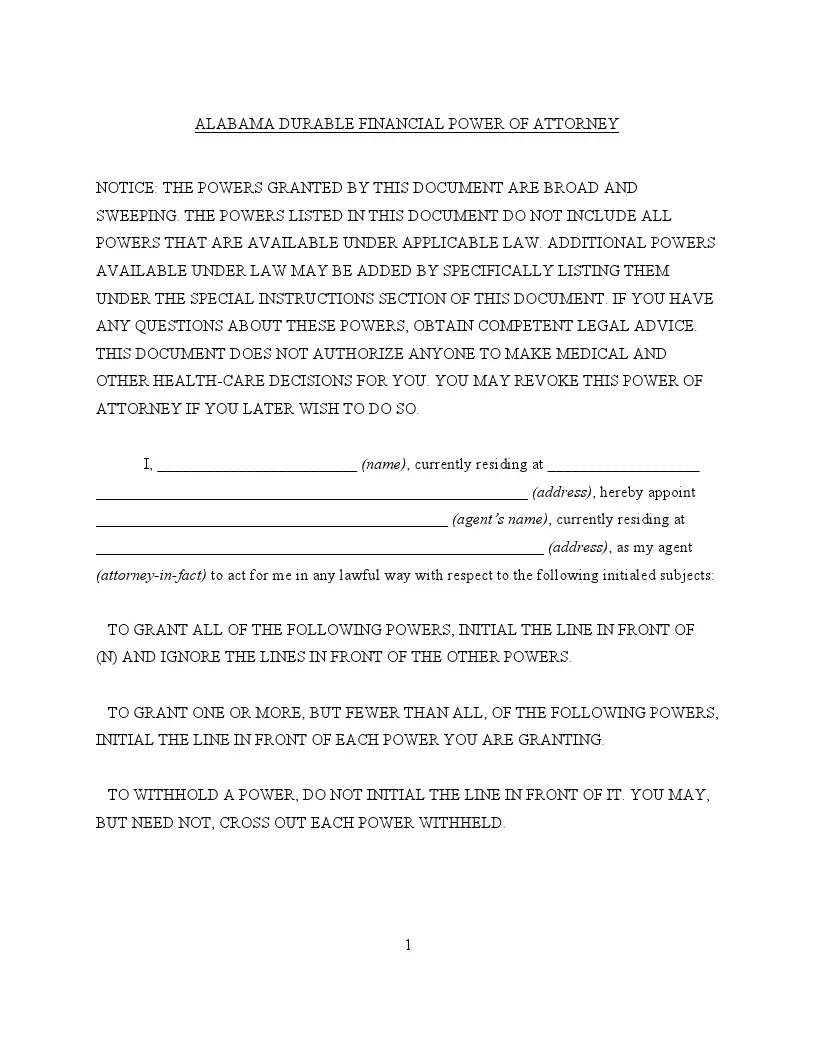
Filling out the Alabama durable power of attorney gives your agent the legal authority to manage your finances. Follow these eight steps in order, from naming your agent to completing the notary acknowledgment, to make sure the form meets Alabama's requirements.
First, fill in your name and address as the principal. Then, enter the name and address of the person you appoint as your agent to act on your behalf.
You have the option to grant broad or specific powers to your agent:
In the “Special Instructions” section, you can specify any additional powers or limitations. For example, you might include specific instructions regarding digital assets or medical reimbursements. Be clear and precise in your instructions to avoid any misunderstandings.
You must indicate when the power of attorney becomes effective by initialing one of the choices on the form. Choose whichever option is suitable for your situation:
If you name more than one agent, the form lets you state whether they must act together on every decision or may each act independently. This choice affects how much control each agent has and how your finances are managed day to day, and it controls what a financial institution will expect to see before honoring an instruction from just one of your agents.
You may name a successor agent to serve if your primary agent is unable or unwilling to act. Choose a trusted family member or friend, and enter that person's name and address in the section provided.
Sign and date the document. The principal's signature is presumed genuine when acknowledged before a notary public or another person authorized to take acknowledgments, so most people sign in the notary’s presence.[2] There are two main reasons most people take this extra step: it is faster for banks and other institutions to process, and it helps avoid challenges to the signature later.
If you use the acknowledgment section, a notary public completes it, verifying your identity and that you are making the decision voluntarily and with understanding.
Make sure that all sections are completed accurately. Make copies of the signed document and provide them to your agent, any successor agent, and relevant financial institutions. Keep the original document safe so that it can be easily accessed if needed.

This Alabama durable power of attorney form is available as a free PDF download. It covers every section described above, from principal and agent information through the notary acknowledgment. Print it and fill it out by hand, or use the online builder below to complete, sign, and download the document in a few minutes.
A durable power of attorney in Alabama is one that stays in effect even after the principal becomes incapacitated. Under the Alabama Uniform Power of Attorney Act, a power of attorney is durable unless it expressly says it ends when the principal becomes incapacitated.[1] That single word, durable, is what lets an agent keep managing the principal’s finances if the principal is later unable to make decisions, without a court having to step in and appoint a guardian.
This is different from a general, non-durable power of attorney, which otherwise ends once the principal loses capacity, except as to an agent who keeps acting in good faith without knowing about it.[4]
A durable power of attorney in Alabama has no fixed expiration date. It stays in effect until the principal revokes it, the principal dies, its purpose is accomplished, or another terminating event under Alabama law occurs.[4] A parent or guardian delegating authority over a minor child is a different, narrower situation with its own duration rule. See the next section below.
Alabama's power of attorney statute ties notarization to a legal presumption, not to a validity requirement. It says the signature is presumed genuine if the principal acknowledges it before a notary public or another individual authorized by law to take acknowledgments.[2] In practice, most people still have the document notarized, since banks, title companies, and other institutions are more willing to accept a document with that presumption attached.
For this durable power of attorney, the signing requirement Alabama's power of attorney statute sets is the principal's own signature, or a signature by someone the principal directs to sign in the principal's conscious presence.[2] The principal might also sign a separate document, such as an advance directive for health care. That document has its own witness rules under a different section of Alabama law, so check the requirements for that specific document rather than assuming they carry over from this one.
A parent or guardian can use a properly executed power of attorney to delegate certain powers over a minor child's health, support, education, or property to another person, for a period not exceeding one year.[5] This is a separate, narrower authority than the durable power of attorney on this page, which an adult principal signs for their own affairs and which has no one-year limit under Alabama law.[1]
General information, not legal or tax advice.
Unless noted otherwise, the sources below are from the Ala. Code.
