
The Maine durable power of attorney is a legal form that allows an individual (the principal) to designate another person (the agent or attorney-in-fact) to manage their financial affairs. This document remains effective even if they become incapacitated, distinguishing it from a non-durable power of attorney.
Last Updated: September 2026. This guide is reviewed and updated regularly to reflect current Maine law. If you notice an error or outdated information, please contact us.
Build Your Document
Answer a few simple questions to make your document in minutes
Save and Print
Save progress and finish on any device, download and print anytime
Sign and Use
Your valid, lawyer-approved document is ready
The scope of authority granted to the agent can be broad or specific, depending on their preferences. Examples include handling banking, real estate, investments, and tax matters, among other financial responsibilities. Common categories include real property transactions, government benefits, and other basic financial affairs handled on the principal’s behalf.
Unless the power of attorney provides otherwise, an agent who has accepted the appointment must act loyally for the principal’s benefit, avoid conflicts of interest that impair the agent’s ability to act impartially, and keep a record of all receipts, disbursements, and transactions made on the principal’s behalf (Section 5-914).[6.1] They are also accountable to them and may be required to report their actions if requested. At the same time, they can revoke the durable POA at any time.[3]
A properly completed Maine POA form provides peace of mind, ensuring that all important matters are handled smoothly during their incapacity.
In Maine, the requirements and laws governing a durable POA are outlined in the Maine Probate Code, specifically under Title 18-C, Part 9: Maine Uniform Power of Attorney Act. This legislation ensures that a power of attorney is executed correctly, even if the principal becomes incapacitated:
The agent is legally bound to act in the principal’s best interest, manage their affairs prudently, avoid conflicts of interest, and comply with their expectations.
The table below summarizes this Maine power of attorney form’s key details.
| Document Name | Maine Durable Power of Attorney Form |
| Other Names | Maine Financial Durable Power of Attorney, ME DPOA |
| Relevant Laws | Maine Revised Statutes, Title 18-C, Section 5-905 |
| Signing Requirements | Acknowledgment Before a Notary Public |
| Avg. Time to Fill Out | 10 minutes |
| # of Fillable Fields | 37 |
| Available Formats | Adobe PDF |
Popular Local Durable POA Forms
DPOA docs are among the most commonly used ones within the USA. Here are some of the most requested durable power of attorney papers.
A Maine durable power of attorney ends automatically at certain events set out in Title 18-C. Unless it says otherwise, the agent’s authority stays valid no matter how much time has passed since signing, until one of those events occurs.[3]
Termination is not effective against an agent or other person who, without actual knowledge of it, acts in good faith under the power of attorney.[3] An act performed that way still binds the principal and their successors, unless the act is otherwise invalid or unenforceable.
If the power of attorney is not durable, the principal’s incapacity by itself does not revoke it.[3] This protects someone who, without actual knowledge of the incapacity, acts in good faith under it.
A new power of attorney does not cancel an earlier one. The earlier one stays valid unless the new one states that it revokes the prior power of attorney, or all prior powers of attorney.[3] For example, under Title 18-C, appointing a new agent through a fresh power of attorney does not by itself cancel the earlier one unless the new one says so.
Following these steps ensures that your Maine durable financial power of attorney is correctly filled out and ready to be used. The seven pages move from naming the principal and agent, to granting powers, to setting an effective date, to signing before a notary, in that order.
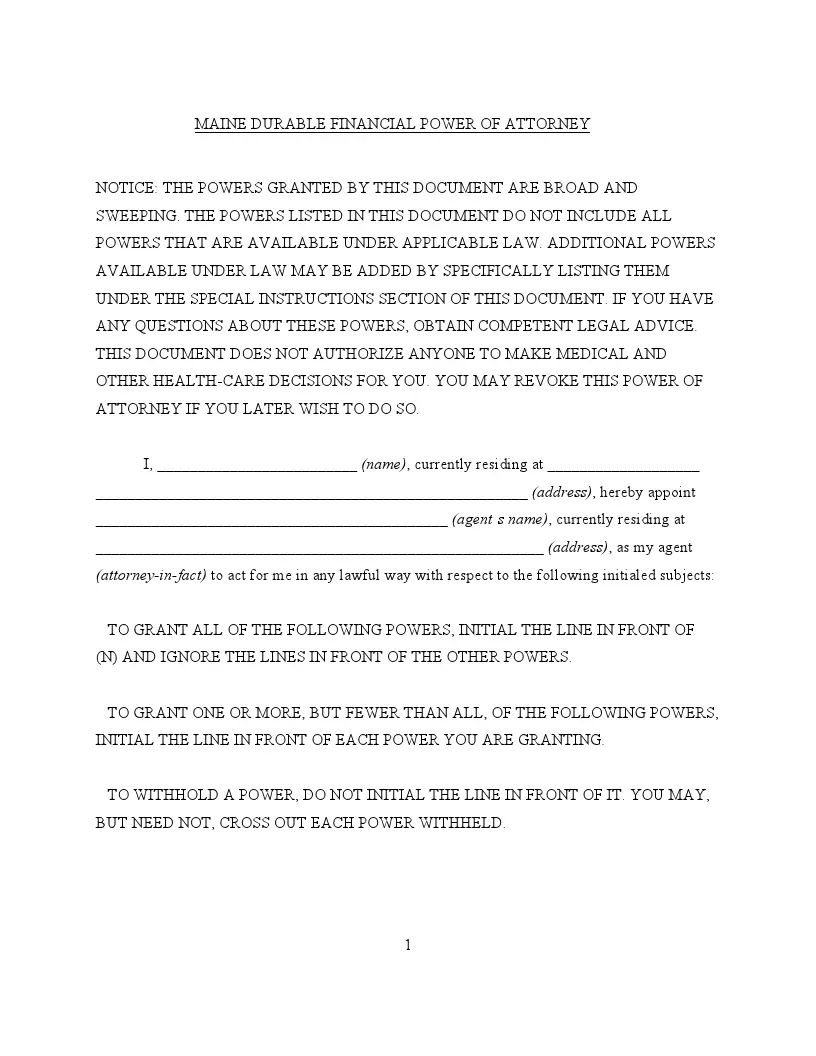
Enter your full legal name and current address in the opening paragraph on page 1, identifying you as the principal.
Enter your agent’s (attorney-in-fact’s) full name and address in that same opening paragraph on page 1.
On page 2, initial line (N) to grant all listed powers, covering real property, banking, and other financial matters, or initial only the specific lettered powers (A) through (M) you want to grant.
Read the four pre-printed special instruction clauses on pages 2 and 3 (HIPAA release, claims handling, retirement accounts, and digital assets). They are already part of it, not blank lines for you to fill in.
On page 3, initial one of the three options for when the power of attorney takes effect: immediately, on a stated future date, or upon incapacity.
If desired, enter the name and address of an alternate agent on page 4 to serve if your first agent becomes unable or unwilling to act.
On page 4, fill in the day, month, and year, then sign and print your name at the end of the document.
Complete the acknowledgment before the notary on page 5, where the notary fills in the county, date, and your printed name.
Once every page is complete and notarized under Title 18-C, keep the original in a safe place and give copies to your agent and any bank or institution that will rely on it.

Use the builder below to create your Maine durable power of attorney online, or download the fillable PDF and complete it by hand. Both versions follow the same eight steps described above and produce the same document once signed and notarized.
A Maine durable power of attorney is a written document a principal signs to appoint an agent, or attorney-in-fact, to manage financial matters. It stays in effect even if the principal later becomes incapacitated, which is what makes it durable rather than a standard, non-durable power of attorney.[2]
The agent can act only within the specific powers the principal grants in the document, and the arrangement ends at the events described below.
Yes. Under Maine law, a power of attorney is not valid unless it is acknowledged before a notary public or another individual authorized by law to take acknowledgments.[1.3] This basic safeguard helps confirm the principal’s identity before the document takes effect.
In practice, a Maine notary public checks a form of identification, confirms the principal is signing voluntarily, and completes a certificate verifying the acknowledgment. Have the principal complete the acknowledgment in the notary’s presence before using it.
In most cases, yes, but Maine law limits who can serve as an agent for financial and property matters. Unless the person is related to the principal by blood, marriage, or adoption, an agent may not be an owner, operator, or employee of a residential long-term care institution.[5] The restriction applies specifically where the principal is receiving care.
General information, not legal or tax advice.
