
The West Virginia durable power of attorney is a legal document that allows one person to appoint an agent to act on their behalf in handling legal and financial matters. This form remains effective even if the person granting power (the principal) becomes incapacitated or unable to decide for themselves. The agent (also called attorney-in-fact) is the person appointed and authorized by the principal to act on their behalf.
Last Updated: September 2026. This guide is reviewed and updated regularly to reflect current West Virginia state law. If you notice an error or outdated information, please contact us.
Build Your Document
Answer a few simple questions to make your document in minutes
Save and Print
Save progress and finish on any device, download and print anytime
Sign and Use
Your valid, lawyer-approved document is ready
A durable POA form becomes effective immediately upon signing or on a date you choose. The principal can grant broad or limited powers to the agent, such as managing bank accounts, paying bills, filing tax returns, and managing investments. Appointing a trustworthy attorney-in-fact matters because they gain real authority over the principal's finances.
In West Virginia, a durable power of attorney does not authorize an agent to make health care decisions. You will need a separate form for such cases, so check out all West Virginia POA templates.
West Virginia law makes a power of attorney durable by default. A power of attorney stays valid even if the principal later becomes unable to make decisions. Under W. Va. Code § 39B-1-104, this is true unless the document itself says the principal's incapacity ends it.[1]
West Virginia law also sets execution requirements for a valid power of attorney.[2] It must be:
West Virginia Code § 39B-1-110 sets out when a power of attorney or an agent's authority terminates.[3] It ends when:
A lapse of time since the power of attorney was signed does not by itself end the agent's authority. Termination is not effective against an agent or another person who, without actual knowledge of it, acts in good faith under the power of attorney. That good-faith act still binds the principal and the principal's successors in interest.[3]
Signing a new power of attorney does not revoke an earlier one. The old one stays valid unless the new document says the earlier one, or all other powers of attorney, are revoked.[3]
West Virginia's Uniform Power of Attorney Act also includes a statutory form of power of attorney. Under that form, an agent must act as the agent knows the principal wants. If the agent does not know, the agent must act in the principal's best interest. The agent must also act in good faith and stay within the authority the document grants.[4]
FormsPal's template already states that it stays in effect if you become incapacitated, so you do not need to add that language yourself.
| Document Name | West Virginia Durable Power of Attorney Form |
| Other Names | West Virginia Financial Durable Power of Attorney, WV DPOA, General Durable Power of Attorney |
| Relevant Laws | West Virginia Code, Section 39B-1-105 |
| Signing Requirements | Notary Public |
| Avg. Time to Fill Out | 10 minutes |
| # of Fillable Fields | 37 |
| Available Formats | Adobe PDF |
Popular Local Durable POA Forms
Durable POA documents are used in each and every state. Take a look at other popular DPOA forms frequently filled out by Americans.
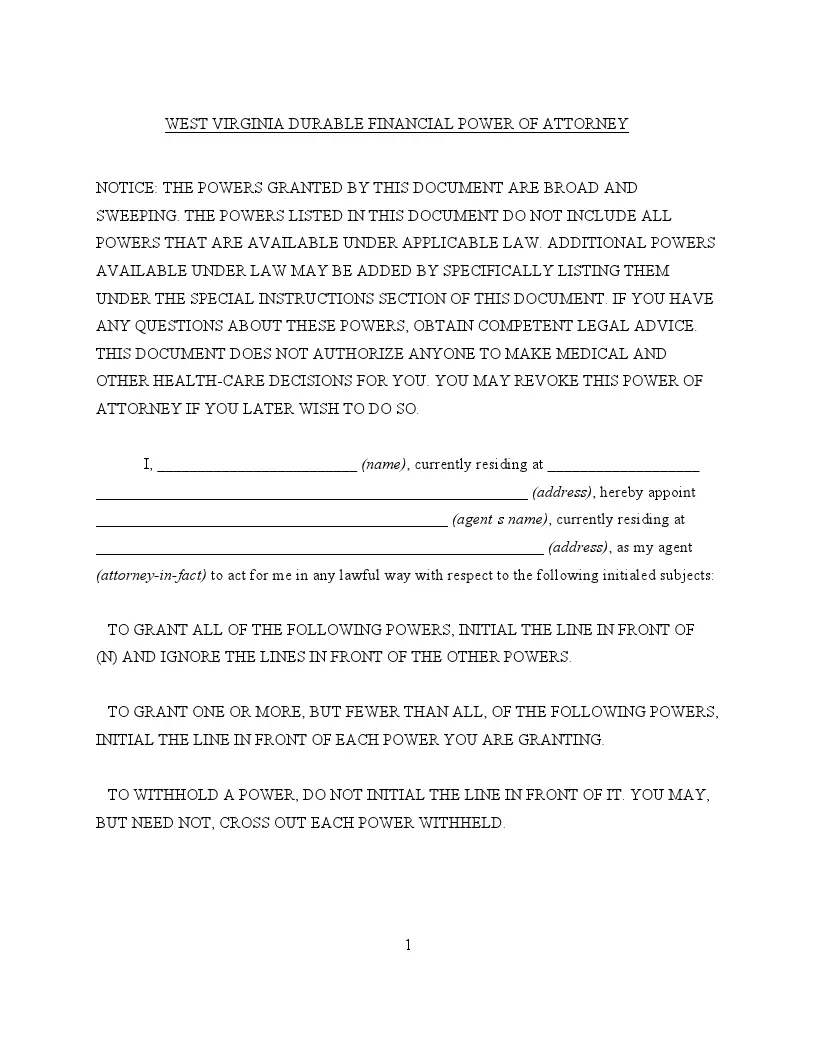
FormsPal's template is seven pages long, and each page builds on the one before it. Follow the seven steps below in the form's own order, using the page numbers as your guide, so every section gets filled out correctly.
On page 1, write your full name and address as the principal, then your agent's full name and address.
Pages 1 and 2 list the powers you can give your agent. Initial line (N) to grant all of them, or initial only the specific powers you want your agent to have:
Pages 2 and 3 contain four special instructions clauses already built into the form. They cover a HIPAA medical records release, authority to pursue medical claims and reimbursements, authority over retirement accounts, and authority over digital assets. These clauses are pre-written, so there is nothing for you to fill in here.
On page 3, select and initial one of three options for when the power of attorney takes effect: immediately, on a specific date you write in, or only once you become incapacitated.
Page 4 lets you select and name a successor agent who can take over if your first agent is unable or unwilling to serve.
On page 4, the principal fills in the date and signs and prints their name.
West Virginia law requires the principal's signature to be acknowledged before a notary public or another individual authorized by law to take acknowledgments.[2] Page 5 is where the notary completes this acknowledgment.
A few mistakes come up often with West Virginia durable powers of attorney, and small errors can cause real problems later. Avoiding them keeps the document valid and easy for your agent to use.

Ready to create yours today? Download the free PDF template below, or use FormsPal's guided online builder to answer a few simple questions and print a completed, ready-to-sign form in just a few minutes.
This page is general information about West Virginia power of attorney law, not legal advice. For advice on your situation, talk to a West Virginia attorney.
Unless noted otherwise, the sources below are from the W. Va. Code.
