
Updated:
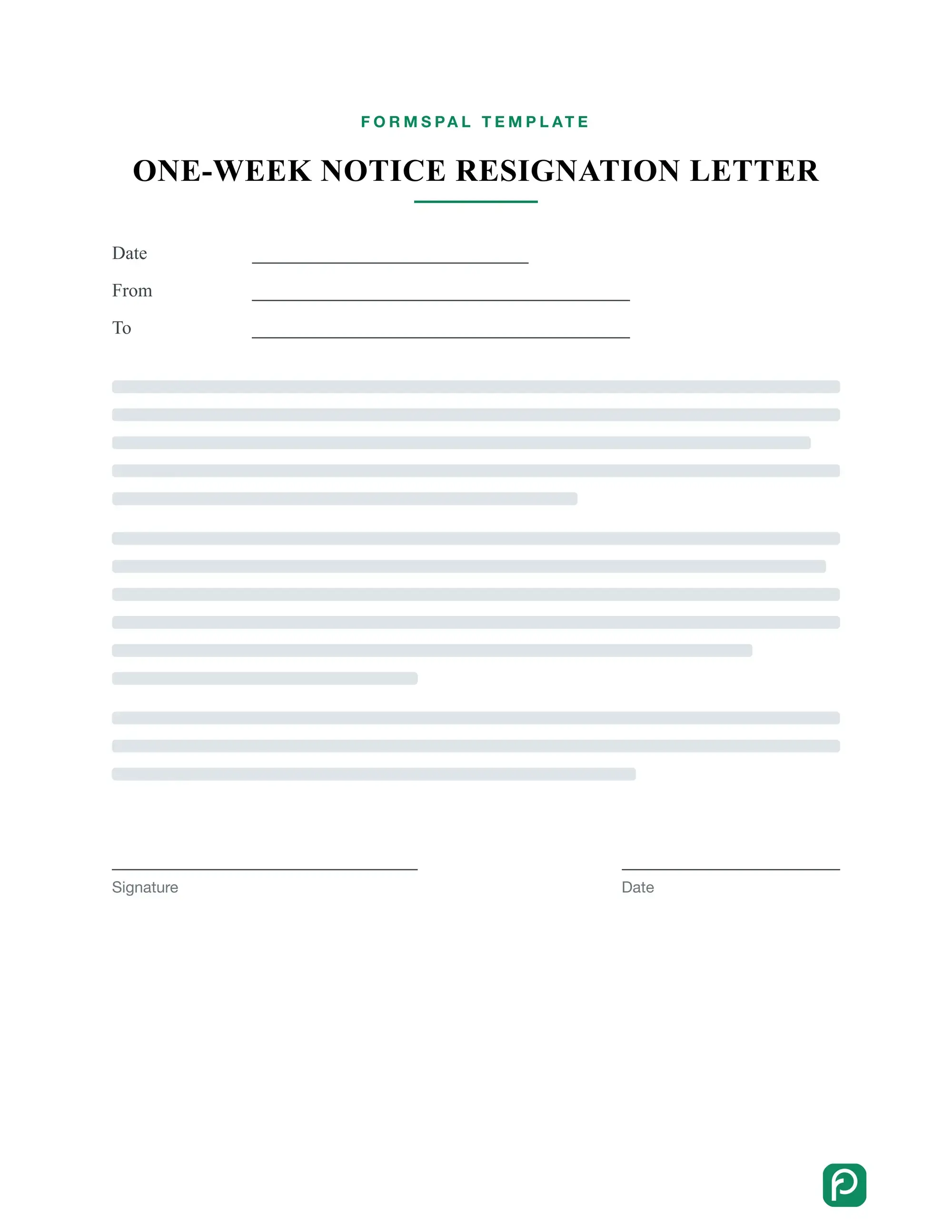
A one week resignation letter is a short written notice, also called a one-week notice letter, that tells your employer your last day of work is seven days away. Under normal conditions, workers give their employer two weeks’ notice, but sometimes the time is short and you are leaving sooner than planned. Write the letter in a polite, professional tone, explain the reason briefly, and offer to help with the handover so you leave on good terms with your employer.
Build Your Document
Answer a few simple questions to make your document in minutes
Save and Print
Save progress and finish on any device, download and print anytime
Sign and Use
Your valid, lawyer-approved document is ready
This message is a written notification to your manager that you will stop working for the company after seven days. Under normal circumstances, an employee should notify the employer at least two weeks in advance, but exceptional circumstances can occur in life.
There are several ways to submit the letter:
We recommend the second option as it eliminates counterfeiting and is more reliable. However, if in doubt, no one forbids you to use both.
The letter is free-form, so you can keep it short and plain. Still, a few points help your employer see your last day, the reason for the short notice, and how you plan to hand over your work. The list below covers the details most letters include:
If you are sending your letter by email, be sure to enter a suitable email subject. For example, it is worth writing something like “Resignation____________ Your Name.” This will allow the manager to notice your letter and realize why it is important immediately. Then proceed in the same way as with a regular letter, writing down everything you need in the body of the resignation letter template.
There is no need to describe in great detail all your troubles or gratitude. A short notice that does not exceed one page is sufficient. If you feel like saying more, it is best to do it in person or via a cover letter. A one-week notice letter has a more formal application.
Writing a one-week notice takes three short steps: explain why your notice is short, give your last day of work, and send the letter so the handover can begin. Each step needs only a few sentences, and the whole letter fits on one page.
1. Describe the Reason
As we mentioned above, under normal circumstances, an employee should notify the supervisor about the intent to leave two weeks in advance. This time is needed to find a new employee, introduce them to business, and sometimes provide additional training. Therefore, shortening this period can put your superiors under stress.
Therefore, to avoid damaging good relations and being considered a villain, you must argue why you need to leave your workplace earlier.
Common reasons:
2. Reveal the Date of Resignation
Enter the date of your last business day. If you have the opportunity to move or discuss the shift of this date, be sure to make a note that it is flexible.
Please note that the company may need your help in training a new employee. It would be best if you were ready to do it efficiently in the shortest time frame that you specify. It is better to part with the boss on good terms because no one knows what fate has in store for you.
3. Resign
After sending the letter, you can proceed to solve administrative issues accompanying the resignation and be accepted into your company. Most likely, you will need to contact the human resource department, where they will give you a clear plan for further action. But it all starts with a letter.
A one-week notice letter is a business letter, so it needs a simple layout and a polite tone. You should follow the generally accepted rules of business correspondence. Put your details at the top, keep the body short, and close with your signature and typed name.
1. Fill in the Header
As with any letter, you should start by writing your details in the upper corner of the paper. First, enter your name, mailing address, and contact details such as email address or telephone number. Next, indicate the full date of writing the letter and the recipient’s contact details (name and mailing address). Then, skipping one line, write a respectful appeal to the addressee.
2. Write Letter’s Body
It would help if you did not write multi-page essays. Nonetheless, you are obliged to give brief information. Do not forget to include the most important things:
Resignation is stressful for both parties. Therefore, try to do everything on your part to smooth out your urgent departure. Mention the reasons.
Apologizing for leaving so quickly is a good idea. If you are ready to stay after your usual hours of work or take additional shifts, then write about it. This will prevent the employer from losing efficiency.
You will also need to bring the new employee up to date. Inform them that you are ready to cooperate and help in this matter. Do it politely and succinctly.
Thank the employer for the position, experience, and time in the company provided to you. You should not leave on a negative note, even if you are not satisfied with everything in your place of work.
3. End the Letter
At the end of your letter, please add your signature and your typed name.
In matters of leaving work, additional discretion and our advice will not be superfluous. Many people want to burn bridges, especially if the work was stressful, but you should not. A polite, professional tone in your last seven days is what your coworkers will remember.
Dos:
Don’ts:
Keep the letter free of complaints about coworkers, managers, or the company. If something went wrong at work, talk about it in person instead.
Use the two samples below as a starting point. Replace each blank with your own details and adjust the wording so it matches your situation. Sample 1 explains a family move, and Sample 2 keeps the reason general.
Before you send either sample, run through this quick list:
Sample Letter 1
_________________
(Your name)
_________________
(Your address and telephone number)
_________________
(The date)
_________________
(Manager’s name)
_________________
(Manager’s address)
Dear Mr/Mrs _________________ (manager’s name),
It is my regret to inform you that I have to quit my position as _________________ (your position). My last day of work will be _________________ (your last day at work).
I am not too fond of the idea of providing only one week’s notice, but my spouse had a promotion on his job, and the whole family is moving to Texas. Unfortunately, I cannot fill out the regular two weeks as we need to move immediately. I hope that you will understand my situation. I have very much enjoyed my _________________ (time in the company) years working under your administration. I am very grateful for the experience and time spent here.
I have put together a list of my projects. I will ensure I bring my colleagues up-to-date so that they can take over.
I hope you will accept this one-week notice of resignation. Do not hesitate to contact me at any time. Thank you for understanding.
Sincerely,
_________________
(Your name)
Sample Letter 2
_________________
(Your name)
_________________
(Your address and telephone number)
_________________
(The date)
_________________
(Manager’s name)
_________________
(Manager’s address)
Dear Mr/Mrs _________________ (manager’s name),
This letter is to inform you of my official resignation from the position of ________________ (your position), effective ________________ (your last day).
I am incredibly sorry due to such a short warning, but unfortunately, personal circumstances have developed such that I am no longer able to continue my work. I also want to mention that the reasons are not related to the company itself or you. I am very grateful for the time spent here and the invaluable experience I received.
I prepared the documentation for my current projects to quickly get a new employee on board. I remain at your disposal for the entire week and will be happy to help with any work questions at any time.
Please accept my sincerest apologies and don’t hesitate to contact me at any time.
Sincerely,
_________________
(Your name)
Departure from a job, for whatever reason, is always stressful, especially if you have spent several years in the organization. You are saying goodbye to an important part of your life, and it is okay to worry. However, try to abstract from your emotions, whatever they may be. Resignation is a good chance to show yourself from a highly professional side.
Even if you leave with just a week’s warning, you can get it right. Warn the management, put all your affairs in order so that they can be painlessly transferred to a new employee, and stay in touch at least for some time. It would be best if you did not burn bridges between yourself and your old place of work. Life often takes an entirely unexpected turn.
Most one-week letters cover the same few points, so your employer can see your last day, the reason for the short notice, and how your work will be handled during your final week:
One page or less is plenty. A short, formal note is enough for your employer. If you want to say more, such as sharing feedback or explaining your plans, do it in person or in a separate cover letter.
You can send both. A printed, signed letter is the more reliable option, and an email gets attention right away. If you email it, use a clear subject line such as “Resignation: Your Name” and put the full letter in the message.
State one honest reason in a sentence or two, such as a move or a family matter. Apologize briefly for the short notice, thank your employer for the role and the opportunity, and offer to stay late or help train a replacement during your final week.
Your next step is usually a conversation with the human resources department, which can walk you through the remaining paperwork and your final days. Until your last day, finish your open projects and hand over your files so your team can take over smoothly. A polite, professional exit also helps your career, since people in the same field often meet again.
General information, not legal or tax advice.
