
Updated:
A board resignation letter is a short written notice that tells the other board members you are leaving the board and on what date. It also lets you thank your colleagues and part on good terms. This guide shows when to send the letter, what to include, and how to write each part, with a sample you can adapt. For other roles, see our general resignation letter template.
Build Your Document
Answer a few simple questions to make your document in minutes
Save and Print
Save progress and finish on any device, download and print anytime
Sign and Use
Your valid, lawyer-approved document is ready
A board resignation letter is a written notice that you are leaving a board of directors or a similar governing board, and it gives your last day, a short reason, and your thanks to your colleagues. The letter leaves a clear record of your decision and helps you part on friendly terms.
The answer is easy: when you decide to leave the board and stop being its member. Another recommendation is to choose a relatively calm moment when the board is not suffering from overwhelming tasks, and your departure will be painless for your colleagues.
Regarding legal terms, in the United States, you can leave “at the moment,” meaning that you do not have to wait for a couple of weeks after calling for resignation. So, it is possible to announce your departure, deliver the letter, and quit on the same day.
However, other board members may find this inappropriate. Furthermore, doing this could leave them with an unpleasant impression of you. Therefore, we would advise you to notify them about your plans and pass the letters at least a couple of days or weeks before your resignation.
This additional time you give to the board will enable them to find someone to replace you. You may think that your quitting from the board is not much of a catastrophe, but your colleagues may have other opinions in this regard.
A simple timeline keeps the handover calm:
Tip: Before you send the letter, read it once more and check that the names, the dates and your contact details are correct.
A written letter makes your exit official and keeps it friendly. While resignation letters must be delivered to a boss or HR specialist, the letter we discuss today should be passed to every board member in writing and signed by the author. Here are the main reasons to put your decision on paper.
It is highly advisable to write and submit the letter. This document supplements other forms stored in the company and attached to you as its ex-member. So, it is highly likely that your colleagues or the HR department will require you to submit one.
One of the main reasons for writing board resignation letters is to declare that you are leaving on a specific day. Of course, you should specify this date in your form. However, if you have massive tasks or unfinished projects that require your intervention, your colleagues may ask you to postpone your departure. Even so, the letter will give other board members an idea of when you intend to go.
Passing an official letter to your fellow board members is much better than simply declaring your intention by word of mouth. It is also a sign of courtesy. Apart from being polite, you can also express how grateful you are and wish them all the best in the future. Finally, do not forget to mention that you wish loads of success to the company you are quitting.
Quitting politely leaves a chance for you to cooperate with your ex-coworkers. You never know when you may need them even after quitting. Good and trusted contacts are always a must regardless of the sphere of your work. Every board resignation letter should contain your contact information and encouragement to board members to reach out to you if they need anything. If you do so, you can always count on them.
There is a set of standard topics to cover in such letters. They work for almost any resignation letter, whether it is a letter for board members or your coworkers and bosses (if you are a regular employee). The topics are the following:
You must state when you plan to resign: today, tomorrow, or on a specific day. This information usually comes at the very beginning. Please ensure that you specify the date in the first or second sentence, as shown in the sample below.
Even if your fellow board members consider the date too soon, or you have some tasks to complete, they will still take note of your departure, and you will then have a discussion to rearrange the departure date.
You should explain the reason for this decision in all honesty, especially if the reason is not tied to your relationships with co-members of the board. For example, people quit jobs because of various causes: getting another job, moving to another place, being tired of the position, and so on. All of these are absolutely normal.
However, if the reason is a conflict between you and someone else who is on board, try to politely explain that you are leaving due to “irreconcilable differences” or omit this information. The key point here is to be polite and kind without telling the details or telling the truth softly.
Make an action plan to hand over your responsibilities to other people. You will likely have unfinished tasks to wrap up. Just ensure that you explain everything to everyone concerned and that your responsibilities are delegated elsewhere. Someone must complete the tasks after you.
Whatever your relations with other members, wish everybody good luck.
As you already know, it is a smart move to mention that you are open to consultation and add your contact details at the end of your letter.
A good board resignation letter has 4 parts: a letterhead, an introduction, a main part, and a conclusion. Keep each part short and clear. Here is what goes into each one, so you can write your own letter step by step.
Before writing the main text, you should identify yourself and the letter recipient. On the top-left corner of the page, write your name, address, and phone number. Then, enter the recipient’s name and address. Remember that it is essential to create an individual letter for every board member. After that, write the current date.
If you are busy and have no chance to write a personal letter to every member, you can use a general salutation “To whom it may concern.” However, we don’t recommend this. Instead, try to find some time and personalize all your letters. You can even use the mail merging feature.
The introduction is where you specify when you are going to leave. Start with “Dear …” or “To whom it may concern” (choose the phrase applicable to your case), mention the reason why you are writing this letter, enter the departure date, and maybe say that you are sorry for any inconvenience caused.
Here, you should say why you have decided to resign, explain what will happen with your responsibilities, and express your gratitude to the recipients. Do not write a long letter because no one likes receiving too much information these days. Remember to check your grammar, spelling, and punctuation (this relates to all letter parts).
This part requires contact details and encouragement to the recipients to contact you if a need arises. You can choose what contacts to leave: email address, phone number, or even a link to any of your profiles in numerous social networks and messengers.
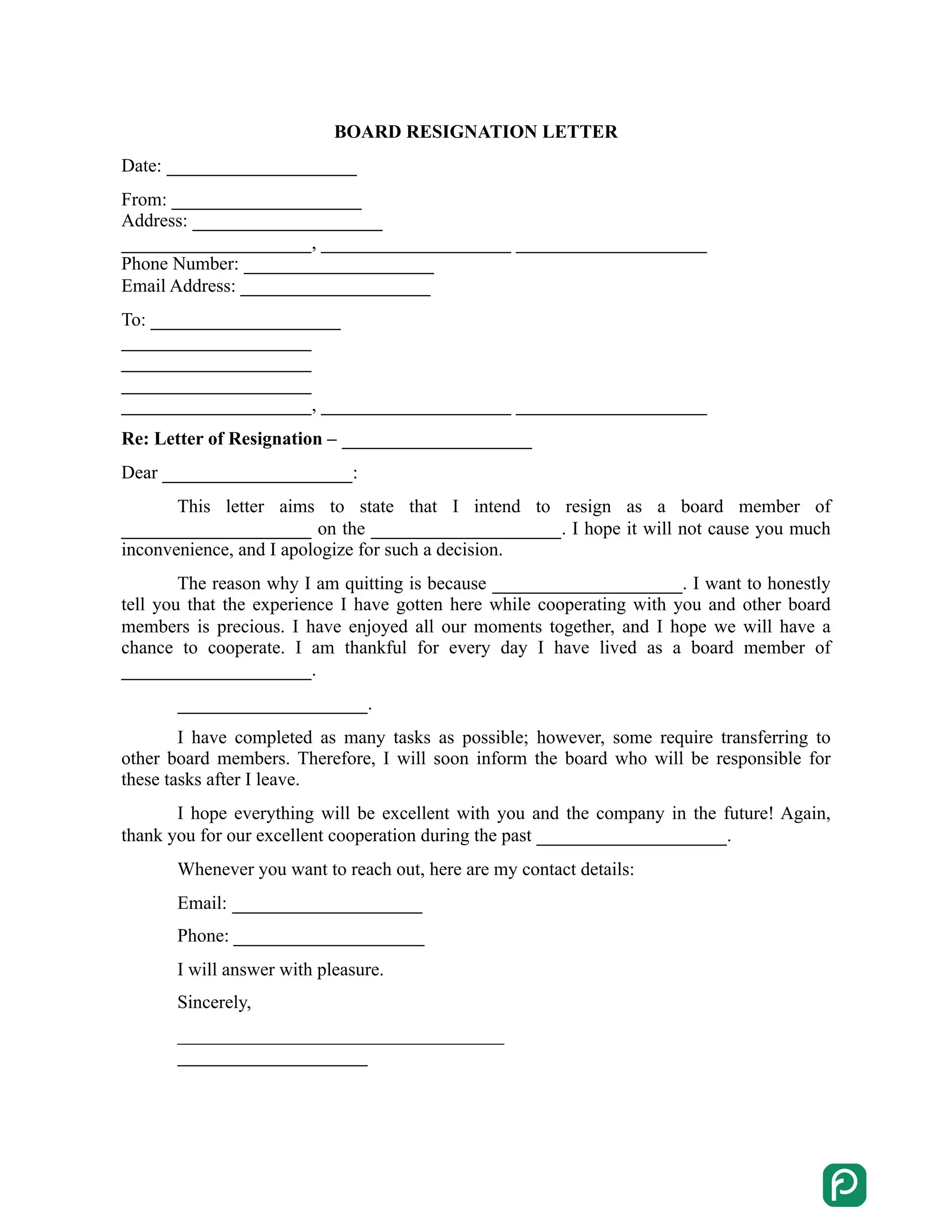
As you can see, the structure is relatively simple. The only thing you lack now is a sample board resignation letter. Use this sample to prepare your own letter that covers all your needs. Remember to read the last section.
Use the sample below as a starting point for your own letter. Replace each blank with your details and keep the tone polite. Before you copy it, go through these quick checks:
[Your name] __________
[Your address] __________
[Your phone number] __________
[The recipient’s name] __________
[The company] __________
[The recipient’s address here] __________
[The date of writing this letter] __________
Dear Mr. (or Ms., or Mrs.) [The recipient’s name here] __________
This letter aims to state that I intend to resign as a board member of ______________ [insert the company’s name] on the ________________[enter the date when you will leave here]. I hope that it will not cause you much inconvenience, and I am sorry for such a decision.
The reason why I am quitting is because _____________________[explain why you are quitting]. I want to honestly tell you that the experience I have gotten here while cooperating with you and other board members is precious. I have enjoyed all our moments together, and I hope that we will have a chance to cooperate in the future. I am thankful for every single day I have lived as a board member of _________________ [enter the company name].
I have tried to complete as many tasks as possible; however, some of them require transferring to other board members. Therefore, tomorrow [or enter another date], I will inform the board on who will be responsible for these tasks after leaving the board.
I hope that everything will be amazing with you and the company in the future! I wish you lots of luck with your career! Again, thank you for our excellent cooperation during the past [indicate the period]. __________
Whenever you want to reach out, here are my contact details:
Email: __________
Phone: __________
I will answer with pleasure.
Best regards,
[Write your name] __________
Quitting a board goes more smoothly when you follow a clear order. Prepare the letter first, talk to the board in person, then hand over the signed copies. These 3 steps keep your colleagues informed and your exit friendly.
A few small slips can make an otherwise polite letter harder for your colleagues to use. Check your draft against this list of common problems before you send it to the board, and fix anything that looks unclear or incomplete.
Leaving a board raises a few practical questions, from what to put in the letter to how to tell your colleagues. These are the ones that come up most often before people send a resignation letter.
A good letter covers a few simple points:
Keep it polite and brief, and read it once more for grammar and spelling before you send it.
Keep it to a few short paragraphs. Long letters are hard to read, and the key facts are simple: your last day, the reason, and your plan for the handover. Add a warm closing line and your contact details, then stop.
A brief, honest reason works best. Common reasons are a new job, a move, or simply feeling ready for a change. If the reason is a conflict, you can say you are leaving because of irreconcilable differences or leave the reason out. Stay polite and skip the details.
A personal letter for each member reads best. If you are short on time, you can use a general greeting such as “To whom it may concern,” or use a mail merge feature to personalize your copies quickly.
Yes, meeting in person first is the friendlier approach. Tell everyone about your decision, answer their questions, and then give the final signed letter to each board member.
General information, not legal or tax advice.
