
A resignation letter due to job dissatisfaction is a short, professional letter that tells your employer you are leaving your position because of poor working conditions or problems with management. It states your last day, gives your reasons in calm words and helps you part on good terms. You can copy the free sample below or build a personalized one online in a few minutes.
Last Updated: October 2026. This guide is reviewed and updated regularly to reflect current law. If you notice an error or outdated information, please contact us.
Build Your Document
Answer a few simple questions to make your document in minutes
Save and Print
Save progress and finish on any device, download and print anytime
Sign and Use
Your valid, lawyer-approved document is ready
First, consider the letter preparation period. In the United States, the law does not oblige you to notify your employer about the departure in advance. Therefore, you can arrive at work in the morning, have a talk with your manager, pass the letter, and leave right away.
Although this is possible and you can save time this way, we strongly recommend tendering your resignation at least a week or two in advance. Yes, we understand that it may be unbearable, but we advise you to be an intelligent person who gives people some time to find a solution and a substitute.
So, your plan regarding the resignation letter template may look like this:
A two weeks notice letter or a one week notice letter is a good fit if you only want to state your last day without giving reasons.
Some people think a resignation letter is pointless when the reason for quitting is unbearable terms or colleagues. Instead, they explain their complaints out loud or walk out without a word.
However, a well-structured letter works better for four reasons:
To prove your excellent manners, you should submit a decent note that does not offend anyone. You may be suffering from the present conditions or facing daily conflicts with your coworkers. However, the best thing to do is to rise above it all and say goodbye to everyone with due respect.
Clearly explain what bothers you and what you consider wrong in written form without writing outrageous things. That way, the chances of quitting on friendly terms are high. You may think that you will never interact with your ex-colleagues ever again, but life is unpredictable. You may have to meet and work together again.
So, it is advisable to keep the door open for normal relationships in the future. In your resignation, you can also say that you are grateful for the time you spent at the company and wish everyone luck. That makes a good impression overall.
Well, we cannot promise that it will happen, and in many cases, people leave their positions, and nothing changes afterward. However, if there is a tiny chance to improve things, why not use it?
For example, in your resignation, you can explain everything that you do not enjoy at work and tell your bosses why it has become impossible to keep working together. Then, maybe they will accept your reasons and improve the terms. Besides, many examples prove that you can deliver the message, discuss it with your supervisor, and win by getting a bigger salary or reducing your working hours.
At most workplaces, you must provide a document stating that you intend to quit on a specific day. It can be a brief note indicating your departure date. Also, if you are asked about the reasons for resigning, it is more convenient to list them in a letter instead of telling them verbally.
An effective resignation covers four things: your last working day, your reasons, a transition plan for the days that follow and a kind goodbye to your coworkers. Here is what to say about each one.
The general idea behind any resignation letter is to state that you will stop working with the company on a specific day. So, remember to include this information.
When you are quitting because of problems at work, it helps to list your reasons. Be honest but gentle, because you do not want to raise a scandal or offend anybody. Remember that your time at the company will end soon, so stay calm and respectful.
Use one or two of these examples as a starting point and change the details to fit your situation. Each one states a fact and avoids blame.
It is pretty rare to leave quickly without any unfinished projects or partners communicating with the company through you. You will have to delegate all your responsibilities to someone. The letter is a great chance to provide your boss with a plan of how everything will be transferred.
Regardless of how much you dislike the company and your colleagues, you must pass all the tasks and needed contacts to someone. Just imagine that it is your business. How would you like your employees to go? Treat others the way you’d like to be treated.
It cannot be all wrong, especially if you have spent a couple of years in your current position. So, please mention that you have enjoyed all the good times you have had in the company, but it is time to move on. It is essential to wish everyone luck in their career.
The words you choose set the tone for your last days in the workplace. Use these phrases as a guide.
Phrases that work
Phrases to skip
It is up to you whether to write a short, formal letter or a longer one. A longer one gives you room to explain, so we would pick it in your place. Use the plan below and decide what to include and what to skip. It has four parts.
This is a formal requirement for every legal form or letter, and this document is not an exemption. You have to add a heading: your name, address, and phone number; your boss’s or HR department representative’s name, company name, address, and the current date.
Use the first part of the letter to explain what it is about and when you intend to quit. It can be just one or two sentences. Then, to be even more polite, you can apologize for the inconvenience the company gets after you go.
In the main part, explain what happened and why you made this decision. You can also say who will take over your tasks and duties, and when.
When ending the letter, wish everyone the best and write your name at the very end.
The plan is rather simple, and your letter will probably not require more than one page. See the sample below and adapt it to your situation, so the final note satisfies you and your colleagues at the same time.
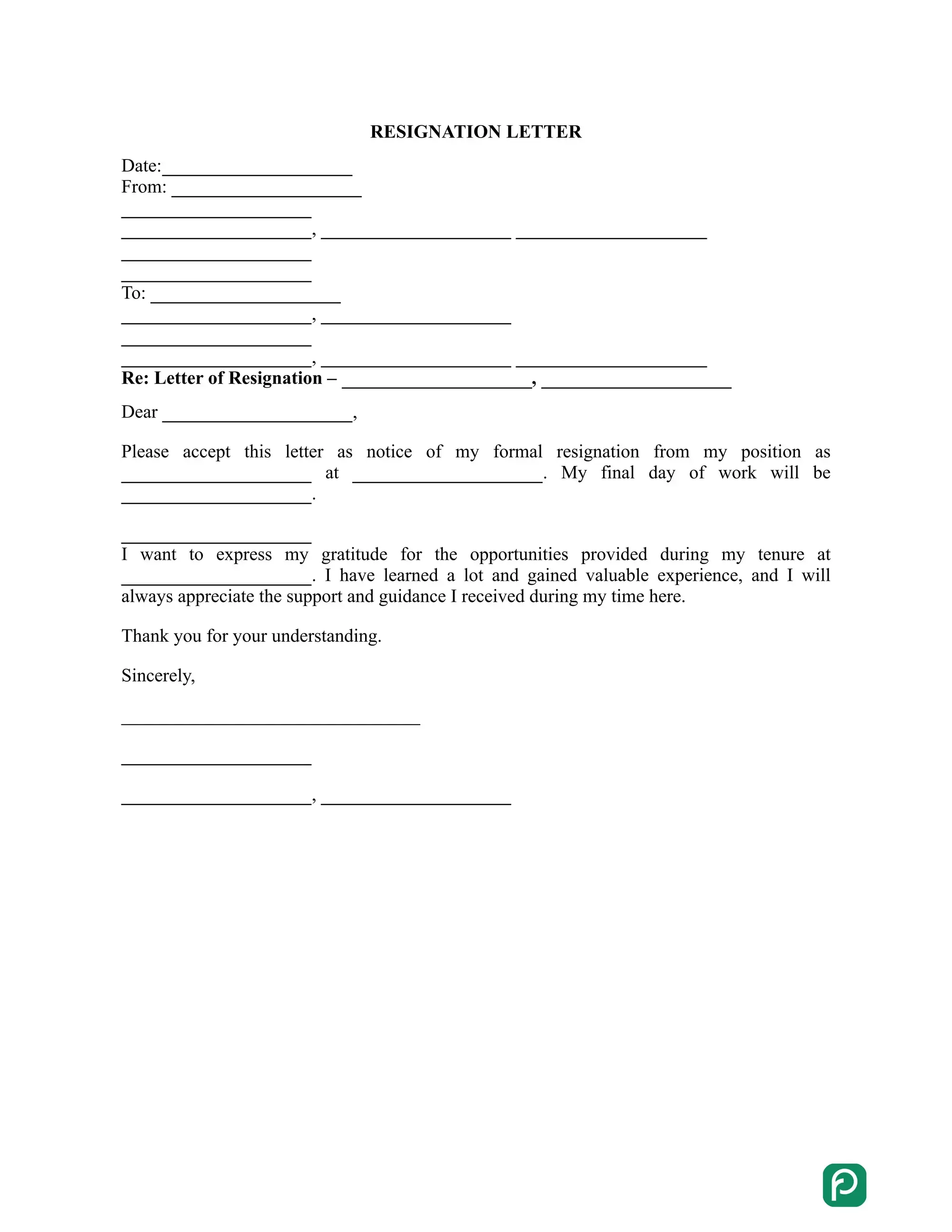
Copy this sample and replace the bracketed parts with your own details. It keeps a calm tone, names one clear reason and offers help with the transition. You can also create a personalized version online with the form at the top of this page.
__________
[Your name here]
__________
[Your address here]
__________
[Your phone number here]
__________
[The recipient’s name here]
__________
[The entity’s name here]
__________
[The entity’s address here]
__________
[Today’s day, month and year]
Dear Mr. (or Ms., or Mrs.) __________ [The recipient’s name]
I regret to inform you that I will terminate my work in ___________________ [enter the entity’s name] on____________ [insert your last working day]. Unfortunately, I have to say that in the past few months, the conditions at my position have become extremely difficult, and I cannot perform with due results anymore.
Among the reasons it is impossible to continue on the same grounds is the new schedule set a month ago. I started to feel immense pressure, and almost all the tasks I had during this period went incomplete.
I would recommend but not insist that you try reconsidering the schedule, so no one needs to stay after hours every day. I hope that it will be possible to reach the balance between work and life for everyone. But, of course, it may be only my problem, so I do not insist on this fact.
In a few days, I will complete transferring all my tasks, and the company will not lose any of its clients or partners.
I wish you all the best in the future. I hope the company will bloom, and everything will be brilliant for you. Thank you very much for all the fantastic moments we had together while I was working here. Good luck!
Sincerely,
__________ [enter your name here]
Before you send it, check these points:
If you plan to send your resignation by email, use this shorter version.
Subject: Resignation, [Your name]
Dear [Recipient’s name],
Please accept this email as my resignation from my position at [Company name]. My last working day will be [your last day]. I am leaving due to the workload and schedule changes of the past few months.
I will hand over my tasks before I go, and I am happy to help with the transition. Thank you for the opportunities I have had at the company.
Sincerely,
[Your name]
If this is your first resignation, a clear plan keeps the process calm and professional. Follow these four steps in order to end things on good terms and protect your reputation at work.
This is an old method, but it still works. Think again about what you will gain and lose after leaving. If there are many more cons than pros and your work is troublesome, it is probably time to go.
Have it ready before you announce your resignation. Check your grammar, punctuation, and spelling before you print it.
Talk to your boss before you hand over your resignation, because they might have no idea that you are planning to quit. It may come as a shock, so the first thing you should do is talk, not send a written note. If talking is impossible, you can skip this step. However, it is better to talk first.
If the conversation did not satisfy you, send your resignation to your boss and finalize your departure.
State that you are resigning from your position, give your last working day, name one or two reasons in calm words, offer to help with the handover and thank your team. Keep it on one page and in a professional tone.
No. Pick the main reasons and describe them as facts, such as the schedule or the workload. Skip names, insults and old arguments. If you have more to say, bring it up in a conversation with your manager.
Address it to your direct manager or to a Human Resources representative. Add their full name, the company name and address, and today’s day, month and year, as in the sample above.
Many people do. An email is quick and leaves a written record, but it is kinder to speak to your manager first and then send the email or hand over the printed letter immediately after the conversation.
Write a first draft to get your feelings out, then wait overnight and rewrite it. Remove anything that blames a person and keep only facts about the work. Ask a trusted friend to read the final version before you send it.
It can. A future employer may ask your manager about you, so a calm, professional letter protects your reputation. Keep the tone polite and stick to facts about the work, and your personal feelings stay out of the record.
Tell your manager first. After that, you can share the news with your team in your own words and keep the message positive.
Sharing your next job or career goals is up to you. A short thank-you line is enough, and you can skip details that do not help the handover.
A few easy steps keep the last days of your position smooth.
Yes. Use the button at the top of this page and answer a few questions. The letter is built for you, and you can then download, print and sign it.
General information, not legal or tax advice.
