
Updated:
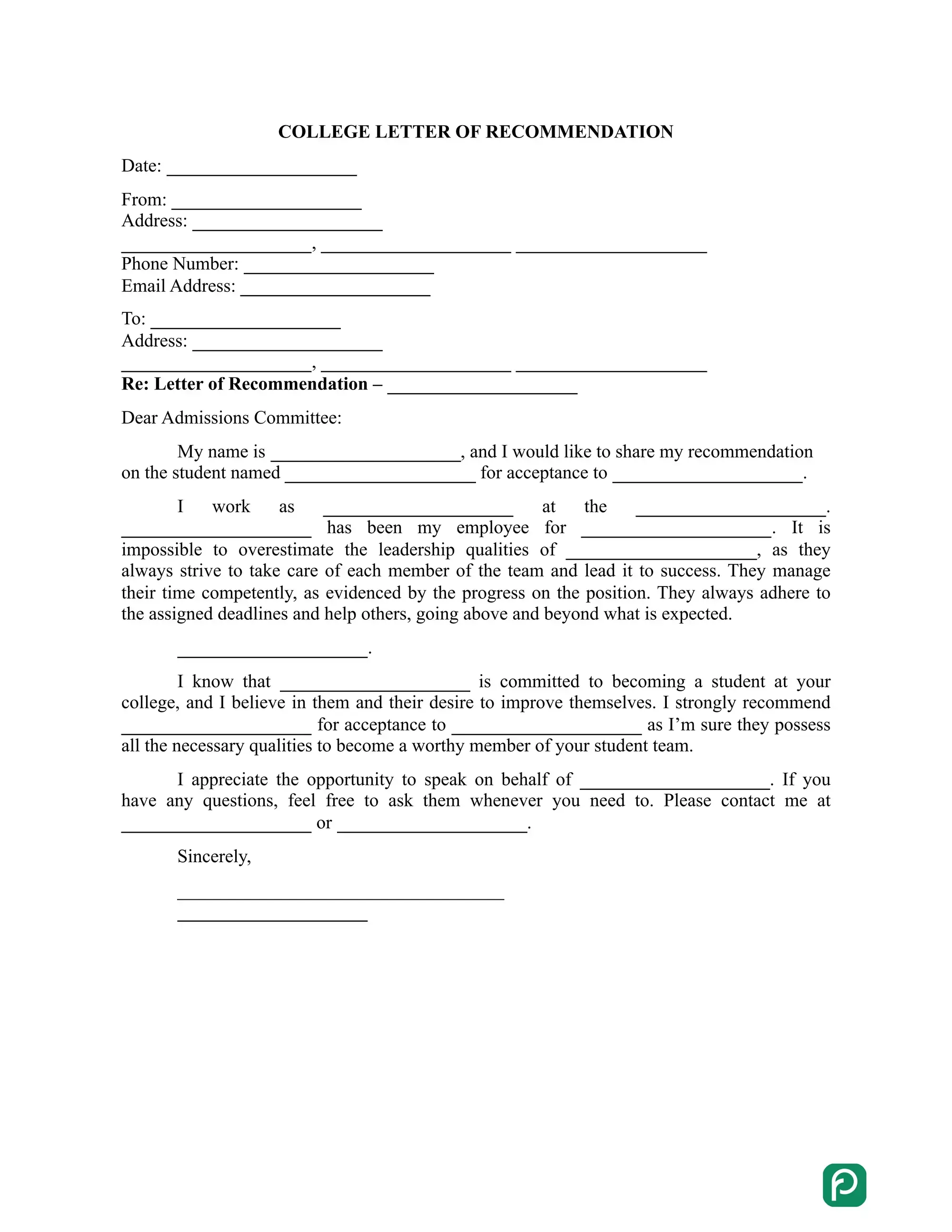
A College Recommendation Letter is a short letter from a teacher, coach, or employer that supports a student’s application to college. The filler, who is the applicant’s teacher or employer, must provide the letter of recommendation not in a freeway but according to specific requirements. A consistent structure makes the praise easier to read and easier to trust. You can start from a free letter of recommendation for student template and adapt it to your student.
Build Your Document
Answer a few simple questions to make your document in minutes
Save and Print
Save progress and finish on any device, download and print anytime
Sign and Use
Your valid, lawyer-approved document is ready
A student recommendation letter is used when an applicant submits documents for admission to a higher school. Many colleges explicitly require a letter of recommendation to understand the applicant’s social track before admission. The recommendation letter must be submitted together with the application for admission is submitted, so please keep an eye on the deadline at the chosen institution.
The key questions that the letter covers relate both to academic and social skills. A strong letter speaks to points like these:
All these facts improve the applicant’s position. Even if the admissions office does not require letters of recommendation for school, you can ask your teacher or employer to prepare the form. It shows that you can get support, and this is an advantage.
A special type of recommendation is a letter from a college alumnus where the applicant wants to enroll. Generally, an alumnus (unless they are the applicant’s permanent teacher) cannot write a detailed letter. Nevertheless, their status is important.
An alumnus can refer to the opinion of parents, teachers, or the school administration. In this letter, it does especially matter to highlight how long the writer has known the applicant and indicate the alumnus’ connection with the college.
All the points that the author must specify in the letter of recommendation are listed on the official website of the University of California, Berkeley. The university administration draws attention to the fact that the letter is a desirable but optional form in the applicant’s documents package.
If you are a student, do not hesitate to request your teacher (coach) to prepare a recommendation letter. You can submit several recommendation forms at once from different authors who know your specific merits and virtues.
College reference letters must be convincing and credible. In other words, the letter shows that the filler is a real person and their relationship with the applicant took place. Therefore, the following points determine the content of the letters:
The applicant should contact the teacher or coach who knows them well and is ready to emphasize the positive features in the recommendation letter. It is good to ask a person who has known you for a long time. This will show the admissions committee that the positive qualities, traits, and habits indicated are your permanent property.
The recommendation letter contains four parts, namely the introduction, the conclusion, and the two main paragraphs in the middle. The structure allows the writer to fully reveal the applicant’s character and academic abilities and to support the main arguments with examples.
Roughly speaking, a recommendation letter follows the structure of an academic essay, with a few differences in content. Here is what goes into each part:
Write your name, full postal address (including zip code), email, and phone number. Enter the name and address of the school below that.
The introductory part takes up to about 100 words of the entire text. It is aimed at clarifying the relationship between the writer and the applicant. That is, you must show your status as a teacher, sports coach, or employer.
Identify your status and terms of communication with the current applicant (in class, in a sports team, school counselor, etc.). The optimal period for how long you have known each other is four to five years or more.
It is not necessary to adhere to a formal style. Warm phrases work well here. Try “I recommend you with great pleasure” or “It is an honor for me to introduce this person.” You can also call the applicant “impressive” or “well-disciplined,” and highlight their “amazing progress” or “brilliant success.”
Emphasize that you not only notice the applicant’s outstanding abilities but also observe their development over time. Do not forget to indicate how long you know the person you are writing about.
The first paragraph includes about 120-150 words. Here, you reveal the positive traits of your mentee. State the main points in the first sentence. For example, your student is organized, has a teaching talent, and is always ready to help their classmates.
Then support this thesis with arguments. Use both your own point of view and other people’s opinions as examples. Name the programs or activities in which the student has performed to confirm what is said. List all the achievements and awards they received during their studies. Show both academic success and personal qualities that contributed to this.
The second paragraph is equal to the first in terms of the number of words and covers the student’s relationships with other people, i.e., students, teammates, teachers, coaches, etc. This part is more dedicated to the student’s personal qualities and complements what is said in the previous paragraph.
Do not be afraid of sentimentality. This is the place to praise your student from the bottom of your heart. Describe their role in society and behavior in public, and give live examples from different situations. Again, use both your own opinion and the view of other people who have known your student for a long time. Allow yourself to be a novelist and use bright adjectives that hit the target.
The last paragraph should be succinct and concise. Collect all the characteristics here. Try to sum up everything said in paragraphs 1 and 2 in two sentences. Where you can, connect the college curriculum to the student’s traits. End with your contact details, so the reader can reach you and see that you are a real person.
Thank the reader, add a closing line such as “Sincerely,” and enter your name again.
Ask a teacher, coach, or employer who knows your work well and can describe it with real examples. A polite, early request gives the writer time to think about your strengths and to write something specific instead of something generic.
Before you read the samples, review the habits that make a college recommendation letter stronger and the ones that weaken it. Strong letters are specific, warm, and built on real examples from the classroom, the team, or the workplace.
Check every name, date, and course title before you send the letter. A small typo can distract the reader from an otherwise strong recommendation.
The three samples below cover a high school student, a university applicant, and a letter from an alumnus. Each one follows the structure described above. Pick the one closest to your situation, then make it your own:
Dear Sir (or) Madam / Dear Admissions Committee,
I am pleased to be writing this letter of recommendation in favor of _____________ (enter full student’s name), the most talented and promising student. I have had the good fortune to train _____________ (student’s name) during _____________ (the period of your relationship) as _____________ (teacher / coach / employer) at _____________ (name of institution).
Through this time, _____________ (student’s name) demonstrated outstanding abilities in _____________ (subject or occupation). This is evidenced by the success of my student at school and regional competitions. At these events, _____________ (the student’s name) has won prizes more than once.
_____________ (Subject) is the main goal of _____________ (student’s name) academic occupation, but they are also interested in _____________ (subject(s)). There is no class which _____________ (student’s name) is not actively involved in. A striking indicator is the school certificate, where you will find only the highest grades. _____________ (Student’s name) talents are accompanied by outstanding diligence and assiduity. This allows them to occupy heights in the _____________ (academic or sports) field from year to year.
_____________ (Student’s name) is the life of the party of our _____________ (class or team). Classmates often turn to them for advice. Teachers assign him/her to organize events because he/she already knows that everything will be done perfectly. He/She always partakes in school holidays, and this class _____________ (student’s name) is always one of the first.
It is impossible to overestimate the leadership qualities of _____________ (student’s name), as he/she always strives to take care of each member of their team and lead it to success. He/she always manages his/her time competently, as evidenced by the progress in the academic field and in extracurricular life.
_____________ (Student’s name) has been attending art school for many years, and their work has been exhibited at school and city exhibitions. An active attitude of _____________ (student’s name) indicates an amazing ability to both self-organize and communicate.
Without a doubt, every college wants to see _____________ (student’s name) among its students. Brilliant time management and the ability to communicate with everyone, along with amazing academic achievements, make him/her one of the best applicants. If you want to know more about the character or school results of _____________ (student’s name), please contact me by phone _____________ (your phone number) or via email _____________ (address).
To Whom It May Concern,
I am delighted to recommend _____________ (full student’s name) for admission to _____________ (university name). As their _____________ (teacher, coach, etc.) during _____________ (the period of interaction), I have observed a steady development as _____________ (a student or athlete, or both). Among the students of _____________ (the name of the school), he/she has always occupied the first positions in both academic and extracurricular life.
_____________ (Student’s name) is a wonderful, bright and lively person. Although _____________ (subject) is his/her main interest for them, he/she manages to get high grades in all courses. Unlike most other students, _____________ (student’s name) is clearly aware of his/her academic goal and has a future plan at the university.
An unstoppable desire to know his/her subject as well as possible has repeatedly led _____________ (student’s name) to victories in school and county competitions, where he/she confidently took prizes. He/She so confidently proved his/her deep interest in the subject that the school administration decided to send him/her to a Summer school last year, taking care of the expenses.
Brilliant academic achievements are only part of _____________ (student’s name) activities . During _____________ (the period), he/she attends acting courses, which allows him/her to partake in the organization of school events at a high level.
For example, in the last academic year, _____________ (student’s name) they performed brilliantly in the organization of the Homecoming Dance without distracting from the current educational process. This was appreciated by both the participants of the event, the school faculty and former students, and parents. Whatever _____________ (student’s name) does, he/she does it well!
To conclude, _____________ (student’s name) is one of the most enthusiastic and bright students I have taught in all the long time of my work. I never cease to be surprised at the combination of such qualities in one person, who can brilliantly perform at competitions and at the same time take an active part in school life.
What to say, _____________ (student’s name) deserves to become a part of the_________________________ (name) university’s students. If you want to know more about him/her, do not hesitate to call me by phone _____________ (your phone number) or write an email to _____________ (email address).
This recommendation letter addresses some of my thoughts about _____________ (full applicant’s name). I know him/her as _____________ (specify how you met and what kind of relationship you maintain) for _____________ (an indication of the time period).
Since I have indeed had the pleasure of knowing _____________ (applicant’s name) for only one term, I will only say what I could notice about him/her. _____________ (Applicant’s name) proved to be an observant and thoughtful student. He/She always asked many questions at the end of the class, which indicates a deep interest in the subject. I can express confidence that _____________ (applicant’s name) will become a conscientious student of _____________ (name of college) college.
As far as I know, _____________ (applicant’s name) took an active part in extracurricular activities, such as the chess club. He/She has achieved significant success in this, which indicates the purposefulness of a person and the ability to do a lot during the school years. I am convinced that during college ,_____________ (name of college) will be able to reach even greater heights.
Taking into account his/her desire to deeply comprehend the topic of the subject, I can say that _____________ (applicant’s name) will become worthy of college students. If you want to talk about (applicant’s name) in more detail, I am waiting for your call _____________ (phone number) or email _____________ (email address).
When you write your own letter, keep three things in mind: a warm style, a clear structure, and details the reader can trust.
A college recommendation letter is a short, positive letter from a teacher, coach, employer, or alumnus who knows the applicant well. It supports the application with specific examples of the student’s abilities and character.
Ask a teacher, coach, or employer who has known you for a long time and can describe your abilities with real examples. A writer who knows you well can add specific details that make the letter convincing.
A good letter covers these points:
Plan for four short parts: an introduction of about 100 words, two body paragraphs of 120 to 150 words each, and a brief conclusion. Keep the tone warm and the examples specific.
A letter from an alumnus of the college is a special type of recommendation. Because the writer may not know the applicant as well as a teacher does, the letter works best when it says how long the writer has known the applicant and describes the writer’s connection with the college.
General information, not legal or tax advice.
