
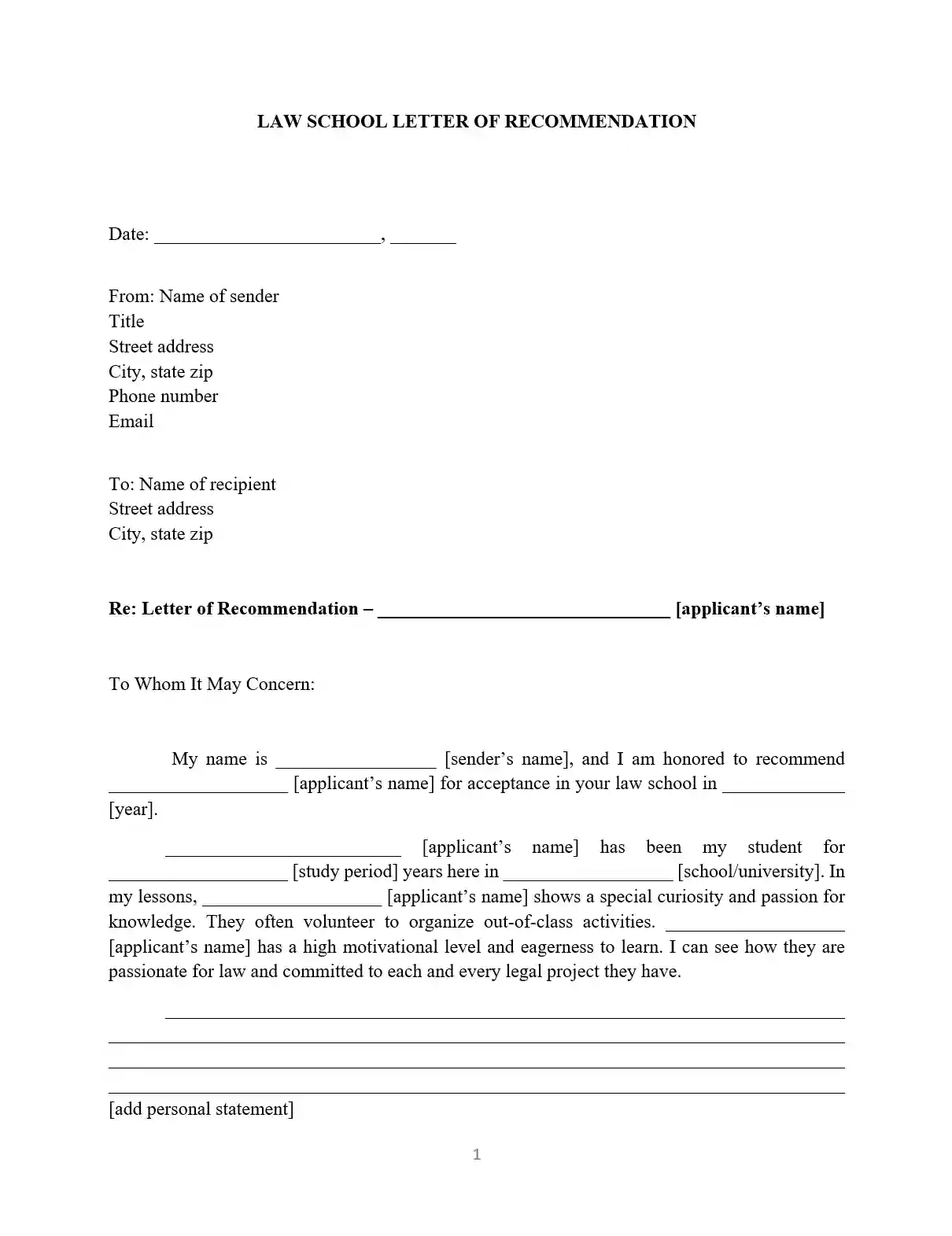
A law school letter of recommendation is a letter from a professor, employer or other referee who knows you well and speaks to your skills and character as part of your application. A Law School Letter of Recommendation (LOR) says a lot about you as a potential student (with all the skills and academic background) and as a person (with positive personal qualities and a strong personality). Use the free template below to create yours online.
Last Updated: October 2026. This guide is reviewed and updated regularly to reflect current law. If you notice an error or outdated information, please contact us.
Build Your Document
Answer a few simple questions to make your document in minutes
Save and Print
Save progress and finish on any device, download and print anytime
Sign and Use
Your valid, lawyer-approved document is ready
Students wishing to join law schools should provide two recommendation letters besides having good LSAT scores and a high GPA. Although it is not obligatory in all law schools, it is a common practice. Even if your desired law school does not require these letters, consider attaching them to increase your chances of being accepted there.
If you aspire to become a law school student, you should prepare a package of documents requested by the institution. The requirements for these documents vary, but law schools require at least two recommendation letters. Do not attach more letters than needed as quality is above quantity. More does not always mean better. It is all about the content, not about the numbers.
For starters, choose a person to write the recommendation letter for you. The person cannot be your friend, judge, or politician as the law school administration will interpret that in the wrong way, leading to disqualification.
It would help if you chose the writer wisely. You can select your employer, teacher’s assistant, or professor, but note you should have a close connection with the author as it significantly affects the quality of the letter. A person who knows your strengths and how to outplay your weaknesses is way better than someone you met once for some educational (or job) purpose.
A recommendation letter carries more weight when it comes from an employer or professor who knows you well. If your employer or professor writes a letter of recommendation for student upon your request, it means they see your potential and the possibility of becoming a future specialist in law. Law schools love to see professionals recommending their students.
Remember to contact this referee in advance, so they have time to prepare—inform them 6-8 weeks earlier. Once you choose the writer, you can discuss the details you want to cover in the letter.
You can provide the writer with some documents to help them to better understand you as a person and as a professional:
Sometimes, law schools require applicants to utilize the Law Student Admissions Council’s Credential Assembly Service to submit their recommendation letters and other documents. Once you do this, LSAC transfers these documents to the selected schools. This saves your time. All in all, utilizing this Service is the best possible option. Remember to notify your referee and teach them how to submit their letters.
A polite, well-prepared request makes it easier for professors and employers to say yes. It also gives your recommender what they need to write about your academic record, your skills and your goals.
Keep the letter clear and focused, and cover each of the points below. There are some mandatory points to include in a Law School Letter of Recommendation (LOR)—the letter would be incomplete without them. So, what should you include in your Law School Letter of Recommendation:
There is a specific structure to follow while writing a letter of recommendation (LOR). The paragraphs must be in a particular order. You cannot mix paragraphs or add extra ones as this is not an essay on a free topic: it is a paper needed for educational purposes. Also, be careful with what you write in the letter and how you do it. Any mistakes or violations can lead to the letter’s rejection, which means risking the applicant’s future.
So, follow the structure of the letter wisely.
The parts of the letter, from top to bottom:
The heading includes a single phrase, “Law School Recommendation Letter.” It should be in the top-middle of the page and highlighted in bold.
Here, the writer is introducing the applicant. Only minor details should be stated in the introduction. The bulk is revealed in the main body of the letter.
The referee should write down their full name, the applicant’s full name, how the two relate, and why they are decent enough to receive such a recommendation. The opening phrase must be either “To Whom It May Concern” or “Dear Law School Admissions Committee.”
If you intend to hand in the letter in person or by mail, write the referee’s full name and contact information.
In this paragraph, the writer should explain why the applicant deserves a positive recommendation. They should be persuasive and convincing enough that the applicant is suitable for admission.
Remember to make the letter as subjective as possible. It is also essential to give a detailed description of the applicant’s traits, their successes compared to others, and qualities that deem them a future successful lawyer.
Avoid generalization and platitudes in the letter.
In conclusion, the writer has to compliment the applicant and support them one more time. Avoid unclear statements in this part to avoid leaving behind blurred emotions.
The conclusion must serve as the summary of everything written in other paragraphs and be as positive as possible.
The referee has to register their contact details at the end of the letter. This includes their full name, address (with city and state), email, and phone number.
The writer should register the current date and sign the letter.
Afterward, the letter should be delivered to the law school or submitted to the Law Student Admissions Council’s Credential Assembly Service depending depends on the conditions established by the law school. Confirm the delivery method beforehand.
Tip: Before the letter goes out, read it once more and check the names, dates and phone number. A quick proofread catches typos that would distract the reader.
Knowing what to add in the letter and what to avoid increases your chances of a favorable outcome regarding letter acceptance. Use the two lists below as a quick checklist before the letter is signed and sent.
Remember to create a positive image of the applicant.
The three samples below cover three different situations involving a Law School Letter of Recommendation (LOR): for law school from employer (Sample 1), for law school from an attorney (Sample 2), for bar admission (Sample 3).
You can use these samples as reference points.
Before you use a sample, go through this short checklist:
Samples are starting points. Fill in every blank with your own facts, and remove anything that does not fit the candidate.
Law School Recommendation Letter
Dear Law School Admissions Committee,
My name is _____________ (insert your name), and I’m willing to recommendation _____________ (type applicant’s name) for acceptance in your law school in _____________ (type the year).
I’ve been acting as _____________ (insert applicant’s name) employer for the past year, and I know only good things about him/her. During this period, _____________ (type applicant’s name) has been combining a full-time job as an assistant bookkeeper in our company and study in the school. Relying on my experience, I can say I’ve never had such a responsible worker as _____________ (insert applicant’s name).
Furthermore, _____________ (insert applicant’s name) has worked as a volunteer in the local shelter and help his/her coworkers with their tasks during free time. Our team can rely on people like _____________ (type applicant’s name) as we know he/she will always be there for us, no matter what.
I firmly believe _____________ (insert applicant’s name) will be an excellent law student and an attorney in the future. All his/her actions make me think like that.
If you have any questions, please contact me at any time.
Best,
_____________ (insert your signature) _____________ (register the signing date)
Phone number: _____________
E-mail: _____________
Law School Recommendation Letter
Dear Law School Admissions Committee,
I would like to recommend _____________ (insert applicant’s name) for an opportunity to become one of your students in _____________ (type the year).
My name is _____________ (type your name), and I’ve known _____________ (insert applicant’s name) for one year. He/she has been an intern at our company in the summer and showed himself/herself from the best side. While other interns would complete only basic requirements, _____________ (type applicant’s name) would volunteer to do tasks even outside the area of his/her competence. Not everyone would do such a thing.
More importantly, I see in _____________ (type applicant’s name) a passion for the law and for what he/she is doing in this field. He/she is curious and yearning for knowledge, and I believe these are essential requirements for everyone who decides to connect their lives with law.
I truly believe _____________ (insert applicant’s name) will be a perfect candidate for the position of an attorney.
For more information, contact me. Let me know if you need my assistance.
Sincerely,
_____________ (insert your signature) _____________ (register the signing date)
Phone number: _____________
E-mail: _____________
Law School Recommendation Letter
To Whom It May Concern,
I feel honored to recommend _____________ (insert applicant’s name) for the position of an attorney at _____________ (type company’s name). As an attorney myself, I had the opportunity to personally supervise _____________’s (type applicant’s name) work at my office. I can say he/she met all necessary requirements and performed all the duties with distinction.
When working in the office, _____________ (insert applicant’s name) made several types of research and helped me with the preparation of presentations for trials. He/she would also conduct several hearings for a few criminal cases. One of those cases covered a brutal murder, and he/she acted as a professional during the process without expressing inappropriate emotions. In my opinion, this is the quality of a true professional. He/she did everything at the highest level, making me feel confident about him/her being able to work as an attorney at your company.
I strongly advise you to consider the candidacy of _____________ (type applicant’s name) for the position of an attorney. I vouch for him/her as I know what he/she is capable of in the professional field.
If you have any questions referring to the candidate, feel free to contact me.
Respectfully Yours,
_____________ (insert your signature) _____________ (register the signing date)
Phone number: _____________
E-mail: _____________
Knowing and following the basic principles of writing a Law School Letter of Recommendation (LOR), you can write one by yourself and do it without any mistakes. Just remember to follow the structure, add essential items, and appropriately deliver the completed letter. Follow the recommendations mentioned above, and always ensure the letter is positive as possible due to the specificity of the letter.
Choose someone who knows your work and character well, such as one of your professors, a teaching assistant or an employer. A writer who can describe concrete examples of your work gives the letter more substance.
Specific examples of your work, your skills and your character, written by someone who has seen them first hand. A short story about a project, a paper or a challenge you handled well says more than general praise.
Aim for about one page. A short letter with concrete examples is easier to read than a long letter full of general praise.
Ask as early as you can, so the writer has time to think about concrete examples and to write without rushing.
Share enough background for the writer to choose strong examples:
Use the samples as a model, not a final draft. Replace each blank with real facts and add your own examples so the letter reflects you.
Select Create My Document at the top of the page and answer a few questions. FormsPal saves your progress, so you can finish on any device, then download and print the letter. You can also download a Microsoft Word version, then keep editing in Word or Google Docs, or send a PDF by Gmail or Outlook.
General information, not legal or tax advice.
