Free Michigan Lady Bird Deed Form

A Michigan lady bird deed is a deed that lets a homeowner keep a life estate and names who receives the home afterward. The person who receives it is called the beneficiary. It is also called an enhanced life estate deed. Michigan's deed statutes set out how a deed is signed, acknowledged and recorded.[1]

Last Updated: October 2026. This guide is reviewed and updated regularly to reflect current Michigan law. If you notice an error or outdated information, please contact us.

Michigan lady bird deed form preview

Create a free high quality Michigan Lady Bird Deed Form online now!

Build Your Document

Answer a few simple questions to make your document in minutes

Save and Print

Save progress and finish on any device, download and print anytime

Sign and Use

Your valid, lawyer-approved document is ready

Download the Michigan Lady Bird Deed: PDF or Word (.docx) or OpenDocument (.odt)

What a Michigan Lady Bird Deed Does

A lady bird deed splits ownership of a property into two parts. The owner, called the grantor, signs the deed and keeps a life estate, which is the right to the property for the rest of their life. The beneficiary receives the property after the grantor's death.

The title line of the FormsPal template reads "Lady Bird Deed (Enhanced Life Estate Deed)".

The FormsPal template conveys the property to the beneficiary effective on the grantor's death and not sooner, subject to a life estate in favor of the grantor. Its stated intention is to let the property pass to the beneficiary without probate proceedings of any form.

The wording also reserves the grantor's right to revoke the deed, and to sell, lease or mortgage the property, without notice to or consent of the beneficiary.

You can also browse our lady bird deed forms and all deed forms.

Reasons People Use a Lady Bird Deed

People choose a lady bird deed to decide ahead of time who receives a home, while they keep living in it. These are common reasons in practice and are not rules of Michigan law. Michigan's actual deed requirements are in the next section.

  • Naming a beneficiary in advance. The deed names the person, trust or organization that receives the property after the owner's death.
  • Staying in the home. The owner keeps a life estate, so the owner can continue to use the property during their lifetime.
  • Using one document. Michigan law says land may be conveyed by a deed that is signed, sealed, acknowledged or proved and recorded as the statute directs, without any other act or ceremony.[1]
  • Keeping the plan separate from a will. A provision for a nonprobate transfer on death in a conveyance is nontestamentary under Michigan law, which means it is not treated as a will provision.[4]

Lady Bird Deed Laws and Requirements in Michigan

In Michigan, land passes by a deed that the owner signs and seals. The owner must be of lawful age. The deed is then acknowledged or proved and recorded as the statute directs.[1] The sections below cover the signing rule, the acknowledgment, and the details a deed must show to be recorded.

Laws

Michigan's deed rules are in Chapter 565 of the Michigan Compiled Laws (MCL).[1] Michigan has no statute that sets out the lady bird deed or its effect, because the doctrine comes from common law and not from a statute. For the same reason, no statute says whether the owner may sell or revoke the deed without the beneficiary.

Before you file, ask your county's recording office what it needs.

Signing and Acknowledgment

The owner signs and seals the deed, and the owner must be of lawful age. The owner's lawful agent or attorney may sign for the owner instead. The deed is then acknowledged or proved and recorded as the statute directs, without any other act or ceremony.[1]

A deed for land that is signed in Michigan is acknowledged before a judge, a clerk of a court of record, or a notary public in the state.[2] The statute puts it this way:

Deeds executed within this state of lands, or any interest in lands, shall be acknowledged before any judge, clerk of a court of record, or notary public within this state.

MCL 565.8

The FormsPal template ends with an acknowledgment block for a notary public.

Recording Requirements

To be recorded in Michigan, a deed must carry these details:

  • The name of each person who signs, legibly printed, typewritten or stamped beneath the original signature or mark, with the signature or mark in black or dark blue ink.[3.1]
  • The address of each grantee, which is the street number address where street number addresses are in common use and the post office address if not.[3.2] The grantee is the person the deed conveys the property to.
  • The name and business address of the person who drafted the deed, if the deed is executed after January 1, 1964.[3.3]

The FormsPal template has a line for the preparer, a printed name under each signature, and the beneficiary's address.

How to Fill Out the Michigan Lady Bird Deed

Build the FormsPal Michigan lady bird deed online or download the PDF, then fill in each part in the order below. The steps follow the template page by page. You can fill in the downloaded PDF with our online PDF editor.

The screenshots under each step show the FormsPal Michigan lady bird deed template filled with sample entries in blue, so you can see where each answer goes. The names, addresses, dates and amounts are examples only.

  1. This Deed was prepared by. Enter the name and address of the person who prepared the deed at the top of page 1. Use the Attn line only if you need it.
    Michigan lady bird deed: This Deed was prepared by, filled with sample entries
    Step 1: sample entries, not a real document.
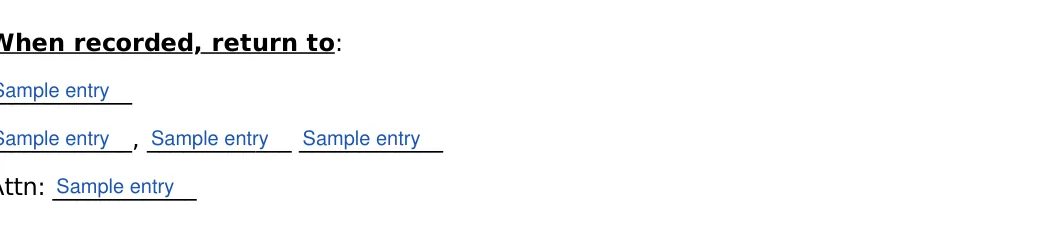
  2. When recorded, return to. Enter the name and address where the recorded deed should be sent back. Add an Attn line if it is needed.
    Michigan lady bird deed: When recorded, return to, filled with sample entries
    Step 2: sample entries, not a real document.
  3. Tax Parcel Number/Assessor Parcel Number. Enter the property's parcel number from your property tax records.
    Michigan lady bird deed: Tax Parcel Number/Assessor Parcel Number, filled with sample entries
    Step 3: sample entries, not a real document.
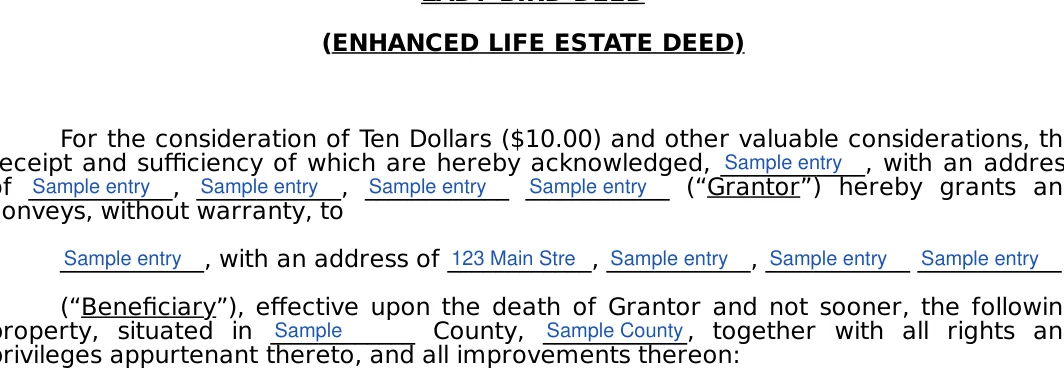
  4. Grantor, beneficiary and property. In the deed paragraph, enter the grantor's name and address, the beneficiary's name and address, and the county and state where the property sits. The grantor is the current owner who signs the deed.
    Michigan lady bird deed: (ENHANCED LIFE ESTATE DEED), filled with sample entries
    Step 4: sample entries, not a real document.
  5. Date the deed. On page 2, enter the month, day and year on the DATED line.
    Michigan lady bird deed: Lady bird deed mi.24.dated, Lady bird deed mi.25.blank and more, filled with sample entries
    Step 5: sample entries, not a real document.
  6. Grantor signature and printed name. Sign on the By line and print the grantor's name on the Name line.
    Michigan lady bird deed: (SEAL), filled with sample entries
    Step 6: sample entries, not a real document.
  7. First witness. The first witness signs on the By line, then prints their name and address.
    Michigan lady bird deed: Witness, filled with sample entries
    Step 7: sample entries, not a real document.
  8. Second witness. The second witness signs and prints their name and address in the same way.
    Michigan lady bird deed: Witness, filled with sample entries
    Step 8: sample entries, not a real document.
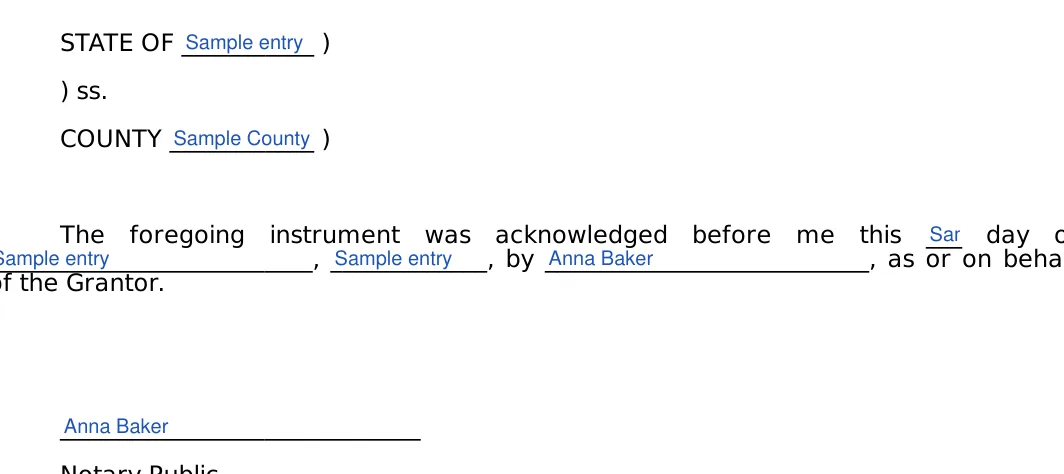
  9. Acknowledgment before the notary. On page 3, enter the state and county, then complete the acknowledgment block with the notary: the day, month and year, and the name of the person acknowledging. The notary signs on the Notary Public line.
    Michigan lady bird deed: Lady bird deed mi.41.state of, Lady bird deed mi.42.county and more, filled with sample entries
    Step 9: sample entries, not a real document.
  10. Notary commission expiration. The notary enters the commission expiration date on the My commission expires line.
    Michigan lady bird deed: My commission expires, filled with sample entries
    Step 10: sample entries, not a real document.
  11. Exhibit A. On page 4, repeat the tax parcel number and write the legal description of the property.
    Michigan lady bird deed: Lady bird deed mi.49.tax parcel number, filled with sample entries
    Step 11: sample entries, not a real document.

How to Sign and Record the Michigan Lady Bird Deed

After you fill in the template, the deed is signed, acknowledged and then recorded.[1] The steps below put those actions in order. The laws section above explains what Michigan requires for each one.

  1. Sign the deed. The grantor signs on the By line of page 2 and prints their name below the signature.
  2. Have the signature acknowledged. Take the deed to a judge, a clerk of a court of record, or a notary public in Michigan, who completes the acknowledgment block on page 3.[2]
  3. Record the deed. Ask your county's recording office how to file the original deed and what it needs. Check the recording details listed above before you go.
  4. Keep a copy. Save a copy of the signed deed for your records.

Frequently Asked Questions

These short answers cover common questions about signing, acknowledging and recording a deed in Michigan. Each answer comes from the Michigan statute cited at its end, so you can check the exact wording.

How must a deed be signed to convey land in Michigan?

The deed must be signed and sealed by the owner, who must be of lawful age, or by the owner's lawful agent or attorney. It is then acknowledged or proved and recorded as the statute directs, without any other act or ceremony.[1]

Who can take the acknowledgment on a deed in Michigan?

A deed of land executed in Michigan must be acknowledged before one of these officers:

  • A judge
  • A clerk of a court of record
  • A notary public

The officer must be within the state.[2]

Must a deed show who drafted it to be recorded in Michigan?

Yes, if the deed is executed after January 1, 1964. To be recorded, it must contain the name and business address of the person who drafted it.[3.3]

Does a deed have to show the address of each grantee in Michigan?

To be recorded, yes. The address of each grantee must be legibly printed, typewritten or stamped on the instrument. It is the street number address where those are in common use, and otherwise the post office address.[3.2]

Must a signer's name be printed under the signature on a deed in Michigan?

To be recorded, the name of each person who signs must be legibly printed, typewritten or stamped beneath the original signature or mark. The signature or mark must be in black or dark blue ink.[3.1]

Is a transfer on death provision in a deed treated as a will in Michigan?

No. A provision for a nonprobate transfer on death in a conveyance, a deed of gift or a similar written instrument is nontestamentary. In plain words, it is not treated as a will.[4]

General information, not legal or tax advice.

Sources

  1. MCL 565.1.
  2. MCL 565.8.
  3. MCL 565.201.
    • 3.1 MCL 565.201(1)(a)
    • 3.2 MCL 565.201(1)(d)
    • 3.3 MCL 565.201(1)(i)
  4. MCL 700.6101(1).
Published: May 15, 2022
Mara Erlach
Mara Erlach
Writer & Attorney
Mara has been practicing estate planning and trust law in California since 2003, taking pride in helping clients of all backgrounds and asset profiles form a complete and customized estate plan. Her specialties are: estate planning, wills and trusts, trust and probate administration.