Colorado Power of Attorney Requirements: General Financial Form
A Colorado general power of attorney is a written document that lets you, the principal, name an agent (also called an attorney-in-fact) to handle your finances. Colorado power of attorney requirements cover signing, acknowledgment, the effective date and governing law. This form does not authorize health care decisions, so use a Colorado medical power of attorney for those. A power of attorney that is not a durable power of attorney ends if the principal becomes incapacitated.[1.5] See all Colorado power of attorney forms.
Last Updated: October 2026. This guide is reviewed and updated regularly to reflect current Colorado law. If you notice an error or outdated information, please contact us.
Create a personalized Colorado General Financial Power of Attorney Form online now!
Build Your Document
Answer a few simple questions to make your document in minutes
Save and Print
Save progress and finish on any device, download and print anytime
Sign and Use
Your valid, lawyer-approved document is ready
... or download your Colorado General Financial Power of Attorney Form as a PDF file
Colorado Power of Attorney Requirements
Colorado's power of attorney statute sets a few basic rules for a general power of attorney. They cover who signs, how a signature is shown to be genuine, when the document takes effect, and which state's law applies. The law is detailed in the Colorado Revised Statutes, Sections 15-14-701 through 15-14-745.[1.7]
Signature and acknowledgment. A power of attorney must be signed by the principal or in the principal's conscious presence by another individual directed by the principal to sign the principal's name on the power of attorney. A signature is presumed to be genuine if the principal acknowledges the signature before a notary public or other individual authorized by law to take acknowledgments.[1.1]
Effective date. A power of attorney is effective when executed unless the principal provides in the power of attorney that it becomes effective at a future date or upon the occurrence of a future event or contingency.[1.4]
Governing law. The meaning and effect of a power of attorney is determined by the law of the jurisdiction indicated in the power of attorney. If it indicates none, the law of the jurisdiction in which the power of attorney was executed applies.[1.3]
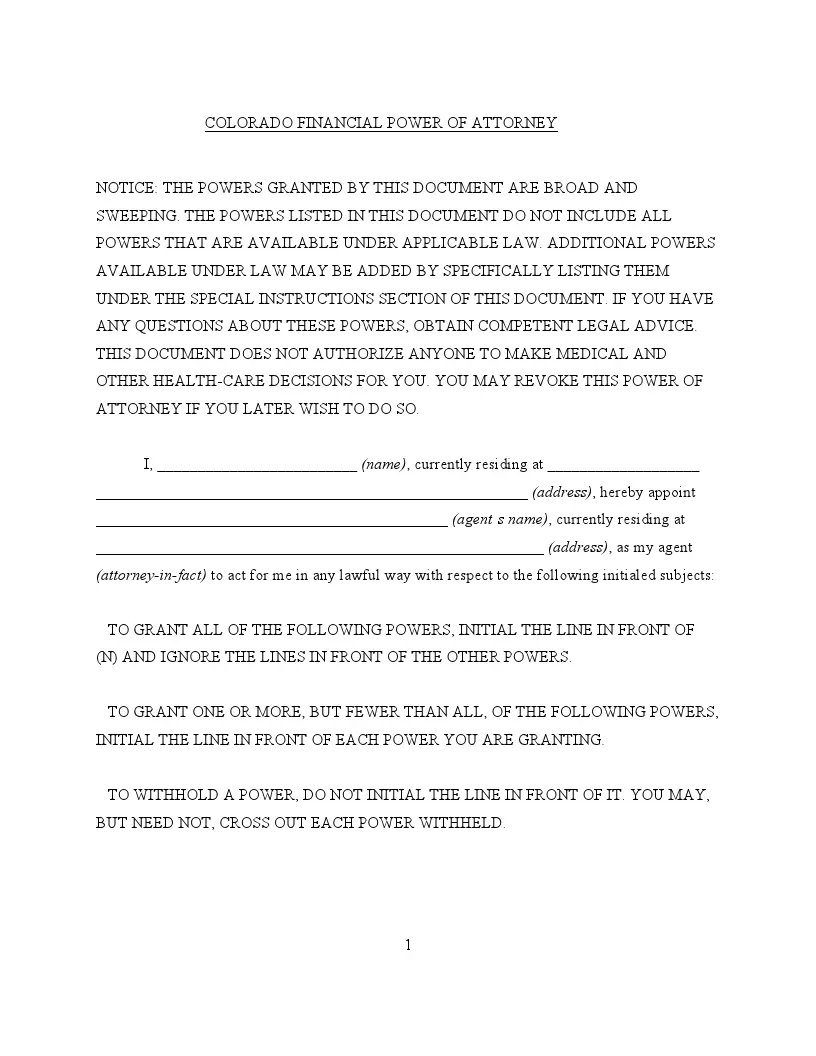
The title printed on the form is "Colorado Financial Power of Attorney." It is the same document as the Colorado general power of attorney. Page 1 of the form says it does not authorize anyone to make medical and other health-care decisions for you.
How to Fill Out the Colorado General Power of Attorney Form PDF
The Colorado general power of attorney form PDF has five form pages. Page 1 names the principal and the agent, page 2 lists the powers you can grant, and page 3 sets the effective and termination dates. Page 4 covers the successor agent and your signature. Page 5 is the acknowledgment. Create the form online with the FormsPal builder above, or download the PDF.
The screenshots under each step show the FormsPal Colorado general power of attorney template filled with sample entries in blue, so you can see where each answer goes. The names, addresses, dates and amounts are examples only.
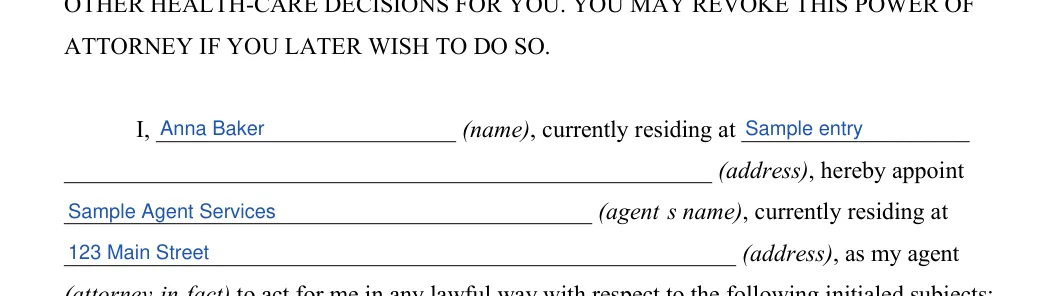
Name the principal and the agent (page 1). Fill in your name and address, then the name and address of your agent, in the sentence that begins "I, ___ (name)." The notice above it is printed text and needs nothing from you.Step 1: sample entries, not a real document.
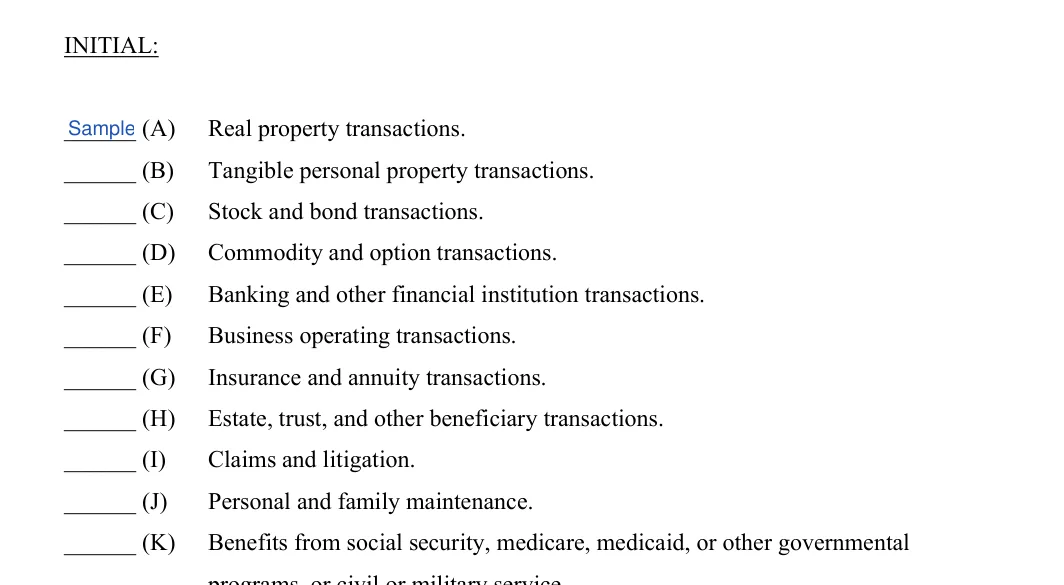
Initial powers (A) to (K) (page 2). Put your initials on the line in front of each power you grant, from (A) Real property transactions to (K) Benefits from social security, medicare, medicaid, or other governmental programs. Leave a line blank to withhold that power.Step 2: sample entries, not a real document.
Initial powers (L), (M) and (N) (page 2). Initial (L) Retirement plan transactions and (M) Tax matters if you grant them. To grant every power, initial only line (N), ALL OF THE POWERS LISTED ABOVE. The form says you need not initial any other line then. The Special Instructions that follow are printed text.Step 3: sample entries, not a real document.
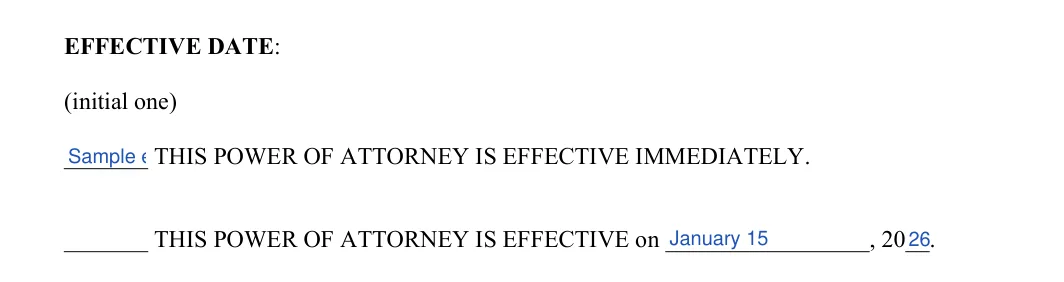
Choose the effective date (page 3). Initial one line: effective immediately, or effective on a date. If you choose a date, write the day and year in the blanks.Step 4: sample entries, not a real document.
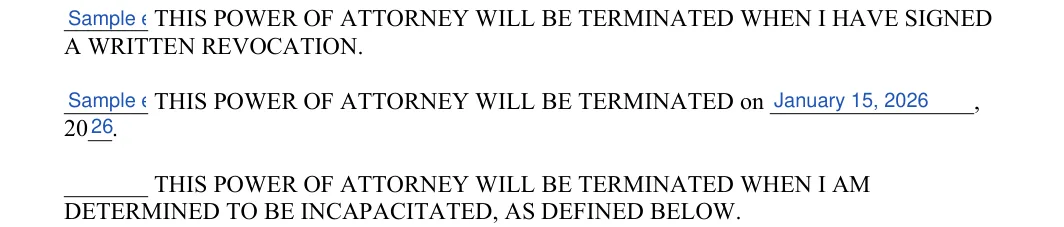
Termination date: written revocation (page 3). Under TERMINATION DATE, initial the first line if the power should end when you have signed a written revocation. The form says to initial one line in this section.Step 5: sample entries, not a real document.
Termination date: a fixed date or incapacity (page 3). Initial the line for termination on a date and write the date and year. Or initial the line for termination when you are determined to be incapacitated, as defined in the paragraph that follows on pages 3 and 4.Step 6: sample entries, not a real document.
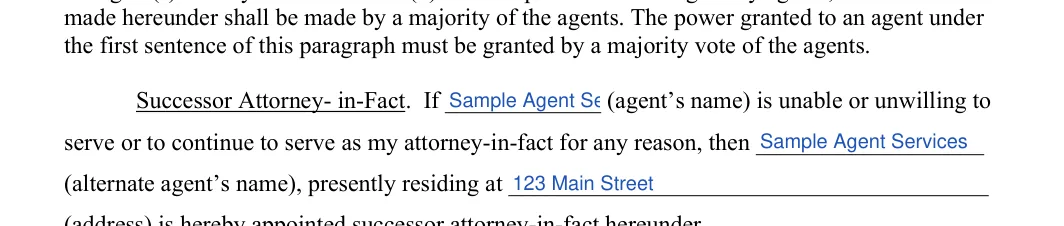
Name the successor attorney-in-fact (page 4). In the Successor Attorney-in-Fact paragraph, write your agent's name, then the alternate agent's name and address. The paragraph above it about multiple agents is printed text.Step 7: sample entries, not a real document.
Date and sign the document (page 4). Fill in the day, month and year in "Signed this ___ day of ___, 20__." Then sign on the signature line and print your name below it.Step 8: sample entries, not a real document.
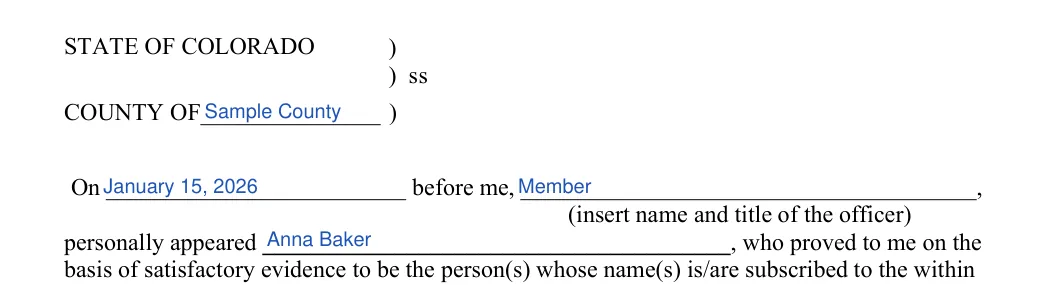
Complete the acknowledgment details (page 5). Under STATE OF COLORADO, enter the county, the date, the name and title of the officer, and the name of the person who signed.Step 9: sample entries, not a real document.
Officer's signature and seal (page 5). The line marked Signature and (seal) at the foot of page 5 is for the notary public or other officer who completes the acknowledgment. Leave it for them.Step 10: sample entries, not a real document.
Read the Termination Date section on page 3 before you initial anything. One line ends the power of attorney when you are determined to be incapacitated. Under the Colorado statute, a power of attorney that is not durable terminates if the principal becomes incapacitated.[1.5]
How to Sign and Use the Colorado General Power of Attorney
Once the form is filled in, three things remain: signing it, having the acknowledgment completed, and getting copies to the people who need them. Then keep the signed original where it will not be lost.
Sign the form. Sign on the signature line on page 4. The acknowledgment on page 5 is completed by a notary public or other officer. See the Colorado notary acknowledgment form.
Tell your agent. Give the person you name as agent a copy and talk through what you expect them to handle.
Share copies. Many people also give copies to a trusted advisor, such as an attorney or financial consultant, and to the banks and other institutions the agent will deal with. Having the document on hand can prevent delays when it is needed.
Keep the original safe. Store the signed original in a secure place and note where it is for your agent.
Revoke it if your plans change. The notice on page 1 of the form says you may revoke the power of attorney if you later wish to do so. The next section explains how a power of attorney ends.
When a Colorado Power of Attorney Ends
A Colorado power of attorney can end in several ways, and the agent's authority can end on its own while the document continues. The statute lists both kinds of events.
The principal becomes incapacitated, if the power of attorney is not durable.[1.5]
The express purpose of the power of attorney is accomplished.[1.5]
The power of attorney provides that it terminates.[1.5]
The principal revokes the agent's authority or the agent dies, becomes incapacitated, or resigns, and the power of attorney does not provide for another agent to act under the power of attorney.[1.5]
The agent dies, becomes incapacitated, or resigns.[1.5]
An action is filed for the dissolution or annulment of the agent's marriage to the principal or their legal separation, unless the power of attorney otherwise provides.[1.5]
Termination of an agent's authority or of a power of attorney is not effective as to the agent or another person that, without actual knowledge of the termination, acts in good faith under the power of attorney.
In plain words, an agent or other person who acts on the document in good faith, not knowing it has ended, is protected. An act so performed, unless otherwise invalid or unenforceable, binds the principal and the principal's successors in interest.[1.5]
Create a personalized Colorado General Financial Power of Attorney Form online now!
Frequently Asked Questions
Does a Colorado power of attorney need to be notarized?
Colorado's statute says a signature is presumed to be genuine if the principal acknowledges it before a notary public or other individual authorized by law to take acknowledgments.[1.1] The form on this page has an acknowledgment block on page 5 for the officer to complete.
How do I get a power of attorney in Colorado?
You prepare a written power of attorney, such as the form on this page. Two statutory points then apply.
It must be signed by the principal or in the principal's conscious presence by another individual directed by the principal to sign the principal's name.[1.1]
A person named as agent accepts the appointment by exercising authority or performing duties as an agent, or by any other assertion or conduct indicating acceptance, unless the power of attorney provides otherwise.[1.6]
Is a photocopy of a Colorado power of attorney valid?
Unless another statute provides otherwise, a photocopy or electronically transmitted copy of an original power of attorney has the same effect as the original.[1.2]
How do you revoke a power of attorney in Colorado?
The principal revokes the power of attorney, or revokes the agent's authority, and that ends it as the statute describes. Signing a later power of attorney does not revoke an earlier one. It does so only if the later one provides that the previous power of attorney is revoked or that all other powers of attorney are revoked.[1.5]
Does a Colorado power of attorney end if the principal becomes incapacitated?
It does if the power of attorney is not durable. Even then, incapacity does not end the power of attorney as to an agent or other person that acts in good faith under it. That protection applies only if they have no actual knowledge of the incapacity.[1.5]
Mara has been practicing estate planning and trust law in California since 2003, taking pride in helping clients of all backgrounds and asset profiles form a complete and customized estate plan. Her specialties are: estate planning, wills and trusts, trust and probate administration.