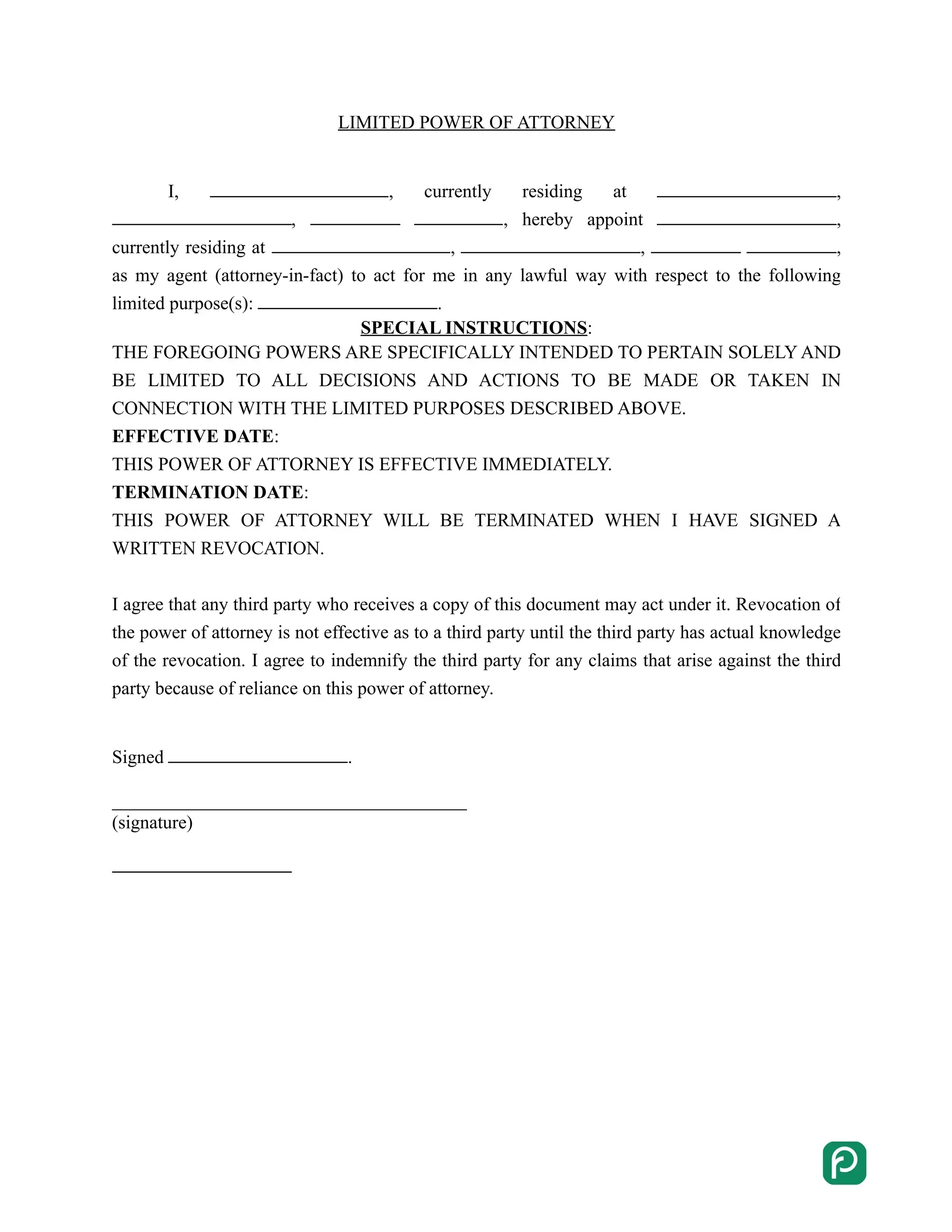
A New Hampshire limited power of attorney is a written document in which you, the principal, appoint an agent to act for you on specific tasks only. A general power of attorney gives an agent broad authority. A limited one confines the agent to the purposes you list. Use this free New Hampshire limited power of attorney form to name your agent, list those purposes and print the PDF.
Last Updated: October 2026. This guide is reviewed and updated regularly to reflect current New Hampshire law. If you notice an error or outdated information, please contact us.
Create a free high-quality New Hampshire Limited Power of Attorney Form online now!
Build Your Document
Answer a few simple questions to make your document in minutes
Save and Print
Save progress and finish on any device, download and print anytime
Sign and Use
Your valid, lawyer-approved document is ready
... or download your New Hampshire Limited Power of Attorney Form as a PDF file
When to Use a New Hampshire Limited Power of Attorney
Use a New Hampshire limited power of attorney when you want someone to handle a defined task for you and nothing more. You list each task on the purpose lines of the form. The Special Instructions printed on the form limit the agent to those tasks.
If the task needs a different document, FormsPal has related New Hampshire forms:
Because a limited power of attorney covers only the tasks you write down, the purpose lines matter most. The examples below show the kind of single task people list on the form. Each one names a defined job, a place or a time limit.
Closing on one real estate transaction while you are out of town.
Handling a single financial or legal matter that needs your signature.
Selling or transferring one vehicle.
Managing one bank account for a set period.
Dealing with one company or office while you are traveling.
The more specific the wording, the clearer the agent's role is to the people who read the document.
New Hampshire Limited Power of Attorney Requirements
Under N.H. Rev. Stat. Ann. § 564-E:105, the principal must sign the power of attorney, other than by electronic signature. Another individual may sign the principal's name instead. That works only if the principal directs it and the signing happens in the principal's conscious presence.[1]
The notary rule depends on the type of power of attorney. The statute sets these rules:
General power of attorney. It must be acknowledged before a notary public or other individual authorized by law to take acknowledgments.
Power of attorney to convey real estate. It must be signed and acknowledged the same way.
Any other power of attorney. It needs only the principal's signature.
Disclosure statement. The statute sets out a disclosure statement. In substantially that form, and signed (other than by electronic signature) by the principal or by another individual directed by the principal to sign the principal's name, it must be affixed to the power of attorney.
A signature on a power of attorney is presumed genuine if the principal acknowledges it before a notary public or other individual authorized by law to take acknowledgments.[1] The form prints an acknowledgment block for a notary on page 3, so you can use it.
The acknowledgment on page 3 says that a notary public or other officer verifies only the identity of the individual who signed the document. The notary does not verify the truthfulness, accuracy or validity of the document.
The agent appointed in the power of attorney must adhere to specific duties outlined in N.H. Rev. Stat. Ann. § 564-E:114. One of them is to act in accordance with the principal's reasonable expectations to the extent actually known by the agent and, otherwise, in the principal's best interest.[3]
New Hampshire Limited Power of Attorney Form Details
When a New Hampshire Limited Power of Attorney Ends
A New Hampshire power of attorney ends on its own terms or when one of the events in the statute happens. On this form, you choose the termination point in the Termination Date section. The list below sets out the events that end the power of attorney itself.
Under N.H. Rev. Stat. Ann. § 564-E:110, a power of attorney terminates when:
The principal dies.
The principal becomes incapacitated, if the power of attorney is not durable.
The principal revokes the power of attorney.
The power of attorney provides that it terminates.
The purpose of the power of attorney is accomplished.
The principal revokes the agent's authority, or the agent dies, becomes incapacitated, or resigns, and the power of attorney does not provide for another agent to act under the power of attorney.
[2] The form has a Successor Attorney-in-Fact paragraph where you can name an alternate agent.
How to Fill Out the New Hampshire Limited Power of Attorney Form
To fill out the New Hampshire limited power of attorney form, start on page 1 with the principal and the agent. Then list the tasks the agent may handle and set the dates. The form has three pages, and the steps below follow its order. Use the Create My Document button above to build the form online, or download the NH limited power of attorney form as a PDF.
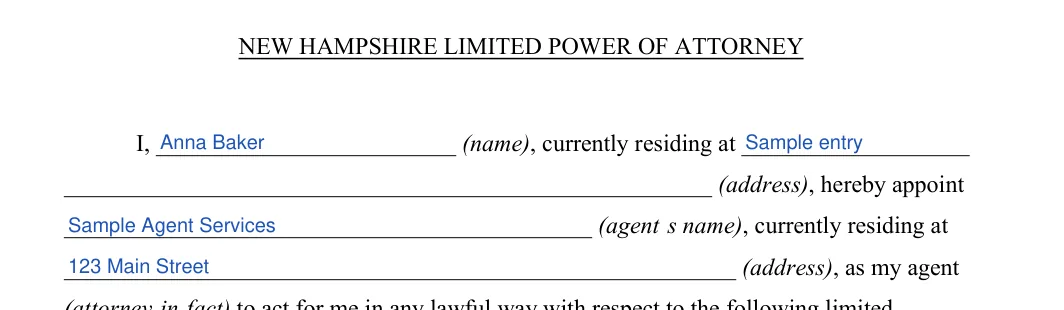
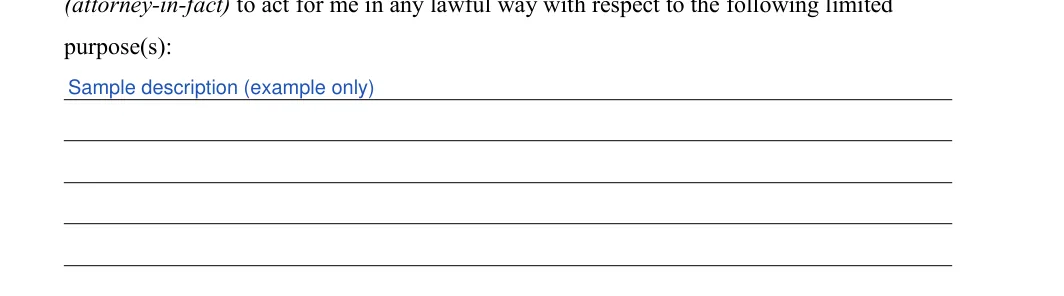
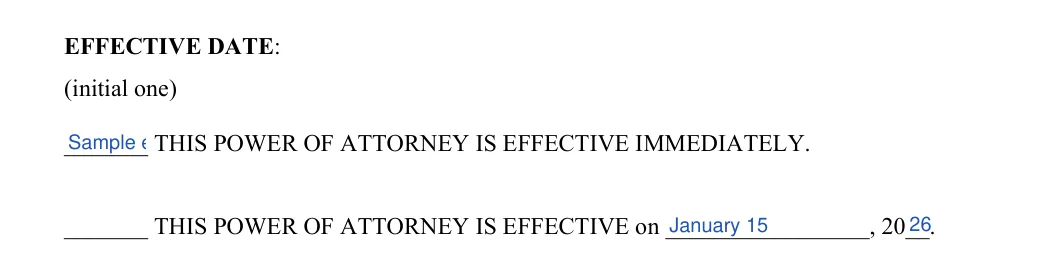
The screenshots under each step show the FormsPal New Hampshire limited power of attorney template filled with sample entries in blue, so you can see where each answer goes. The names, addresses, dates and amounts are examples only.
Principal and agent (page 1). In the opening paragraph, enter your name and address as the principal. Then enter the name and address of the person you appoint as your agent, also called the attorney-in-fact.Step 1: sample entries, not a real document.
Limited purposes (page 1). Write each task the agent may handle on the purpose lines. Be specific, because the Special Instructions printed below the lines limit the powers to these purposes. That statement is preprinted and needs no entry.Step 2: sample entries, not a real document.
Effective date (page 1). The form offers two lines, and you initial one. The first line starts the agent's role right away. The second starts it on a date that you write in the blank.Step 3: sample entries, not a real document.
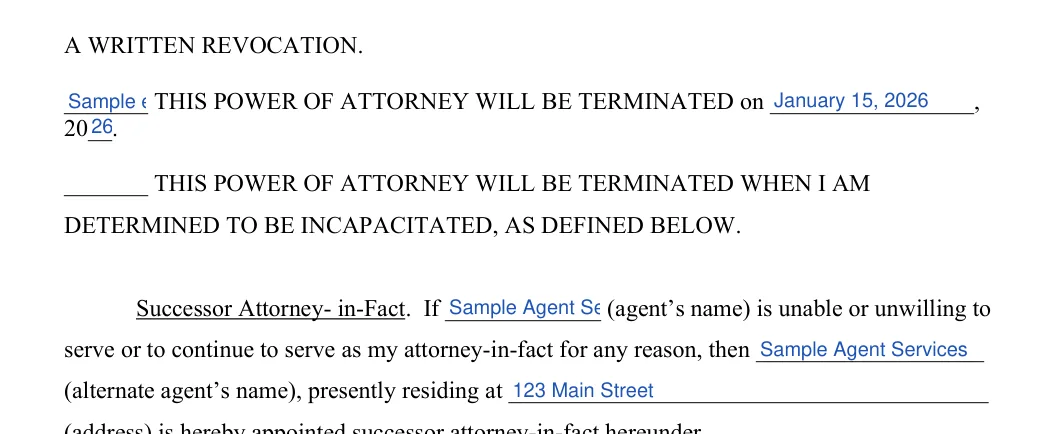
Termination date: written revocation (page 1). Under Termination Date, you initial one line in total. Initial this first line if the power of attorney should end when you have signed a written revocation. The other termination choices continue on page 2.Step 4: sample entries, not a real document.
Other termination options and successor agent (page 2). Initial the line for a set termination date or the line for when you are determined to be incapacitated, if you choose one of those instead. Write the date if you use the date line. Then enter your agent's name, the alternate agent's name and the alternate's address in the Successor Attorney-in-Fact paragraph. The next paragraph says you agree to indemnify a third party who relies on a copy, so read it before you sign.Step 5: sample entries, not a real document.
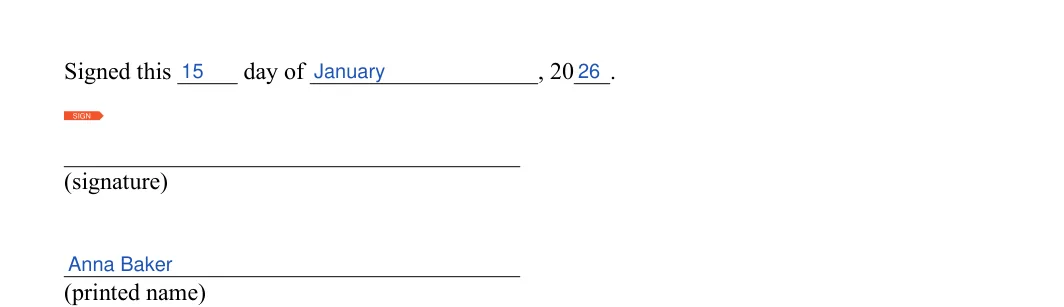
Date, signature and printed name (page 2). Enter the day, month and year on the "Signed this" line. Sign on the signature line and print your name below it.Step 6: sample entries, not a real document.
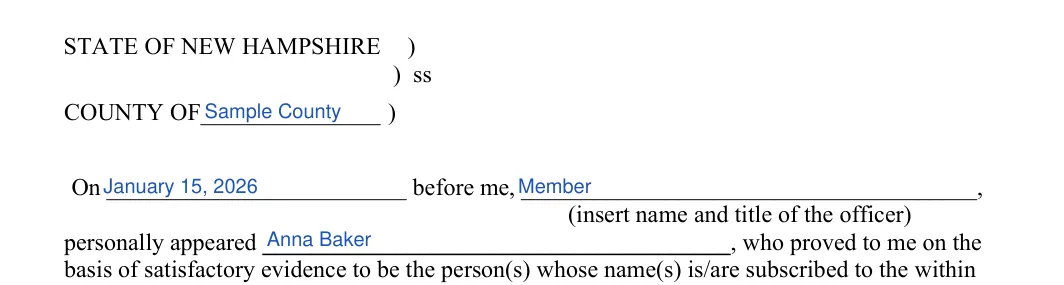
Acknowledgment: county, date, officer and principal (page 3). Page 3 opens with the acknowledgment for a notary. Enter the county, the date, the name and title of the officer, and your name as the person who appeared.Step 7: sample entries, not a real document.
Officer signature and seal (page 3). The notary public or other officer signs on the Signature line next to the seal mark. You do not fill in this line.Step 8: sample entries, not a real document.
The incapacity option on page 2 says "as defined below", but the form prints no definition. If you want that option, consider spelling out in the limited purposes what you mean. Otherwise, choose a date instead.
How to Sign and Use the New Hampshire Limited Power of Attorney
Once the form is filled in, read it again before you sign. Then print it, sign it and share copies with the people who will rely on the document. The steps below cover what to do before and after you sign.
Read the whole form first. Make sure you understand the powers you give your agent and the limits you set.
Sign in front of a notary if you want one. The acknowledgment on page 3 is for a notary public or other officer, who completes it after you sign.
Share copies. Give copies of the signed form to your agent, any alternate agent and the banks or offices that will ask for proof of the agent's authority.
Keep the original safe. Store it where you and your agent can find it, such as a safe deposit box.
Tell people if you end it early. If you sign a written revocation, tell your agent and everyone who holds a copy.
Common Mistakes to Avoid
Most problems with a limited power of attorney come from unclear wording or missing paperwork. Check the form against this list before you hand it to anyone:
Purposes that are too vague, such as "handle my affairs", which read like a general power of attorney.
Blank lines or an unchecked date option on pages 1 and 2.
Missing signatures, either yours or the notary's if you use the acknowledgment.
Handing over the only copy instead of keeping the original.
Frequently Asked Questions
These questions cover what happens to a New Hampshire power of attorney and to the agent's authority when the facts change. Each answer comes from the New Hampshire statutes listed in the Sources section at the end of this page.
When does an agent's authority end?
Under N.H. Rev. Stat. Ann. § 564-E:110, an agent's authority terminates when:
The principal revokes the authority.
The agent dies, becomes incapacitated, or resigns.
A petition for divorce, annulment, separation or a decree of nullity is filed about the agent's marriage to the principal, unless the power of attorney says otherwise.
What happens to my power of attorney if I become incapacitated?
If the power of attorney is not durable, your incapacity ends it. The statute adds a limit for people who rely on it. Your incapacity does not revoke or terminate the power of attorney as to an agent or other person who acts in good faith. That holds only when they have no actual knowledge of the incapacity.[2]
What if my agent acts before learning the power of attorney has ended?
A termination does not take effect as to an agent or another person who acts in good faith under the power of attorney without actual knowledge of it. An act done that way binds the principal and the principal's successors in interest, unless the act is otherwise invalid or unenforceable.[2]
Does a new power of attorney cancel an earlier one?
Not by itself. Signing a new power of attorney does not revoke one the principal signed earlier. It does so only if the new one provides that the previous power of attorney is revoked or that all other powers of attorney are revoked.[2]
General information, not legal or tax advice.
Create a free high-quality New Hampshire Limited Power of Attorney Form online now!
Sources
Unless noted otherwise, the sources below are from the N.H. Rev. Stat. Ann.
Mara has been practicing estate planning and trust law in California since 2003, taking pride in helping clients of all backgrounds and asset profiles form a complete and customized estate plan. Her specialties are: estate planning, wills and trusts, trust and probate administration.