
A New Hampshire motor vehicle power of attorney form is a paper that lets an owner, the principal, appoint an agent to handle titling, registration and other car matters. It is useful when the owner cannot visit the office in person. This power of attorney template is necessary for conducting various transactions at the New Hampshire Division of Motor Vehicles (DMV) without the vehicle owner’s direct involvement. The FormsPal template below lets you create the form online or download it as a PDF.
Last Updated: October 2026. This guide is reviewed and updated regularly to reflect current law. If you notice an error or outdated information, please contact us.
Build Your Document
Answer a few simple questions to make your document in minutes
Save and Print
Save progress and finish on any device, download and print anytime
Sign and Use
Your valid, lawyer-approved document is ready
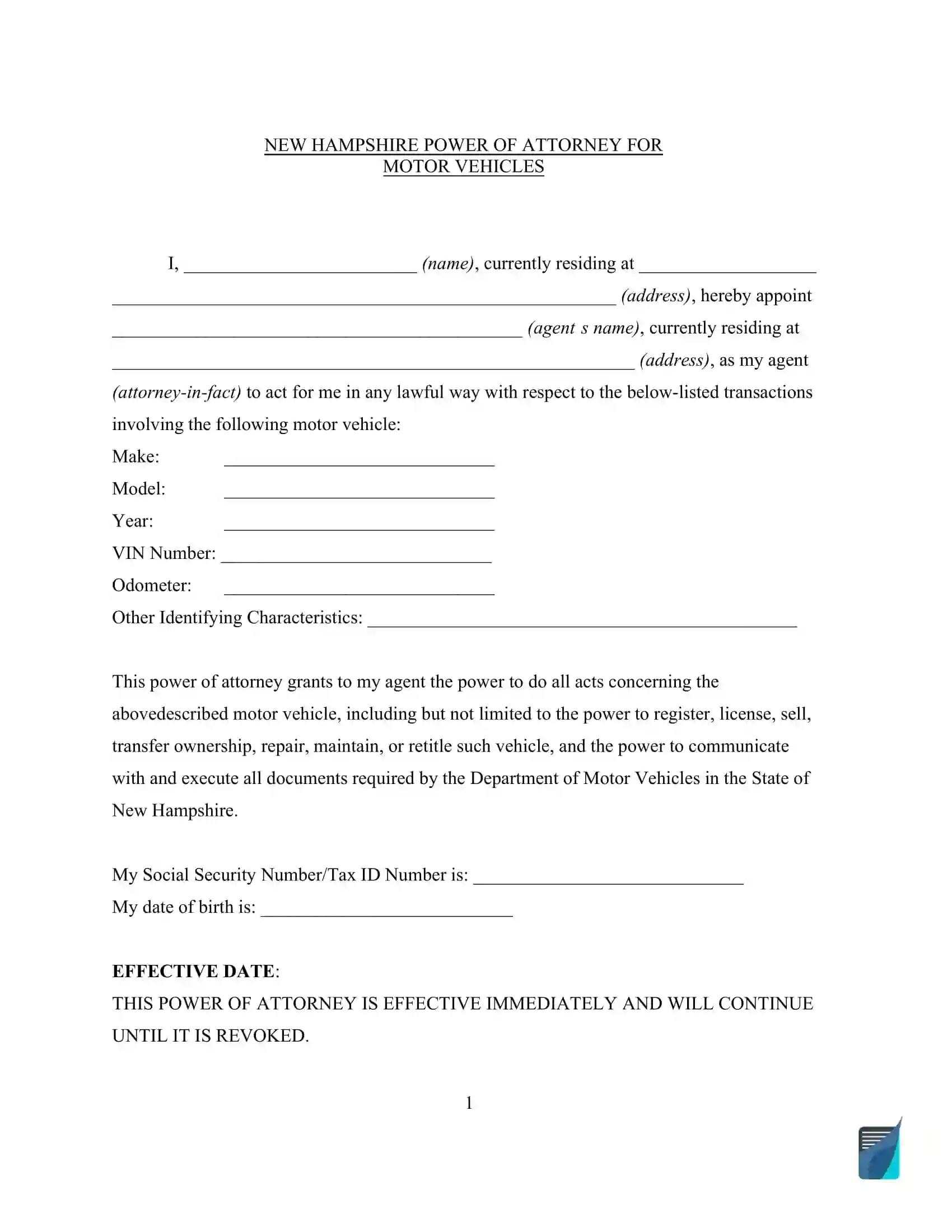
The FormsPal template is a fillable PDF with three form pages. Page 1 names the principal, the agent and one vehicle. Page 2 has lines for a successor agent and the signing line. Page 3 is the acknowledgment block that the notary completes.
Your agent, also called your attorney-in-fact, is the person listed on page 1. This individual will have the authority to act on your behalf for the vehicle-related matters specified. The wording on page 1 lists actions such as registering, licensing, selling, transferring ownership, repairing, maintaining or retitling the vehicle.
| Document Name | New Hampshire Motor Vehicle Power of Attorney Form |
| State Form Name | New Hampshire Title 5 Form |
| Relevant Link | New Hampshire Division of Motor Vehicles |
| Avg. Time to Fill Out | 10 minutes |
| # of Fillable Fields | 23 |
| Available Formats | Adobe PDF |
Before starting, ensure you have all the necessary information about the vehicle and the person you designate as your attorney-in-fact. The form must be filled out correctly to avoid any legal complications. The steps below follow the FormsPal template on this page.
The screenshots under each step show the FormsPal New Hampshire New Hampshire Motor Vehicle Power of Attorney template filled with sample entries in blue, so you can see where each answer goes. The names, addresses, dates and amounts are examples only.
Principal and agent
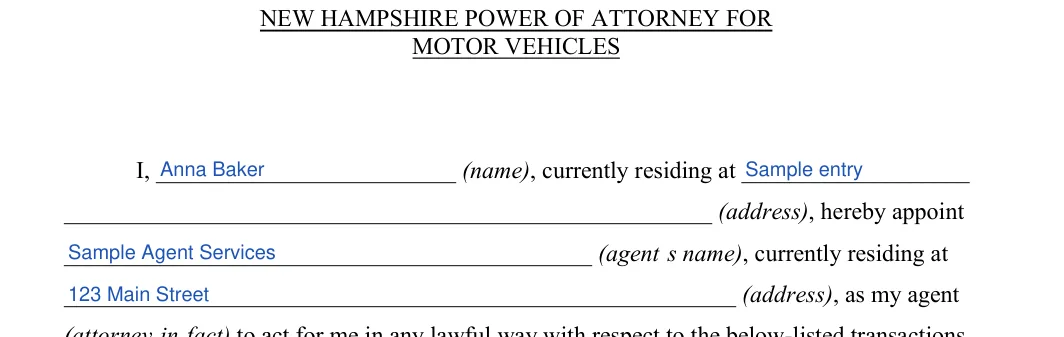
In the opening paragraph on page 1, enter your full name and current address, then the same details for your agent. Include the address, city/state, zip code, and telephone number where indicated. If the vehicle is owned jointly, both owners must be listed.
The motor vehicle
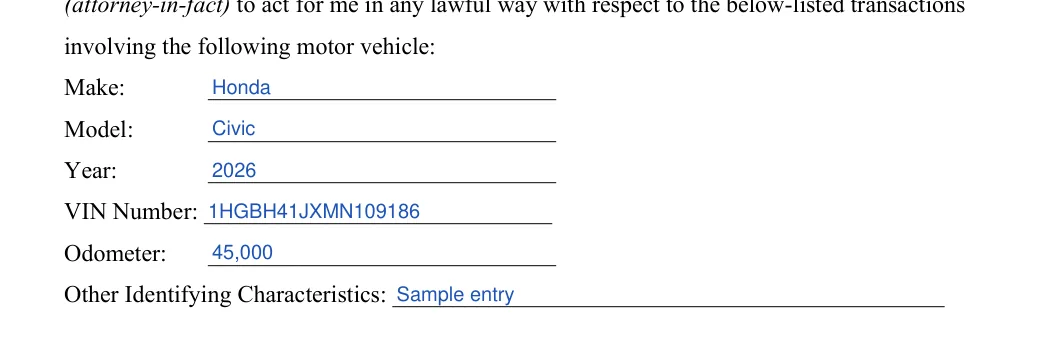
Under “involving the following motor vehicle,” enter Make, Model, Year, VIN Number and Odometer. This information must be accurate and match the details on the vehicle’s title and registration documents. Use Other Identifying Characteristics for anything else that describes the vehicle.
Social Security Number/Tax ID Number and date of birth
Write your Social Security Number or Tax ID Number and your date of birth on the two lines below the paragraph that lists your agent’s powers. The effective date statement under them is already printed.

Successor attorney-in-fact
On page 2, repeat your agent’s name in the first blank. Then add the alternate agent’s details.

Date, signature and printed name
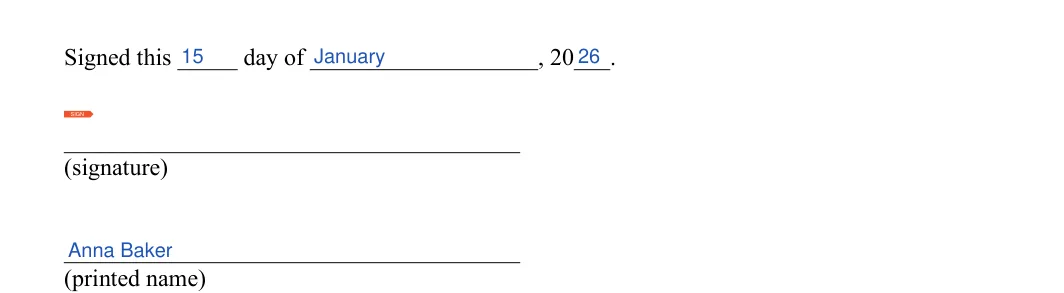
Fill in the day, month and year on the “Signed this” line. Each owner must print their name, sign, and date next to their printed name. Ensure that the signatures match those on the vehicle’s title, as discrepancies can delay processing.
Acknowledgment block
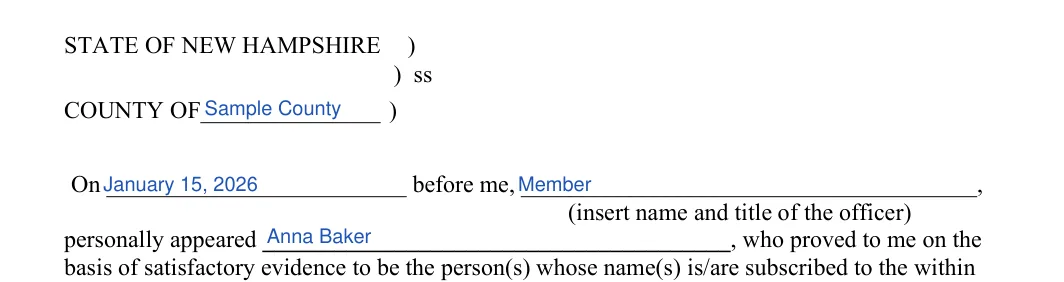
On page 3, under the state heading, the acknowledgment block has blanks for the county, the date, the officer’s name and title, and the principal’s name. The notary will fill in the county, the date, and their details and witness and verify the signatures.
Officer signature and seal
The notary public or other officer signs on the Signature line and adds their seal at (seal).

The signing rules for New Hampshire POA forms are in RSA 564-E:105. To be legally recognized, the POA must be signed by the principal or by another individual directed to do so in the principal’s presence.[1] Notarization is not required for a limited vehicle POA, though acknowledging the signature before a notary public creates a presumption that the signature is genuine.[1] In practice, the form is often notarized for that reason.
Meet the notary
It is common practice to sign the form in front of a Notary Public or Justice of the Peace. Wait to sign until you are with the notary.
Review the finished form
After completing all sections and notarization, review the form to ensure all information is correct and no sections have been inadvertently skipped. The form is now ready to be used for any vehicle-related legal transactions as specified.
Keep a signed copy
Make a copy of the signed form for your records, and give your agent a copy to keep with them.
It is a paper in which an owner, the principal, appoints another person, the agent, to act for them on matters for one vehicle, such as titling and registration. The FormsPal template has lines for both parties, the vehicle details and a notary acknowledgment.
Gather these details first, so you can complete the template in one sitting.
Yes. Page 2 of the template has a Successor Attorney-in-Fact section where you write the alternate agent’s details.
Yes. Download the PDF and type your answers into the fields, or open it in the FormsPal PDF editor. Print the pages when you are done, so you can take them to the notary.
The template has one set of vehicle lines, so it describes a single vehicle. Start a fresh copy for each additional vehicle.
General information, not legal or tax advice.
