
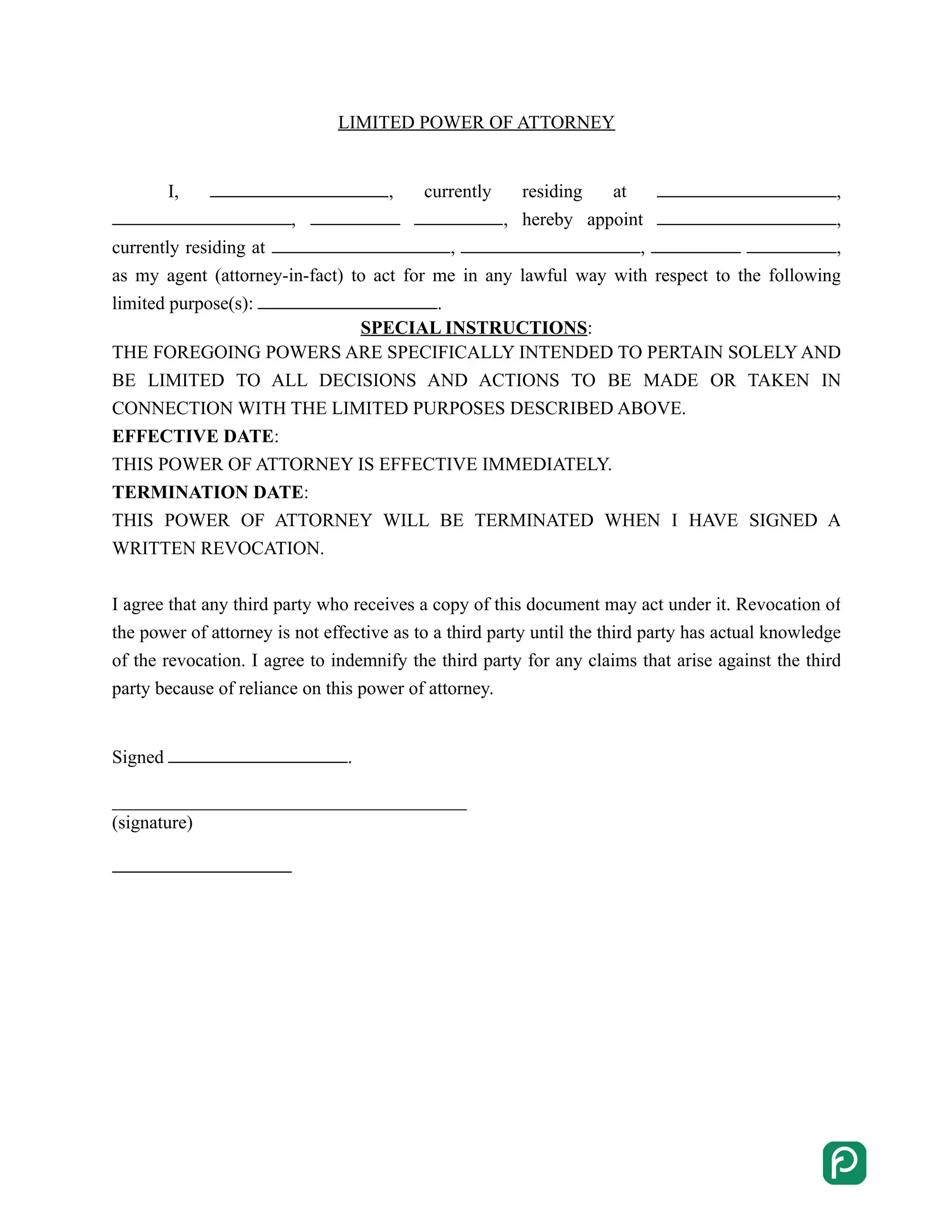
A Nebraska limited power of attorney is a document in which you, the principal, appoint an agent (also called an attorney-in-fact) to act for you on specific purposes only. Under the Nebraska Uniform Power of Attorney Act, it is not valid unless acknowledged before a notary public or other individual authorized by law to take acknowledgments.[1] In Nebraska, the creation of a limited power of attorney must adhere to specific signing requirements and laws, as detailed in the Nebraska Uniform Power of Attorney Act (§§ 30-4001 to 30-4045).[5] This free Nebraska limited power of attorney form, also called a special power of attorney, lets you name your agent, list the purposes and print the PDF.
Last Updated: October 2026. This guide is reviewed and updated regularly to reflect current Nebraska law. If you notice an error or outdated information, please contact us.
Build Your Document
Answer a few simple questions to make your document in minutes
Save and Print
Save progress and finish on any device, download and print anytime
Sign and Use
Your valid, lawyer-approved document is ready
If you need broader authority, use a general power of attorney instead. You can also browse all Nebraska power of attorney forms.
A Nebraska limited power of attorney must be signed by the principal and acknowledged before a notary public.[1] Below is the text of the signing rule in the Nebraska statute, followed by what it means for your document.
A power of attorney must be signed by the principal or marked by the principal in accordance with section 64-105.02 or signed in the principal's conscious presence by another individual directed by the principal to sign the principal's name on the power of attorney.
In plain words, the law sets two requirements for the document:
| Document Name | Nebraska Limited Power of Attorney Form |
| Other Name | Nebraska Special Power of Attorney |
| Relevant Laws | Neb. Rev. Stat. § 30-4005 and § 30-4024[6] |
| Avg. Time to Fill Out | 8 minutes |
| # of Fillable Fields | 32 |
| Available Formats | Adobe PDF |
A Nebraska limited power of attorney ends when one of the events listed in the state statute happens. These include the principal's death, a revocation by the principal and the accomplishment of the document's purpose. Each event on the list below ends the document.[3]
When the power of attorney terminates, the agent's authority terminates with it. The agent's authority also ends when the principal revokes it.[3]
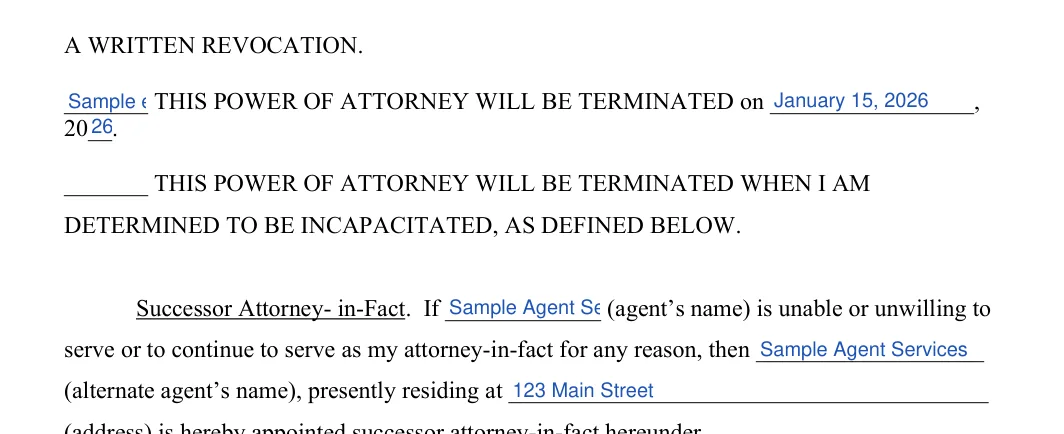
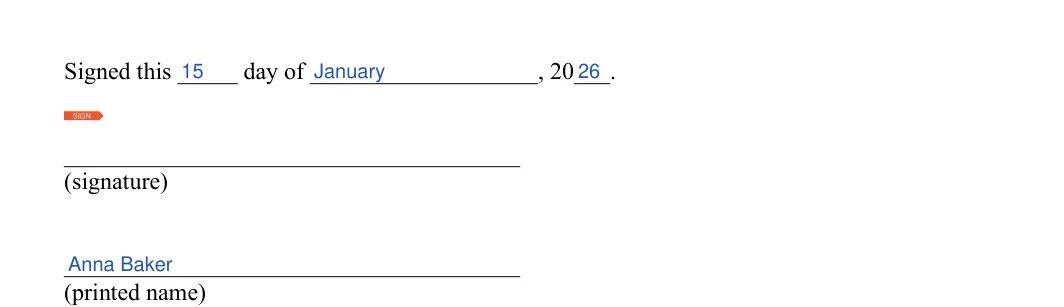
To fill out the Nebraska limited power of attorney form, start on page 1 with the principal and the agent, then list the purposes and set the dates. The steps below follow the order of the three-page PDF. Use the Create My Document button above to build the form online, or fill in the downloaded PDF with the online PDF editor.
The screenshots under each step show the FormsPal Nebraska limited power of attorney template filled with sample entries in blue, so you can see where each answer goes. The names, addresses, dates and amounts are examples only.
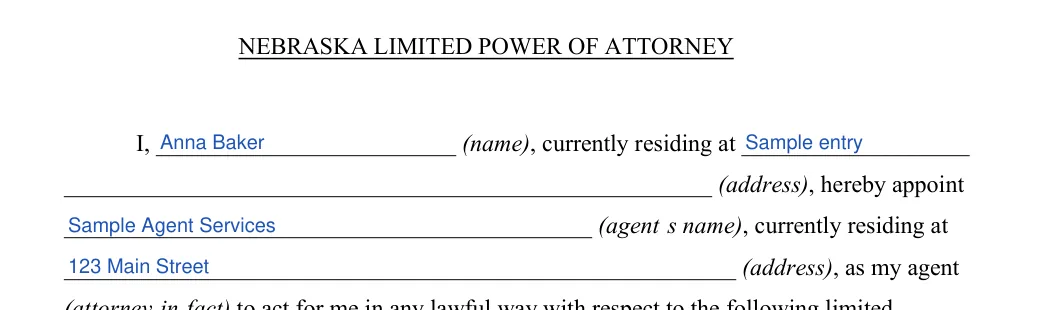
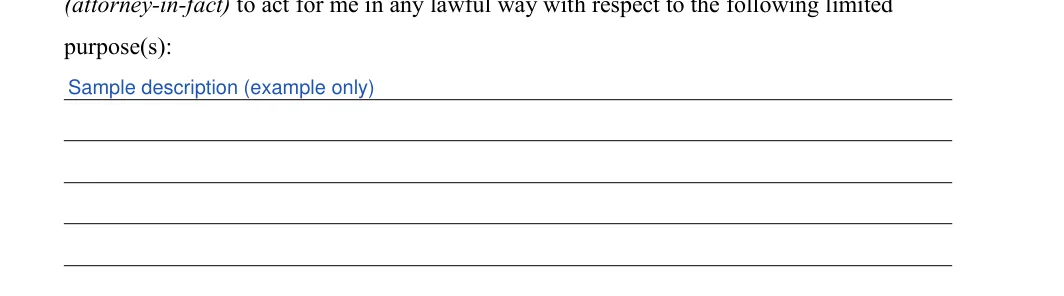
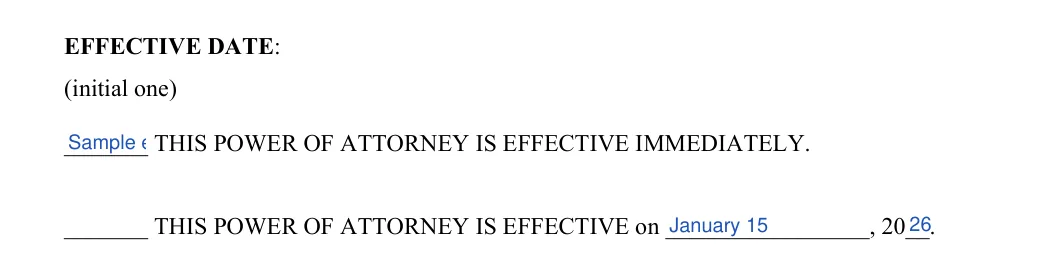

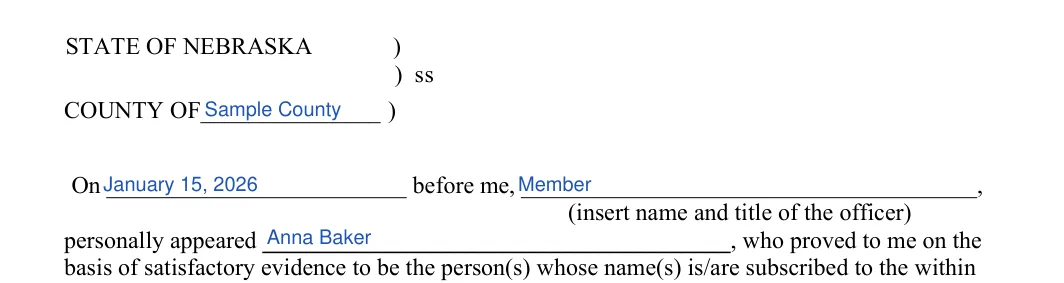

To put your Nebraska power of attorney to use, print the completed form and take it to a notary public. The law requires the document to be acknowledged before a notary public or another individual authorized to take acknowledgments.[1] After that, share copies with the people who will rely on it and keep the original somewhere safe.
These questions cover when a Nebraska limited power of attorney starts, how an agent accepts the role and what ends or changes it. Each answer comes from the Nebraska power of attorney statutes.
A power of attorney is effective when it is executed, meaning signed as the law requires. The exception is a document that says it becomes effective at a future date or when a future event happens.[2]
Unless the power of attorney says otherwise, a person accepts appointment as an agent by exercising authority or performing duties as an agent. Any other assertion or conduct that shows acceptance also counts.[4]
Not by itself. Signing a new power of attorney does not revoke one that the principal signed earlier. It does so only if the new document provides that the previous power of attorney is revoked or that all other powers of attorney are revoked.[3]
The agent's authority ends. The power of attorney itself ends too when both of these are true:
It can, if your agent is your spouse. The agent's authority ends when an action is filed for the dissolution or annulment of the agent's marriage to the principal, or for their legal separation. The power of attorney can provide otherwise.[3]
Not as to an agent or another person who, without actual knowledge, acts in good faith under the power of attorney. This covers a termination of the agent's authority or of the power of attorney. It also covers the principal's incapacity when the power of attorney is not durable.[3]
General information, not legal or tax advice.
Unless noted otherwise, the sources below are from the Neb. Rev. Stat..
