
A Nebraska general power of attorney is a written document that lets a person, the principal, name an agent to handle financial matters. The FormsPal Nebraska power of attorney form lists 13 financial powers and one line that grants all of them, and the principal initials the ones the agent receives. It does not cover health-care decisions. Nebraska's general power of attorney rules are in the Nebraska Uniform Power of Attorney Act, Neb. Rev. Stat. 30-4001 through 30-4045.[5] Under Neb. Rev. Stat. 30-4004, a Nebraska power of attorney created after January 1, 2013, under the Nebraska Uniform Power of Attorney Act is durable unless it expressly provides that it is terminated by the incapacity of the principal.[7] Nebraska law requires the principal's signature and a notary's acknowledgment.[1]
Last Updated: October 2026. This guide is reviewed and updated regularly to reflect current Nebraska law. If you notice an error or outdated information, please contact us.
Build Your Document
Answer a few simple questions to make your document in minutes
Save and Print
Save progress and finish on any device, download and print anytime
Sign and Use
Your valid, lawyer-approved document is ready
A Nebraska general power of attorney must be signed by the principal. Another individual may sign the principal's name, but only in the principal's conscious presence and at the principal's direction. The principal may also mark the document as another Nebraska law allows. It is not valid unless it is acknowledged before a notary public or other individual authorized by law to take acknowledgments.[1]
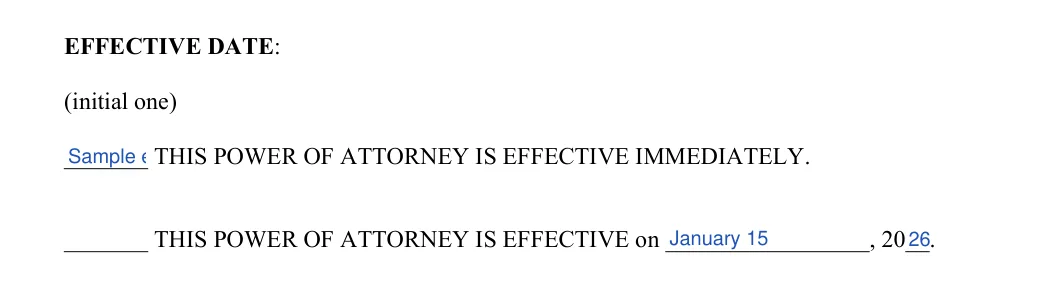
The statute also says when the document starts to work. Here are its own words for any power of attorney in the state:
A power of attorney is effective when executed unless the principal provides in the power of attorney that it becomes effective at a future date or upon the occurrence of a future event or contingency.
In plain terms, there are two ways to set the start.[2]
The Effective Date block on page 3 of the form is where you choose between them.
| Document Name | Nebraska General Power of Attorney Form |
| Other Name | Nebraska Financial Power of Attorney |
| Relevant Laws | Nebraska Revised Statutes, Chapter 30 |
| Avg. Time to Fill Out | 10 minutes |
| # of Fillable Fields | 41 |
| Available Formats | Adobe PDF |
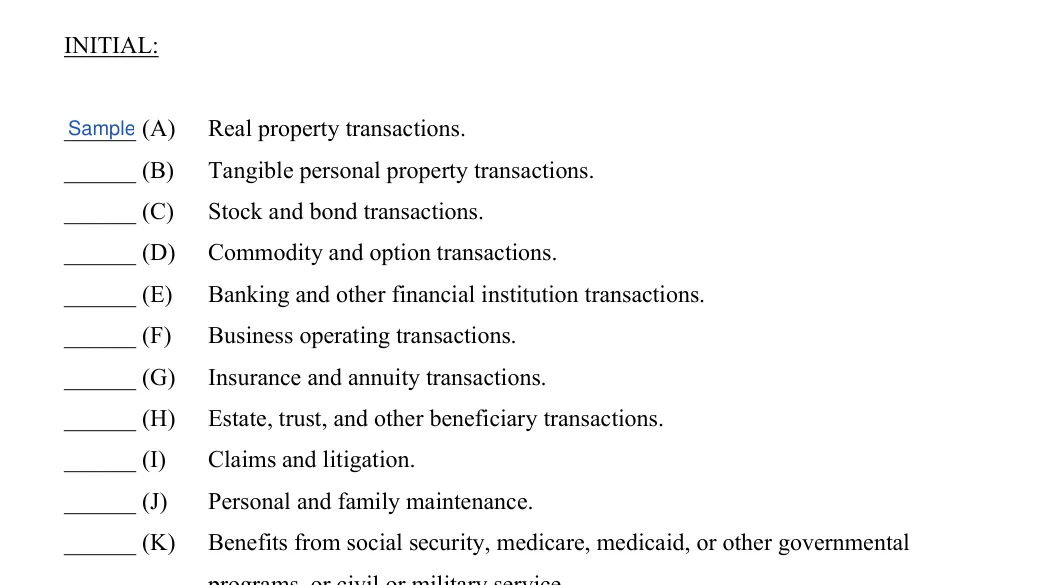
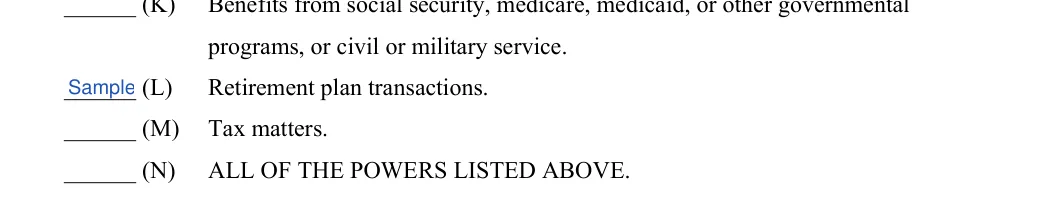
The Nebraska form is a menu of financial choices. The principal initials the line in front of each power the agent receives and leaves the other lines blank. The form lists these 14 lines, from (A) to (N). Line (N) grants all of the powers listed above.
The notice at the top of page 1 warns that the powers are broad and sweeping. It also says the document does not authorize anyone to make medical or other health-care decisions, and that the principal may revoke the power of attorney later.
If you have questions about the powers, the notice on the form advises you to obtain competent legal advice. Special Instructions 1 to 3 on pages 2 and 3 add medical reimbursement claims, retirement and savings accounts, and digital assets to the powers.
To grant fewer powers than all of them, initial only the lines you want. The form allows you to cross out each power you withhold, but that is optional.
Section 30-4024 states that if a power of attorney explicitly grants an agent the authority to perform any act the principal could, the agent is endowed with a wide range of powers. These powers are detailed in Sections 30-4027 to 30-4039.[6]
Key actions that require explicit authorization in the power of attorney include: creating or amending trusts, making gifts, changing rights of survivorship or beneficiary designations, delegating the principal's authority, and renouncing or disclaiming property.[6]
The Nebraska general power of attorney (POA) form has five form pages and 41 fillable fields. Create it online with the builder above, or download the PDF and fill it in. Then go through the pages in order.
You can fill in the downloaded PDF with our online PDF editor.
The screenshots under each step show the FormsPal Nebraska general power of attorney template filled with sample entries in blue, so you can see where each answer goes. The names, addresses, dates and amounts are examples only.
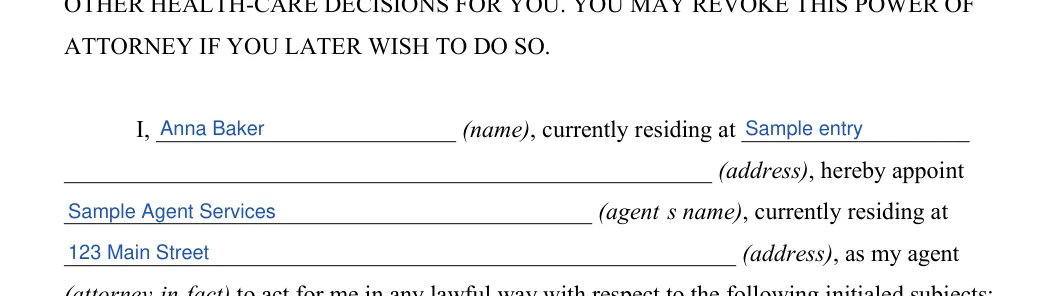

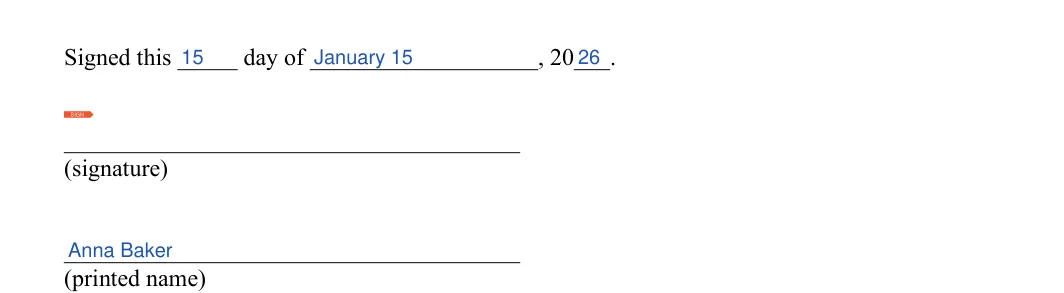
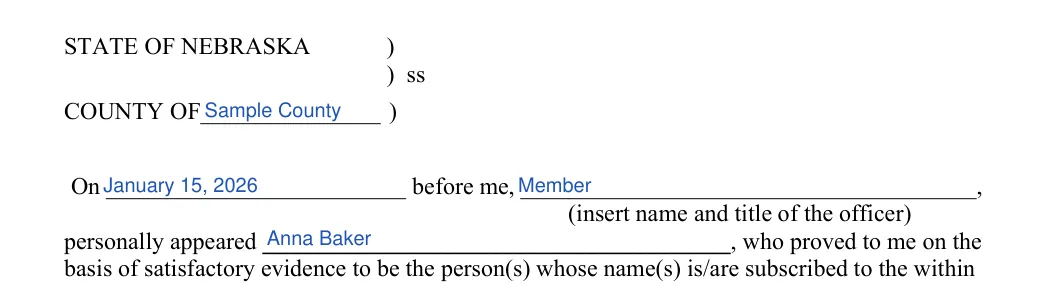

After you fill out the form, the signing and sharing steps matter as much as the answers. The principal signs it, or directs someone else to sign the principal's name in the principal's conscious presence, and the signature must be acknowledged before a notary public.[1] Follow these steps in order.
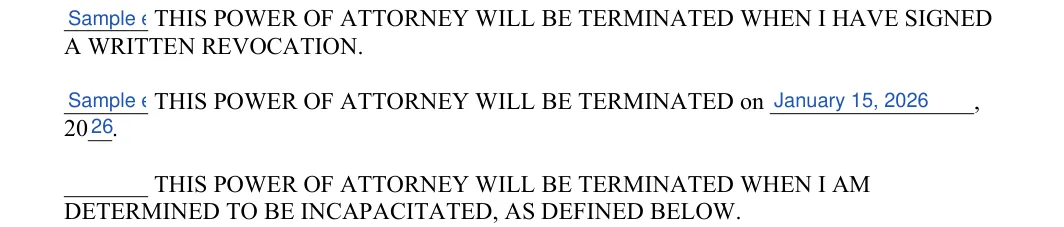
A Nebraska power of attorney ends in several ways. It terminates when the principal dies, when the principal revokes it, when its purpose is accomplished, or when its own terms provide that it terminates. It also ends if the principal becomes incapacitated, unless the power of attorney is durable.[3]
The agent's authority can end on its own terms too. The agent's authority terminates when:
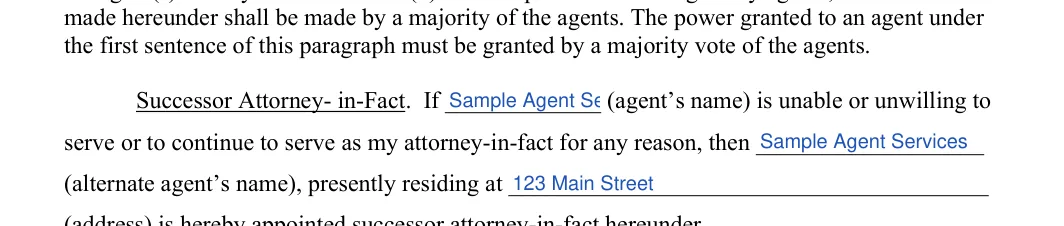
The power of attorney itself also terminates if the principal revokes the agent's authority, or the agent dies, becomes incapacitated, or resigns, and no other agent is provided for.[3] The successor attorney-in-fact paragraph on page 4 of the form is where you name another agent.
Ending a power of attorney does not always bind the people who rely on it. A termination is not effective as to an agent or another person who, without actual knowledge of it, acts in good faith under the power of attorney.[3]
The same goes for the principal's incapacity when the power of attorney is not durable. In practice, send written notice of a revocation to the bank and everyone else who holds a copy.
These short answers cover 6 common questions about signing, starting and ending a Nebraska general power of attorney. The statutes behind each answer are listed under Sources at the end of the page, so you can read the exact wording yourself.
Yes. It is not valid unless it is acknowledged before a notary public or other individual authorized by law to take acknowledgments.[1] The form has an acknowledgment block on page 5 for the notary to complete.
The principal signs it. The principal can also mark it as another Nebraska law allows, or direct another individual to sign the principal's name in the principal's conscious presence.[1]
A power of attorney is effective when executed, unless the principal provides otherwise.[2] The principal can set a later start in the document itself:
The Effective Date block on page 3 of the form is where you choose.
It ends if the principal becomes incapacitated, unless the power of attorney is durable. If it is not durable, the incapacity does not revoke or terminate it as to a person who, without actual knowledge of the incapacity, acts in good faith under it.[3]
A power of attorney terminates when the principal revokes it, and the agent's authority terminates when the principal revokes that authority. A termination is not effective as to an agent or another person who, without actual knowledge of it, acts in good faith under the power of attorney.[3]
Not automatically. A new power of attorney revokes an earlier one only if it provides that the previous power of attorney is revoked or that all other powers of attorney are revoked.[3]
General information, not legal or tax advice.
Unless noted otherwise, the sources below are from the Neb. Rev. Stat.
