Kansas Limited Power of Attorney Form

A Kansas limited power of attorney is a written document in which you, the principal, name an agent to act for you for specific purposes only. The agent is also called an attorney-in-fact. Kansas requires a power of attorney to be signed, dated and notarized.[2] You can fill out the free Kansas limited power of attorney form online with FormsPal, or download the PDF to print and sign.

Last Updated: October 2026. This guide is reviewed and updated regularly to reflect current Kansas law. If you notice an error or outdated information, please contact us.
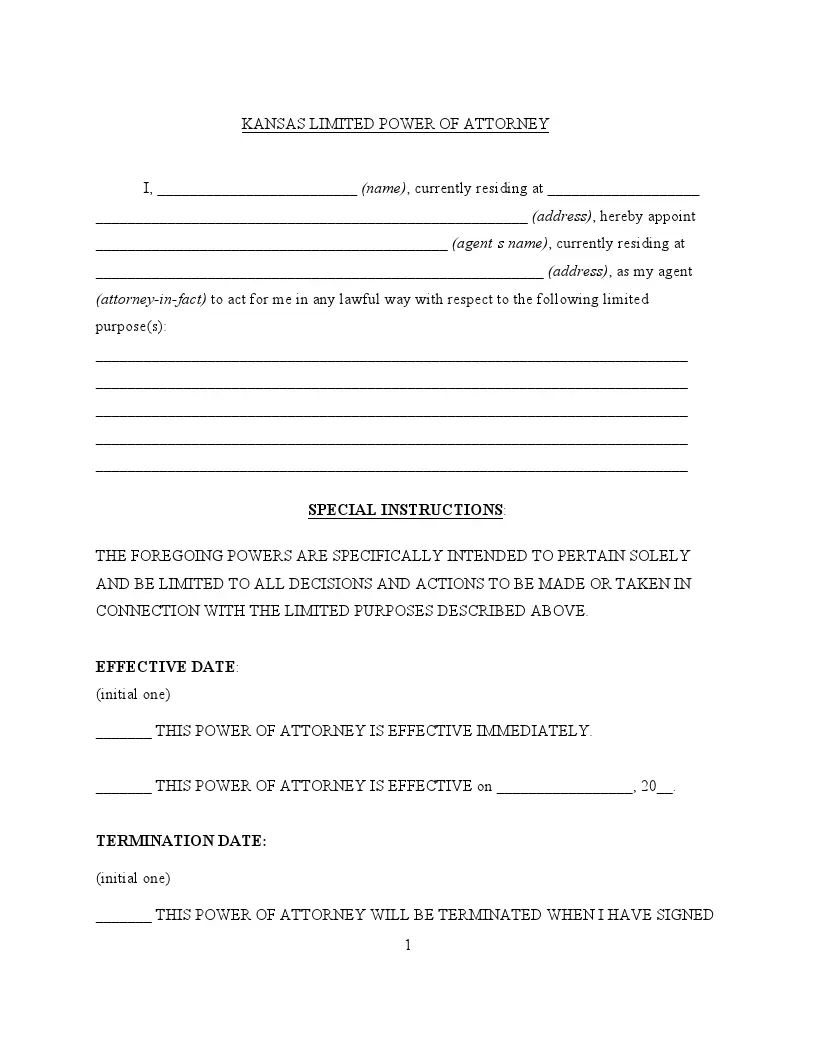
Kansas limited power of attorney form preview

Create a high-quality Kansas Limited Power of Attorney Form online now!

Build Your Document

Answer a few simple questions to make your document in minutes

Save and Print

Save progress and finish on any device, download and print anytime

Sign and Use

Your valid, lawyer-approved document is ready

... or download your Kansas Limited Power of Attorney Form as a  PDF file

What a Kansas Limited Power of Attorney Covers

A limited power of attorney gives your agent authority only for the purposes you write on the form. With the limited form you choose the task, when the document starts and how it ends. The FormsPal template has five lines for the purposes. A general power of attorney is the opposite, because it gives the agent a wide range of powers.

Many people use a limited power of attorney for one defined job, such as:

  • Handling one banking or financial matter while they are away.
  • Signing the papers for a particular property sale.
  • Dealing with a specific claim or application.

If a limited document does not fit your situation, FormsPal has other Kansas power of attorney forms.

Tip: Put the detail on the purpose lines of page 1. A short, specific description keeps the document tied to the task you have in mind.

Kansas Limited Power of Attorney Requirements

Kan. Stat. Ann. § 58-652 sets the signing rules for a Kansas power of attorney. You must sign it, date it, and have it notarized. The statute puts the notarizing step in these words: the document is acknowledged in the manner prescribed by the revised uniform law on notarial acts.[2]

That gives three requirements:

  • The principal signs the power of attorney.
  • The power of attorney is dated.
  • The power of attorney is acknowledged before a notary public.

The FormsPal template has an acknowledgment on page 3 for the notary or other officer to complete.

Kansas also sets a standard for the form of the document. The statute says:

A power of attorney executed on or after july 1, 2021, shall be deemed sufficient if in substantial compliance with the form set forth by the judicial council.

Kan. Stat. Ann. § 58-652

Kansas also protects people who are shown the document. In the absence of actual knowledge to the contrary, any person to whom the power of attorney is presented is entitled to rely on an affidavit executed by the attorney in fact. The affidavit states that the event or condition on which the power's effectiveness depends has occurred or exists.[2]

Kansas Limited Power of Attorney Form Details

Document Name Kansas Limited Power of Attorney Form
Other Name Kansas Special Power of Attorney
Relevant Laws Kansas Statutes, Section 58-652[2], Section 58-657(a)(1)[1]
Avg. Time to Fill Out 8 minutes
# of Fillable Fields 32
Available Formats Adobe PDF

Filling Out the Kansas Limited Power of Attorney Form

The FormsPal Kansas limited power of attorney template has three pages. Page 1 names you and your agent, lists the purposes, and starts the effective and termination choices. Page 2 finishes the termination choices, names a successor agent, and holds your signature. Page 3 is the acknowledgment that a notary public or other officer completes.

Download the free printable PDF, or fill it in on screen with the PDF editor.

The screenshots under each step show the FormsPal Kansas limited power of attorney template filled with sample entries in blue, so you can see where each answer goes. The names, addresses, dates and amounts are examples only.
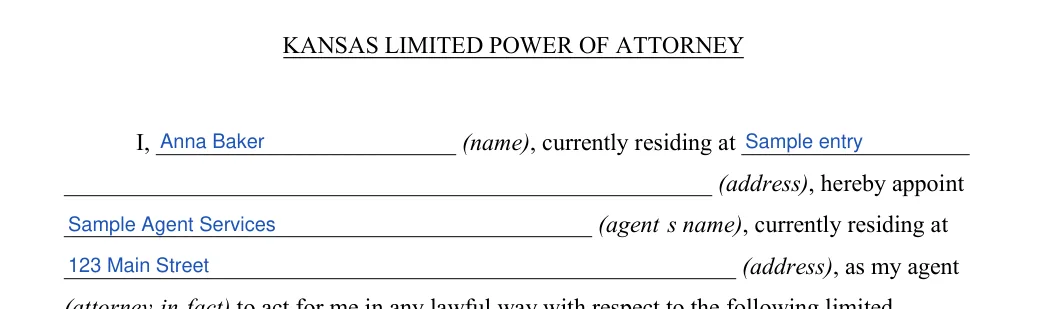
  1. Name yourself and your agent (page 1). Write your name and address, then your agent's name and address, in the opening paragraph.
    Kansas limited power of attorney: KANSAS LIMITED POWER OF ATTORNEY, filled with sample entries
    Step 1: sample entries, not a real document.
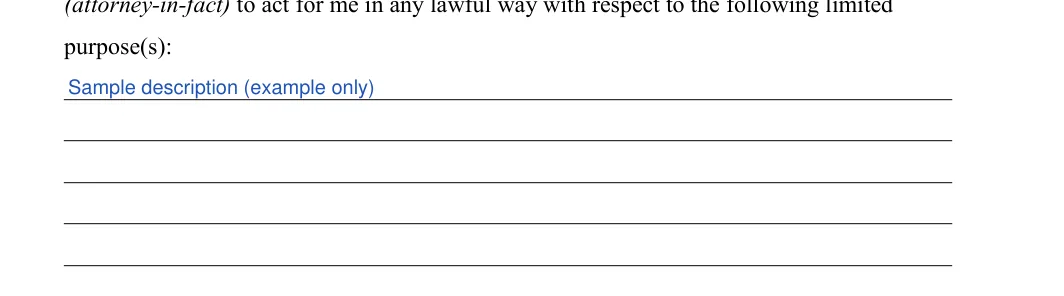
  2. List the purpose(s) (page 1). Describe each limited purpose on the lines under "purpose(s)". The printed notice below them limits the agent to those purposes.
    Kansas limited power of attorney: purpose(s), filled with sample entries
    Step 2: sample entries, not a real document.
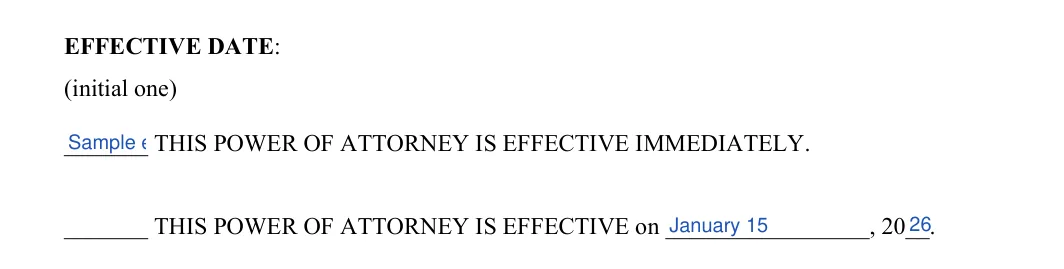
  3. Choose the effective date (page 1). Initial one line. The first line starts the document right away. The second starts it on a date you write in.
    Kansas limited power of attorney: EFFECTIVE DATE, filled with sample entries
    Step 3: sample entries, not a real document.
  4. Start the termination date (page 1). The options are marked "initial one". Initial the first option if the power of attorney should end when you sign a written revocation. The other options continue on page 2.
    Kansas limited power of attorney: TERMINATION DATE, filled with sample entries
    Step 4: sample entries, not a real document.
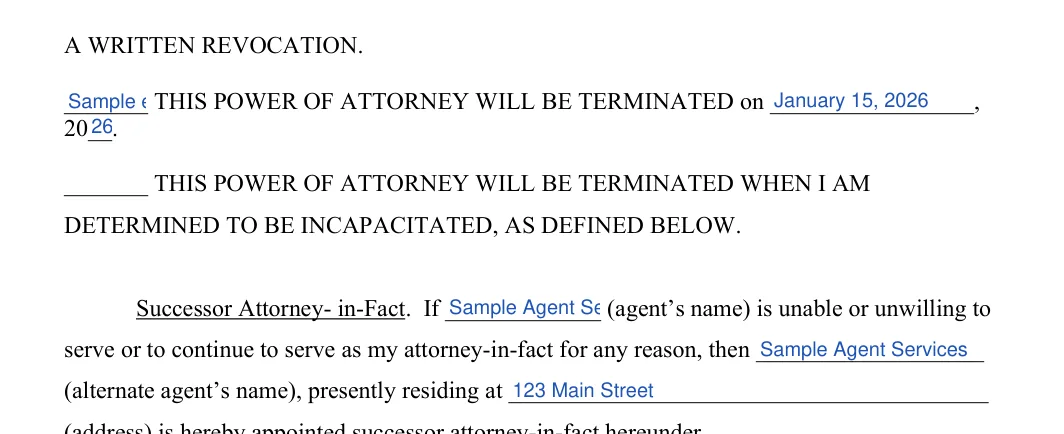
  5. Finish the termination options and name a successor (page 2). Initial a different option only if you chose it instead of the first one, either an end date or an end when you are determined to be incapacitated. Then fill in the successor paragraph with the agent's name, and the alternate agent's name and address.
    Kansas limited power of attorney: A WRITTEN REVOCATION, filled with sample entries
    Step 5: sample entries, not a real document.
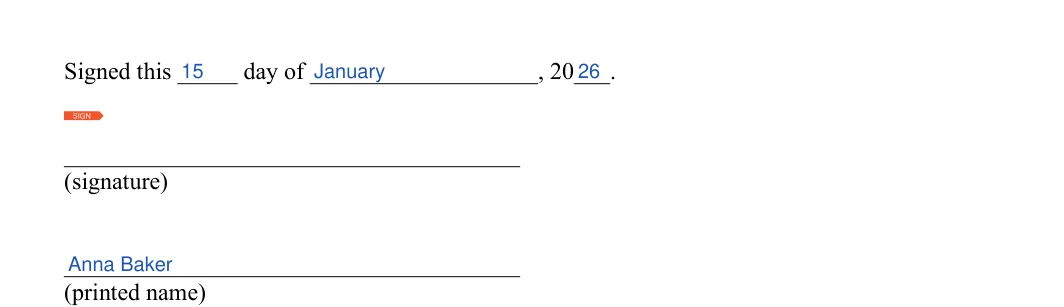
  6. Date and sign (page 2). Read the paragraph above the date line first. It says a third party who receives a copy may act under it, that a revocation is not effective as to a third party until that party has actual knowledge, and that you agree to indemnify (cover the claims of) a third party who relies on the document. Then fill in the day, month and year, sign above "(signature)" and print your name.
    Kansas limited power of attorney: Day, Month and more, filled with sample entries
    Step 6: sample entries, not a real document.
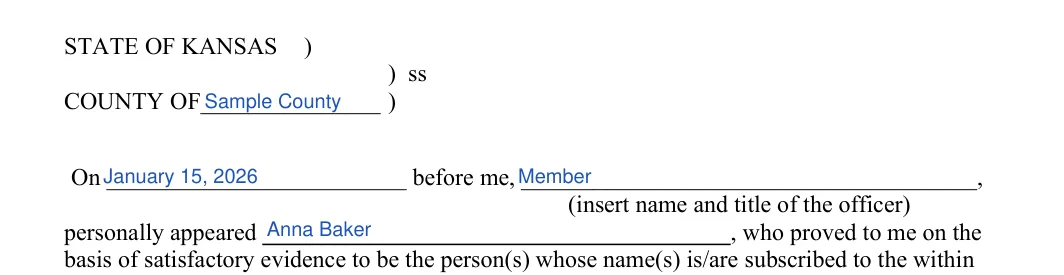
  7. Complete the acknowledgment (page 3). Together with the notary or other officer, fill in the county, the date, the officer's name and title, and your name as the person who appeared. "STATE OF KANSAS" is already printed.
    Kansas limited power of attorney: STATE OF KANSAS, filled with sample entries
    Step 7: sample entries, not a real document.
  8. Notary signature and seal (page 3). The notary or other officer signs the "Signature" line on page 3 and adds the seal. This line is the officer's, not yours.
    Kansas limited power of attorney: Signature, filled with sample entries
    Step 8: sample entries, not a real document.

How to Sign and Use the Kansas Limited Power of Attorney

After you fill in the form, review it, sign it, and have a notary public complete the acknowledgment on page 3. Then give your agent a copy and store the original safely. These steps cover what happens around the form, not the entries on it.

  1. Review the finished form. Check the names, the listed purposes, the start date and your termination choice before you sign.
  2. Go to the notary. Bring a photo ID. The acknowledgment on page 3 says the notary or other officer verifies only the identity of the person who signed, and not the truthfulness, accuracy or validity of the document.
  3. Give your agent a copy. Your agent may need to show it to a bank or another institution when acting for you.
  4. Keep the original safe. Store it where you and your agent can find it, and write down who holds copies.
  5. End it in writing when the job is done. A signed written revocation is the first termination option on the form. Tell your agent and everyone who holds a copy.

How a Kansas Limited Power of Attorney Ends

One way a Kansas power of attorney ends is on the terms it sets for itself. Under Kan. Stat. Ann. § 58-657(a)(1), the authority granted in a power of attorney is modified or terminated on the date shown in the document and under its express provisions.[1]

The termination date section of the FormsPal template lets you choose how yours ends:

  • When you sign a written revocation.
  • On a date you write in.
  • When you are determined to be incapacitated, as the form says.

Notice matters too. If a power of attorney requires notice of revocation to be given to named persons, those persons may continue to rely on its authority until they receive the notice.[2]

The form says a revocation is not effective as to a third party until that party has actual knowledge of it. Tell your agent and every institution that holds a copy as soon as you revoke.

Frequently Asked Questions

Does a Kansas power of attorney have to be recorded?

No. A power of attorney does not have to be recorded to be valid and binding between the principal and the attorney in fact, or between the principal and third persons.[2]

What if I cannot sign the power of attorney myself?

A power of attorney may be signed by an adult designee of the principal in this situation:

  • The principal is physically unable to sign but otherwise competent and conscious.
  • The designee signs in the presence of the principal.
  • The designee signs at the specific direction of the principal, expressed in the presence of a notary public.[2]

Does my agent have to act for me?

Kan. Stat. Ann. § 58-652 speaks to this for a durable power of attorney:

A person who is appointed an attorney in fact under a durable power of attorney has no duty to exercise the authority conferred in the power of attorney, unless the attorney in fact has agreed expressly in writing to act for the principal in such circumstances.

Kan. Stat. Ann. § 58-652

In practice, many principals talk to the person first and ask for their agreement in writing.

How do I revoke a Kansas limited power of attorney?

It depends on whether the power of attorney was recorded. If it was not recorded, it may be revoked by a recorded revocation or in any other appropriate manner. If it was recorded, any revocation must be recorded in the same manner for the revocation to be effective.[2]

General information, not legal or tax advice.

Template Preview
Create a high-quality Kansas Limited Power of Attorney Form online now!

Sources

  1. Kan. Stat. Ann. 58-657(a)(1).
  2. Kan. Stat. Ann. § 58-652.
Published: Aug 15, 2024
Mara Erlach
Mara Erlach
Writer & Attorney
Mara has been practicing estate planning and trust law in California since 2003, taking pride in helping clients of all backgrounds and asset profiles form a complete and customized estate plan. Her specialties are: estate planning, wills and trusts, trust and probate administration.