
An Oklahoma limited power of attorney is a written document in which you, the principal, name an agent (also called an attorney-in-fact) to act for you on specific matters only. Use this Oklahoma limited power of attorney form to list those tasks, name your agent, and print it for signing. A limited one is narrower than a general power of attorney, which covers a broad range of affairs.
Last Updated: October 2026. This guide is reviewed and updated regularly to reflect current Oklahoma law. If you notice an error or outdated information, please contact us.
Build Your Document
Answer a few simple questions to make your document in minutes
Save and Print
Save progress and finish on any device, download and print anytime
Sign and Use
Your valid, lawyer-approved document is ready
Oklahoma law sets a few rules for signing a power of attorney. The principal signs it, or another person the principal directs signs the principal's name in the principal's conscious presence.[2] An acknowledgment of the signature before a notary public makes the signature presumed genuine.[2] The sections below explain each rule.
Section 3005 of Title 58 of the Oklahoma Statutes puts the signing rule this way:
A power of attorney must be signed by the principal or in the principal's conscious presence by another individual directed by the principal to sign the principal's name on the power of attorney. A signature on a power of attorney is presumed to be genuine if the principal acknowledges the signature before a notary public or other individual authorized by law to take acknowledgments.
In plain words, the signing rule has three parts:
A power of attorney signed in Oklahoma on or after November 1, 2021 is valid if it is signed as described above, so you do not need witnesses for an Oklahoma limited power of attorney.[1.1] Oklahoma law also offers a statutory power of attorney form, which you may use but do not have to. It ends with the principal's signature and a notary's acknowledgment, and it has no lines for witnesses.[1.3]
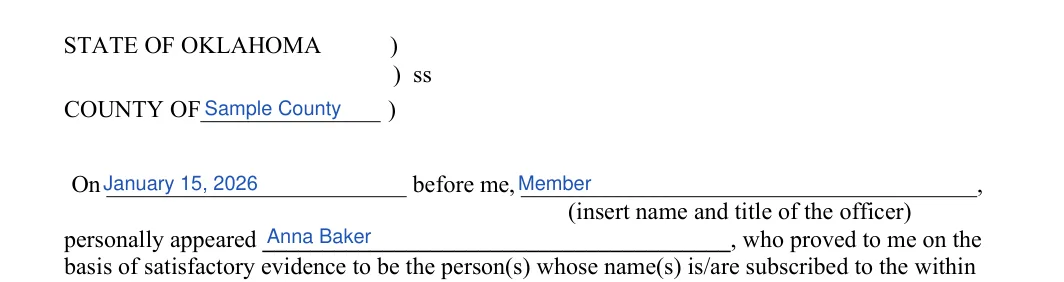
The PDF on this page has a notary acknowledgment on page 3 and no witness block.
| Document Name | Oklahoma Limited Power of Attorney Form |
| Other Name | Oklahoma Special Power of Attorney |
| Relevant Laws | Oklahoma Statutes, Title 58, Sections 3001 to 3045 |
| Avg. Time to Fill Out | 8 minutes |
| # of Fillable Fields | 32 |
| Available Formats | Adobe PDF |
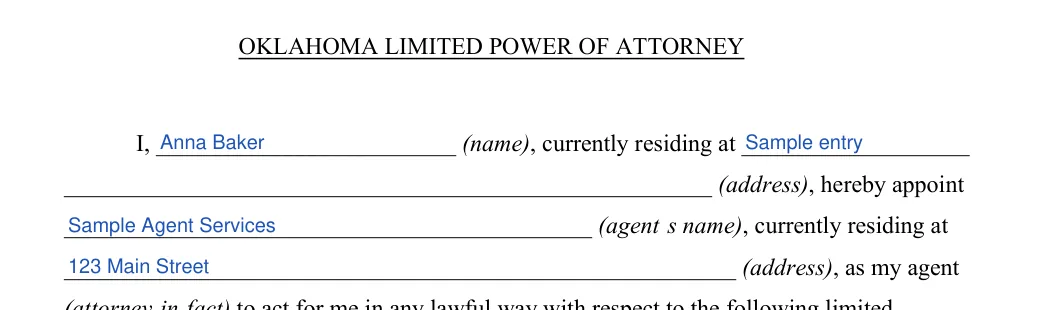
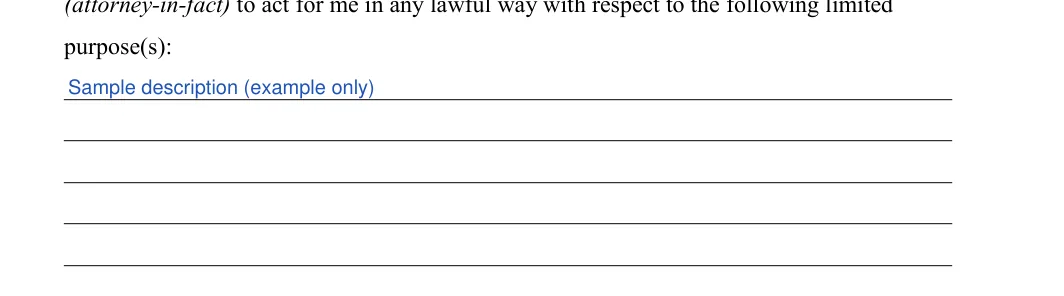
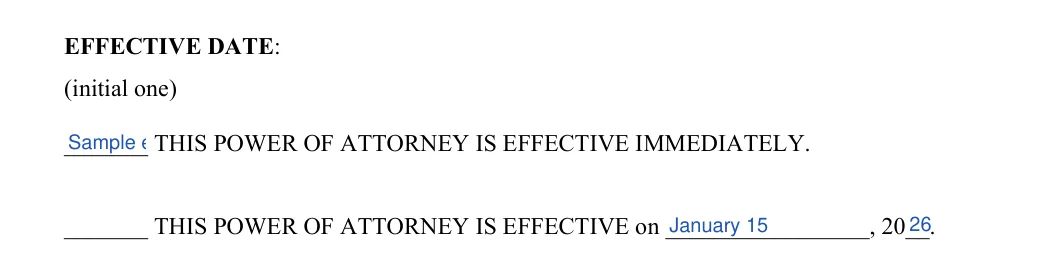
To fill out the Oklahoma limited power of attorney form, start on page 1 with the principal and the agent. Then list the tasks the agent may handle and set the dates. The form has three pages, and the steps below follow its order. Download the PDF or build the form online with the buttons above.
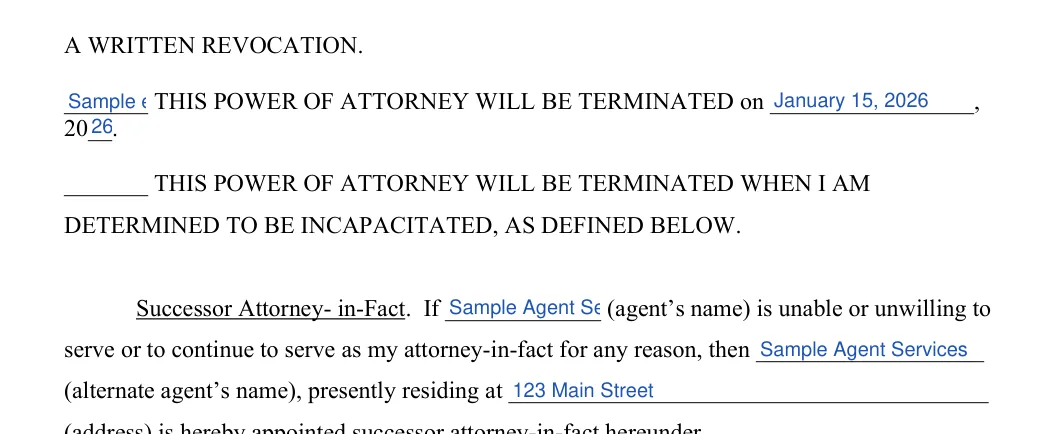
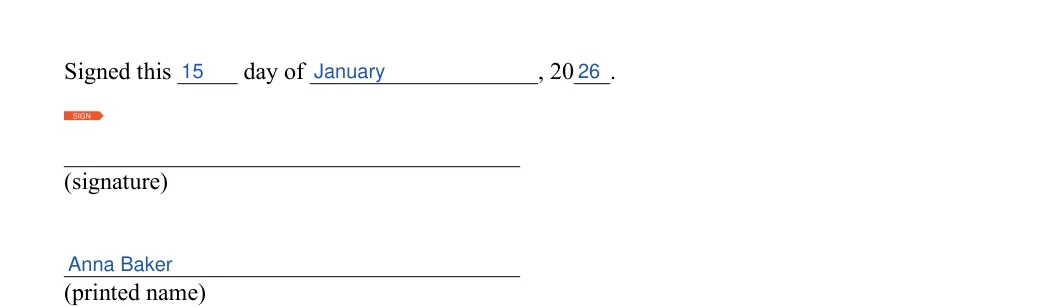
The screenshots under each step show the FormsPal Oklahoma limited power of attorney template filled with sample entries in blue, so you can see where each answer goes. The names, addresses, dates and amounts are examples only.


To put an Oklahoma limited power of attorney in place, print the completed form and sign it. A notary acknowledgment is the step that makes your signature presumed genuine.[2] Then share copies with the people who will rely on it. The steps below cover what to do once the form is filled in.
Need something different? For planning that continues if you become incapacitated, see the Oklahoma durable power of attorney. Other options include the minor child power of attorney and the motor vehicle power of attorney. You can also browse all our Oklahoma power of attorney forms.
Under Title 58 of the Oklahoma Statutes, a power of attorney ends when the principal dies. This section explains the exception for acts done in good faith, and what revoking the power of attorney does.
A power of attorney ends when the principal dies.[1.2]
There is one exception, for good-faith acts. The death does not end the power of attorney as to the agent or another person who acts under it when both of these are true:
An action taken that way, unless otherwise invalid or unenforceable, binds the principal and the principal's successors in interest.[1.2]
Ending a power of attorney does not undo what others do in good faith. Termination of the agent's authority, or of the power of attorney, has a limit. It is not effective as to the agent or another person who acts in good faith under the power of attorney without actual knowledge of the termination.[1.2]
In Oklahoma, a power of attorney is durable, so the principal's incapacity does not end it, unless it expressly says that incapacity ends it, as the form's incapacity option does.[1.6] If the power of attorney is not durable, the same good-faith rule holds for incapacity. Suppose a person acts in good faith, without actual knowledge of the principal's incapacity. The action binds the principal and the principal's successors in interest, unless it is otherwise invalid or unenforceable.[1.2]
Revoking the power of attorney ends it, and revoking the agent's authority ends that agent's authority.[1.2] Because a person who acts in good faith without actual knowledge of the revocation is still protected, tell your agent and every person who relies on it when you revoke a limited power of attorney.
These answers cover what a notary acknowledgment does, whether you need witnesses, and how an agent is held to account. Each answer comes from the Oklahoma statutes named in the Sources section at the end of this page.
It makes the principal's signature presumed genuine. The signature is presumed genuine if the principal acknowledges it before a notary public or other individual authorized by law to take acknowledgments.[2]
No. A power of attorney signed in Oklahoma on or after November 1, 2021 is valid if the principal signs it, or another person signs the principal's name in the principal's conscious presence and at the principal's direction.[1.1][2] The statutory power of attorney form in Oklahoma law has no lines for witnesses.[1.3]
It can be. A power of attorney signed in another state is valid in Oklahoma if, when it was signed, the signing met the law that governs the document. That is the law of the state the document names or, if it names none, the law of the state where it was signed.[1.1][1.5]
Yes. Any attorney-in-fact, whether acting under a durable or nondurable power of attorney or otherwise, is bound by standards of conduct and liability applicable to other fiduciaries.[1.4]
General information, not legal or tax advice.
Unless noted otherwise, the sources below are from the Okla. Stat. tit. 58.
