An Oklahoma minor child power of attorney is a written document in which a parent or legal custodian names another adult to act for the child for a limited time. Parents often use one while they travel or recover from an illness. The rules come from Okla. Stat. tit. 10, §§ 700 and 701, which set the length, the powers a parent keeps, and revocation.[1.1][1.2] Section 701 provides the statutory form of power of attorney to delegate parental or legal authority.[1.2] The PDF you can download on this page reproduces that statutory form word for word.[2] Create My Document builds a separate FormsPal document.
Last Updated: October 2026. This guide is reviewed and updated regularly to reflect current Oklahoma law. If you notice an error or outdated information, please contact us.
Create a high-quality Oklahoma Minor Child Power of Attorney Form online now!
Build Your Document
Answer a few simple questions to make your document in minutes
Save and Print
Save progress and finish on any device, download and print anytime
Sign and Use
Your valid, lawyer-approved document is ready
... or download your Oklahoma Minor Child Power of Attorney as a PDF file
Oklahoma Power of Attorney Requirements for a Minor Child
Oklahoma lets a parent or legal custodian hand some authority over a child to another adult. A power of attorney form like this one puts that choice in writing. The rules below come from Okla. Stat. tit. 10, §§ 700 and 701 and cover the length, the powers a parent keeps, the agent, and revocation.[1.1][1.2]
Length: the power of attorney is effective for a period not to exceed one year.[1.2]
Renewal: if the delegation lasts longer than one year, the parent or legal custodian must sign a new power of attorney for each additional year it continues.[1.1]
Powers a parent keeps: consent to marriage or adoption of the child, the performance or inducement of an abortion on or for the child, and the termination of parental rights cannot be delegated.[1.1]
The agent: the attorney-in-fact must exercise parental or legal authority on a continuous basis for not less than 24 hours and without compensation for the intended duration of the power of attorney.[1.1]
Revocation: the parent or legal custodian may revoke or withdraw the power of attorney at any time.[1.1]
The attorney-in-fact shall exercise parental or legal authority on a continuous basis for not less than twenty-four (24) hours and without compensation for the intended duration of the power of attorney authorized by subsection a of this section
In everyday words, the agent acts for the child without pay. For more templates, see all Oklahoma POA forms.
Oklahoma Minor Child Power of Attorney Form Details
Document Name
Oklahoma Minor Child Power of Attorney Form
Other Name
Oklahoma Parental Power of Attorney
State Form Name
Statutory Form for Power of Attorney to Delegate Parental or Legal Custodian Powers (10 O.S. § 701(A))
Up to one year, with a new power of attorney for each additional year[1.2][1.1]
Avg. Time to Fill Out
10 minutes
Form Length
2 pages
# of Fillable Fields
27
Available Formats
Adobe PDF
What the Agent Can Do on the Oklahoma Minor Child Power of Attorney Form
The agent, also called the attorney-in-fact, is the adult you name to act for your child. The statutory form lets you give the attorney-in-fact all of your power and authority in paragraph 3, or only the specific powers and responsibilities you write in paragraph 4.[2] Some powers always stay with the parent.[1.1]
Paragraph 3 delegates all of your power and authority regarding the care, custody and property of each child named, including the right to enroll the child in school, to inspect and obtain copies of education records and other records concerning the child, to attend school activities and other functions concerning the child, and to give or withhold any consent or waiver with respect to school activities, medical and dental treatment, and any other activity, function or treatment that may concern the child.[2]
Paragraph 4 delegates only the specific powers and responsibilities you write on the lines.[2]
With either paragraph, the power to consent to marriage or adoption of the child, the performance or inducement of an abortion on or for the child, and the termination of parental rights stay with the parent.[1.1]
The statutory form names one attorney-in-fact. It has no paragraph for a successor or alternate attorney-in-fact.[2]
People also search for this document as an Oklahoma temporary guardianship form, and FormsPal lists that as another name for it. The statutory form is a power of attorney that the parent or legal custodian signs and the attorney-in-fact accepts in writing.[2] Keep a signed copy for yourself and give the agent a copy to show at the school or the doctor's office.
Choosing an Agent for Your Child
Choose an adult you trust to act in your child's best interests, such as a close relative or a friend. Oklahoma laws set rules for the agent, and the rest comes down to practical fit for your minor child.[1.1]
Pick someone who can handle specific matters for your minor child, such as medical visits, school forms and daily care decisions, for the whole period.
Pick someone who is available and willing, because the agent must exercise parental or legal authority on a continuous basis for not less than 24 hours and without compensation.[1.1]
Talk to the agent first. Share the child's routine, medical needs and the legal forms the agent may need to show.
Pick someone who can serve for the whole period. The statutory form has no line for a backup attorney-in-fact.[2]
Remember that the arrangement is temporary. The agent makes these decisions as a stand-in for you, and the POA ends on the date you enter on the form.
Examples of When Parents Use an Oklahoma Minor Child POA
Parents use an Oklahoma minor child power of attorney when another adult must act for the child for a short, defined period. These examples reflect common practice, not a list from the statute.
A parent travels for work, and a grandparent handles school forms and medical appointments.
A parent recovers from surgery or an illness, and an aunt or uncle takes over daily care decisions.
A family sends a child to stay with a relative for a school term, and the relative needs to enroll the child and consent to care.
How to Fill Out the Oklahoma Minor Child Power of Attorney Form
The PDF this page hands out is the statutory form from 10 O.S. § 701(A), reproduced word for word from the Oklahoma Statutes.[2] It has two pages: paragraphs 1 to 6, then an acknowledgment for a notary public. You can type your entries in the PDF's fillable fields or with our online PDF editor, or print it and write by hand. Sign by hand. The eight steps below follow the form in order and use its own paragraph numbers and labels.
Gather these details first so you can finish in one sitting.
The full name and date of birth of each child. The form has lines for up to three children.
The attorney-in-fact's full name, street address, city, state and zip code, and home and work phone numbers.
Whether you delegate all of your power and authority (paragraph 3) or only specific powers (paragraph 4), and the list of those powers.
The beginning and ending dates, no more than one year apart.[1.2]
A notary public to complete the acknowledgment, before whom you and the attorney-in-fact appear.
The screenshots under each step show the Oklahoma statutory form for a power of attorney to delegate parental or legal custodian powers with sample entries in blue, so you can see where each answer goes. The names, addresses, dates and phone numbers are examples only.
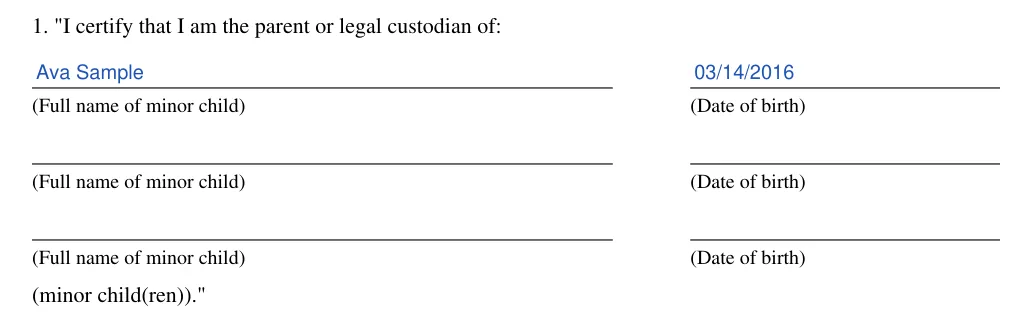
Paragraph 1 (page 1). Write each minor child's full name and date of birth. The form has lines for up to three children. With paragraph 1 you certify that you are the parent or legal custodian of each child you list.Step 1: sample entries, not a real form.
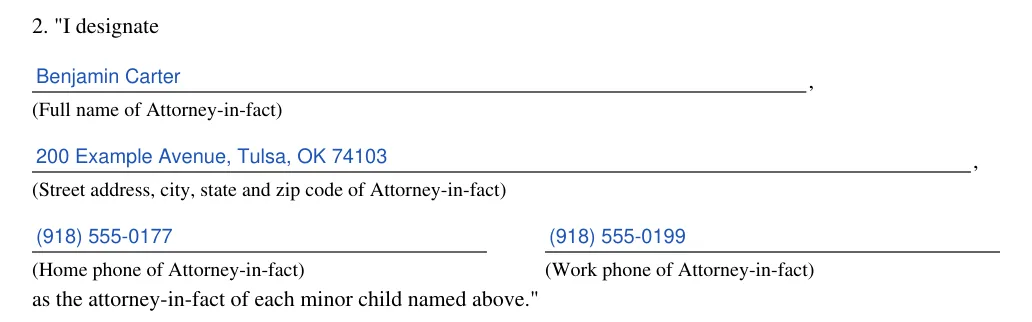
Paragraph 2 (page 1). Write the full name of the person you designate as attorney-in-fact, their street address, city, state and zip code, and their home and work phone numbers.Step 2: sample entries, not a real form.
Paragraph 3 (page 1). To delegate all of your power and authority regarding the care, custody and property of each child, write a mark or your initials on the blank line the form prints in front of paragraph 3.[2] The wording is printed in full and needs no other entry.
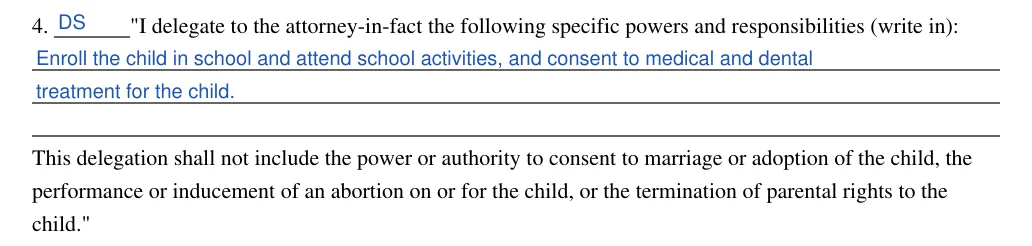
Paragraph 4 (page 1). To delegate only some powers, write a mark or your initials on the blank line in front of paragraph 4 instead, and write the specific powers and responsibilities on the lines. The form joins paragraphs 3 and 4 with "or", so mark only one of the two blank lines. Either way, the delegation does not include the power or authority to consent to marriage or adoption of the child, the performance or inducement of an abortion on or for the child, or the termination of parental rights to the child.[2]Step 4: sample entries, not a real form.
Paragraph 5 (page 2). Write the beginning and ending dates. The form says the power of attorney is effective for a period not to exceed one year, and that you reserve the right to revoke this authority at any time.[2]Step 5: sample entries, not a real form.
By: (Parent/Legal Custodian signature) (page 2). Sign on the By line. You and the attorney-in-fact then appear before the notary public who completes the acknowledgment (step 8).Step 6: sample entries, not a real form.
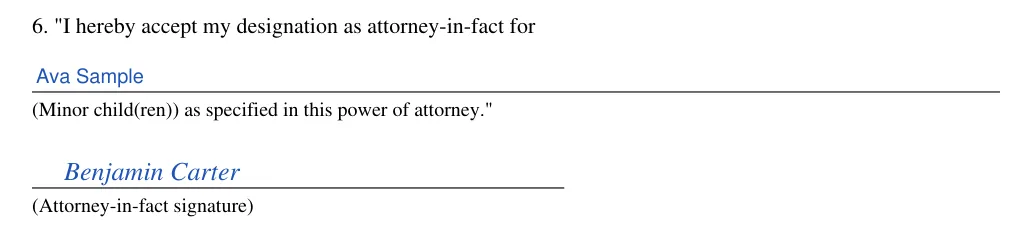
Paragraph 6 (page 2). The attorney-in-fact writes the name of each minor child on the line in paragraph 6, which begins "I hereby accept my designation as attorney-in-fact for", and signs on the (Attorney-in-fact signature) line.[2]Step 7: sample entries, not a real form.
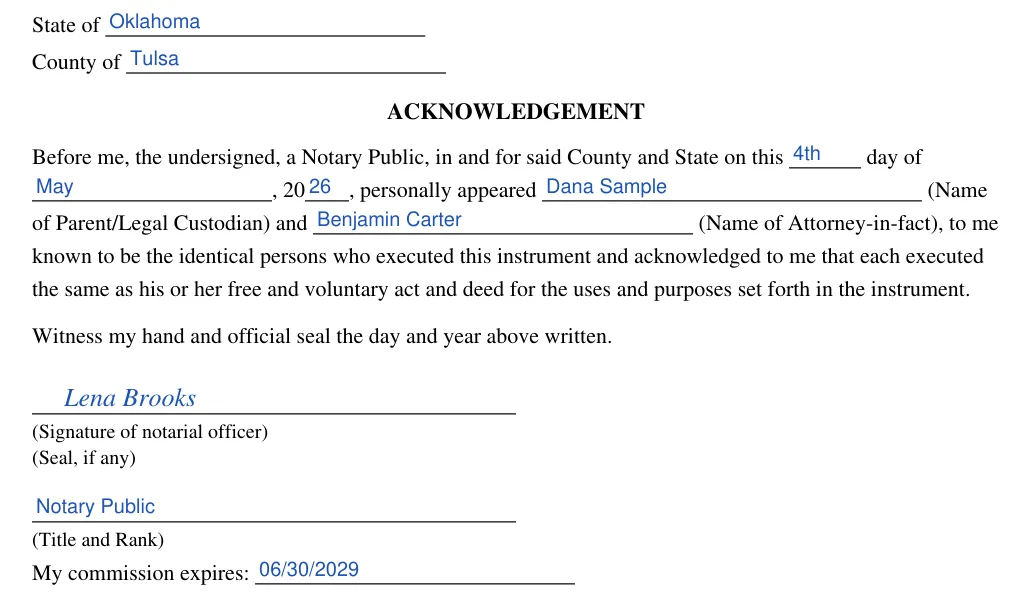
State of, County of and ACKNOWLEDGEMENT (page 2). This part is for the notary public. The notary fills in the state and county, the date, and the names of the parent or legal custodian and the attorney-in-fact, who personally appear and acknowledge that each executed the instrument as his or her free and voluntary act and deed. The notary then signs, adds a seal if any, and fills in the title and rank and the date the commission expires.[2]Step 8: sample entries, not a real form.
How the statutory form is signed. You sign on the By line, and the attorney-in-fact signs the paragraph 6 acceptance. The form ends with one notary acknowledgment, in which a notary public certifies that the parent or legal custodian and the attorney-in-fact personally appeared and acknowledged that each executed the instrument. The form has no lines for witnesses.[2] Under 10 O.S. § 701(B), the power of attorney is legally sufficient if the wording of the form complies substantially with subsection A, the form is properly completed, and the signatures of the parties are acknowledged.[1.2]
The FormsPal template from Create My Document. Section 701 makes the statutory form legally sufficient.[1.2] The FormsPal template is a general form, not the statutory form, and it does not follow the statutory form's wording.
Check every name and date against your records before you sign. A wrong birth date or a misspelled name can slow things down when the agent shows the document to a school or a doctor.
Common Mistakes With the Oklahoma Minor Child Power of Attorney Form
The most common mistakes with this form involve dates, powers and the agent's role. Each item below names the slip and the Oklahoma rule that prevents it, so you can check your form before you give it to the agent.
Setting an end date more than one year after the start date. The power of attorney is effective for a period not to exceed one year.[1.2]
Letting the document run past its end date. A delegation that lasts longer than one year needs a new power of attorney for each additional year.[1.1]
Writing a power on the paragraph 4 lines that a parent cannot delegate, such as consent to marriage or adoption.[1.1]
Naming an agent who cannot take on parental or legal authority for at least 24 hours or who expects pay for it.[1.1]
Leaving paragraph 6 unsigned. The statutory form has the attorney-in-fact accept the designation and sign.[2]
Skipping a copy. Keep one for your records and give the agent one to show to schools and doctors.
Create a high-quality Oklahoma Minor Child Power of Attorney Form online now!
Frequently Asked Questions
The answers below cover how long the document lasts, renewal, revocation, the powers a parent keeps, and what Oklahoma asks of the agent. Each answer comes from Okla. Stat. tit. 10, §§ 700 and 701, and the source is cited after it.
How long is an Oklahoma minor child power of attorney valid?
The power of attorney is effective for a period not to exceed one year. It runs from the start date you enter on the form to the end date you enter.[1.2]
Do I need a new power of attorney after one year?
In general, yes. If the delegation of authority lasts longer than one year, the parent or legal custodian must sign a new power of attorney for each additional year the delegation continues. The statute allows some exceptions, so read section 700 before you rely on this answer.[1.1]
Can a parent revoke an Oklahoma minor child power of attorney?
Yes. The parent or legal custodian of the child has the authority to revoke or withdraw the power of attorney at any time.[1.1]
Which powers can a parent not give to an agent in Oklahoma?
A parent cannot delegate these powers.
Consent to the marriage or adoption of the child.
The performance or inducement of an abortion on or for the child.
The termination of parental rights to the child.
Other powers regarding the care and custody of the child can be delegated.[1.1] On the statutory form, paragraph 3 delegates all of them and paragraph 4 only the ones you write in.[2]
What does Oklahoma require of the agent?
The attorney-in-fact must exercise parental or legal authority on a continuous basis for not less than 24 hours and without compensation for the intended duration of the power of attorney.[1.1]
Mara has been practicing estate planning and trust law in California since 2003, taking pride in helping clients of all backgrounds and asset profiles form a complete and customized estate plan. Her specialties are: estate planning, wills and trusts, trust and probate administration.