
A Utah limited power of attorney is a written document that lets you, the principal, name an agent to act for you on specific matters only. It is narrower than a general power of attorney. This page offers a power of attorney form Utah residents can fill out online or download as a PDF. A Utah power of attorney must be signed before a notary public or another person authorized by law to take acknowledgments.[1.1]
Last Updated: October 2026. This guide is reviewed and updated regularly to reflect current Utah law. If you notice an error or outdated information, please contact us.
Build Your Document
Answer a few simple questions to make your document in minutes
Save and Print
Save progress and finish on any device, download and print anytime
Sign and Use
Your valid, lawyer-approved document is ready
Utah's Uniform Power of Attorney Act, in Title 75A, Chapter 2 of the Utah Code, sets a few formalities.[2] Section 75A-2-102 defines a power of attorney as a writing or other record, governed by that chapter, that grants authority to an agent to act in the place of the principal.[3] The principal must sign the document before a notary public or another person authorized to take acknowledgments. The principal must also have enough mental capacity at the time of signing to understand that the principal is appointing an agent to handle their financial affairs.[1.1]
In plain words, the signing rules are:
Section 75A-2-105 of the Utah Code also says when the signature is treated as genuine:
A signature on a power of attorney is presumed to be genuine if the principal acknowledges the signature before a notary public or other individual authorized by law to take acknowledgments.
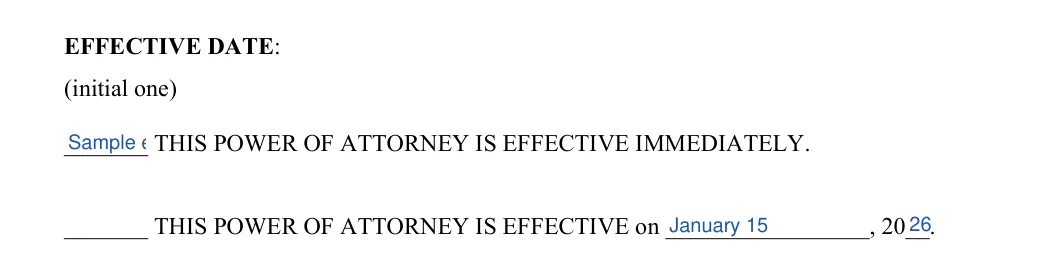
A power of attorney is effective when it is executed, unless the principal provides in the power of attorney that it becomes effective at a future date or upon the occurrence of a future event or contingency.[1.3] The form has an Effective Date part for this choice, covered in step 3 below.
A principal who lives, or is about to live, in a hospital, assisted living, skilled nursing or similar residential care facility may not name an agent who is the owner, operator, health care provider or employee of that facility. The statute allows two exceptions:
Unless the power of attorney provides otherwise, a person accepts appointment as an agent by exercising authority or performing duties as an agent, or by any other assertion or conduct indicating acceptance.[1.6]
| Document Name | Utah Limited Power of Attorney Form |
| Other Name | Utah Special Power of Attorney |
| Relevant Laws | Utah Code, Sections 75A-2-105 to 75A-2-113 |
| Avg. Time to Fill Out | 8 minutes |
| # of Fillable Fields | 32 |
| Available Formats | Adobe PDF |
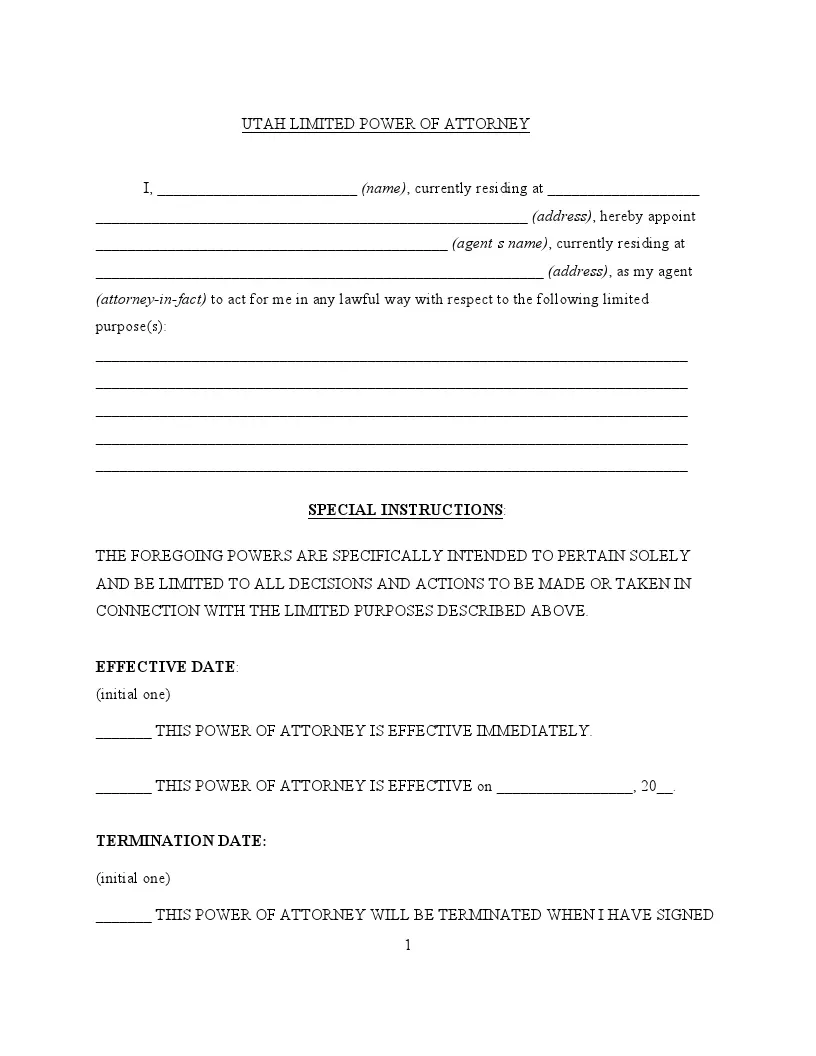
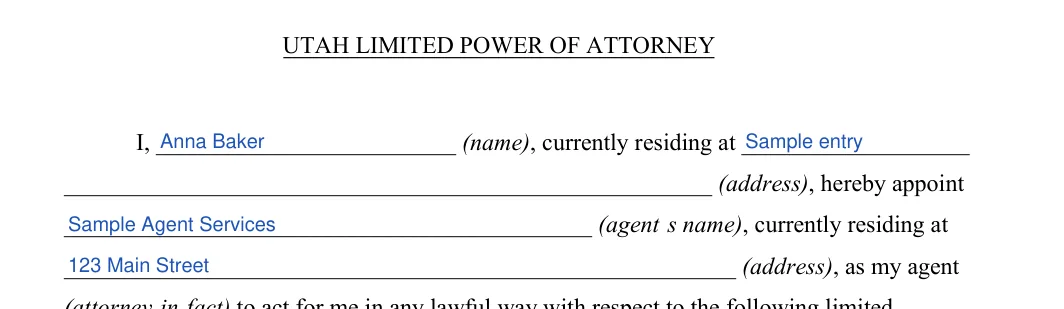
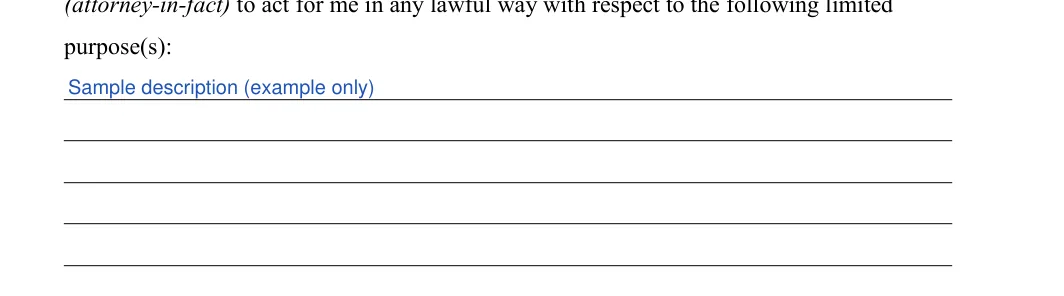
To fill out the Utah limited power of attorney form, start on page 1 with the principal and the agent. Then list the tasks the agent may handle and choose the dates. The form has three pages, and the steps below follow its order. Download the PDF or build it online with the buttons above, or type into the PDF with our online PDF editor.
A limited power of attorney under Chapter 75A-2 of the Utah Code does not grant health care decision authority. The chapter does not apply to a power to make health care decisions.[2]
The screenshots under each step show the FormsPal Utah limited power of attorney template filled with sample entries in blue, so you can see where each answer goes. The names, addresses, dates and amounts are examples only.

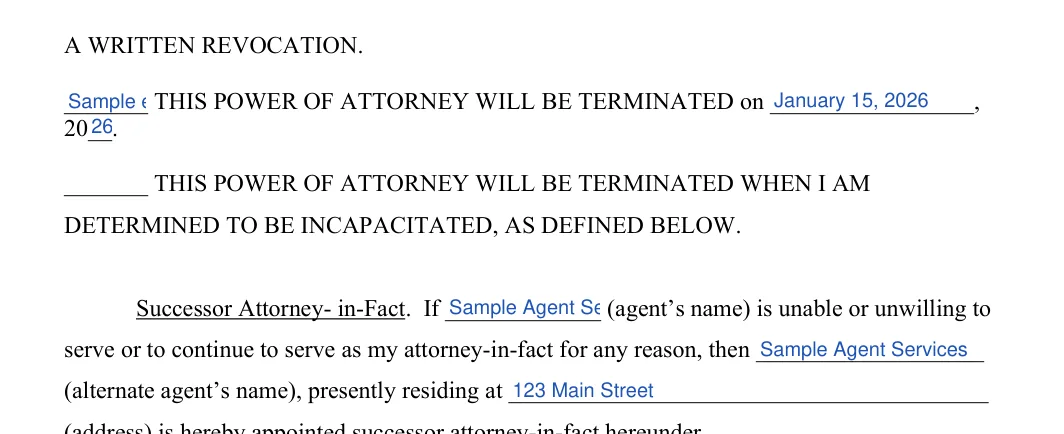
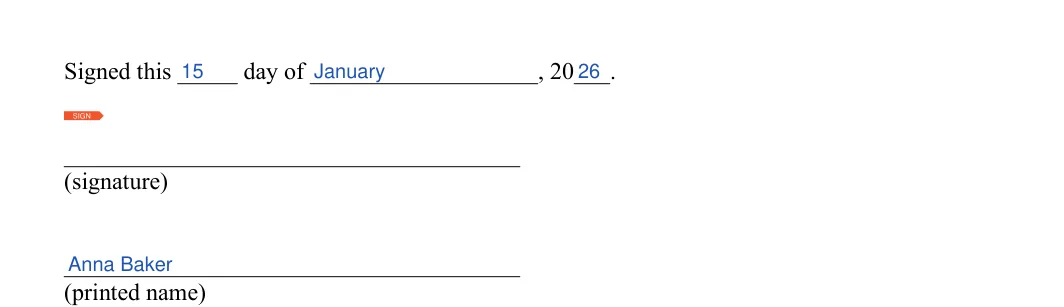
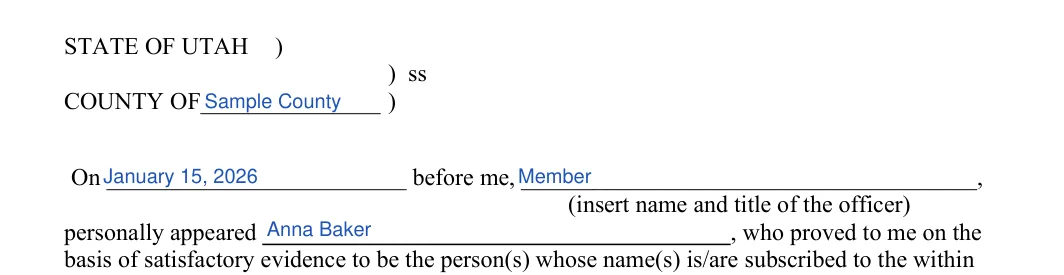

If you want an agent to handle your finances broadly, see our Utah general power of attorney form instead. You can also browse all Utah power of attorney forms on FormsPal.
A Utah power of attorney ends when one of the events in Section 75A-2-110 of the Utah Code happens. This section lists those events, explains how the principal can revoke, and covers acts done in good faith before anyone knew the power of attorney had ended.
The principal may revoke or amend a power of attorney in one of two ways:
If you revoke a limited power of attorney, tell your agent and every person who relies on it.
Ending a power of attorney does not undo what others do in good faith. Termination of an agent's authority or of a power of attorney is not effective as to the agent or another person that, without actual knowledge of the termination, acts in good faith under the power of attorney.[1.4]
The same is true if the power of attorney is not durable and the principal becomes incapacitated. Incapacity does not revoke or terminate it as to an agent or other person who, without actual knowledge of the incapacity, acts in good faith under it.[1.4]
These answers cover notarization, copies, later documents and divorce. Each one comes from the Utah Code sections listed under Sources at the end of this page, so you can check the wording yourself.
Yes. A Utah power of attorney must be signed before a notary public or another individual authorized by law to take acknowledgments.[1.1]
Generally, yes. Except as another law provides, a photocopy or electronically transmitted copy of an original power of attorney has the same effect as the original.[1.2]
Not automatically. A later power of attorney does not revoke an earlier one unless the later one provides that the previous power of attorney is revoked or that all other powers of attorney are revoked.[1.4]
It can. The agent's authority terminates when an action is filed for any of these, unless the power of attorney otherwise provides:
General information, not legal or tax advice.
