
An Alabama limited power of attorney is a written document in which you, the principal, name an agent (an attorney-in-fact) to act for you only for the purposes you list. It is narrower than a general power of attorney, which hands the agent broad powers. You can fill out this free three-page Alabama form online with FormsPal, then print and sign it.
Last Updated: October 2026. This guide is reviewed and updated regularly to reflect current Alabama law. If you notice an error or outdated information, please contact us.
Build Your Document
Answer a few simple questions to make your document in minutes
Save and Print
Save progress and finish on any device, download and print anytime
Sign and Use
Your valid, lawyer-approved document is ready
A limited power of attorney lets your agent act only for the purposes you write on the form. The form itself states that the powers pertain solely to those purposes. You choose the task, when the document starts, and how it ends. Many people use one for a single, defined job, such as:
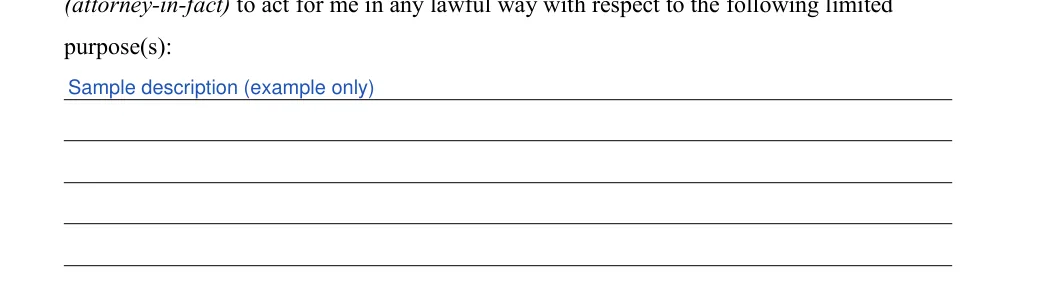
Describe each purpose in clear, specific terms, so your agent and anyone who sees the document know what it covers. If you want an agent to have broad authority instead, use a general power of attorney.
Tip: Put the detail on the "limited purpose(s)" lines of page 1. A short, specific description keeps the document limited to the task you have in mind.
Under the Alabama Uniform Power of Attorney Act, a power of attorney must be signed by the principal. A signature the principal acknowledges before a notary public or other individual authorized by law to take acknowledgments is presumed to be genuine.[1]
The statute also lets another individual sign for the principal, in these words:
A power of attorney must be signed by the principal or in the principal's conscious presence by another individual directed by the principal to sign the principal's name on the power of attorney.
In plain words, someone else can sign for you only if you direct them to, and they must sign your name in your conscious presence.
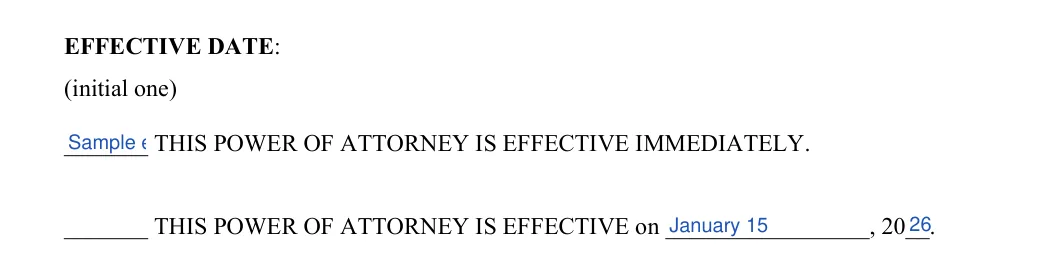
A power of attorney is effective when it is signed, unless it says that it becomes effective at a future date or when a future event or contingency happens.[2] On page 1 of the FormsPal template you initial either an immediate start or a start date.
| Document Name | Alabama Limited Power of Attorney Form |
| Other Name | Alabama Special Power of Attorney |
| Relevant Laws | Ala. Code § 26-1A-105[1], § 26-1A-109(a)[2], § 26-1A-110[3] |
| Avg. Time to Fill Out | 8 minutes |
| # of Fillable Fields | 32 |
| Available Formats | Adobe PDF |
Follow this link to see all the Alabama power of attorney forms you can fill out.
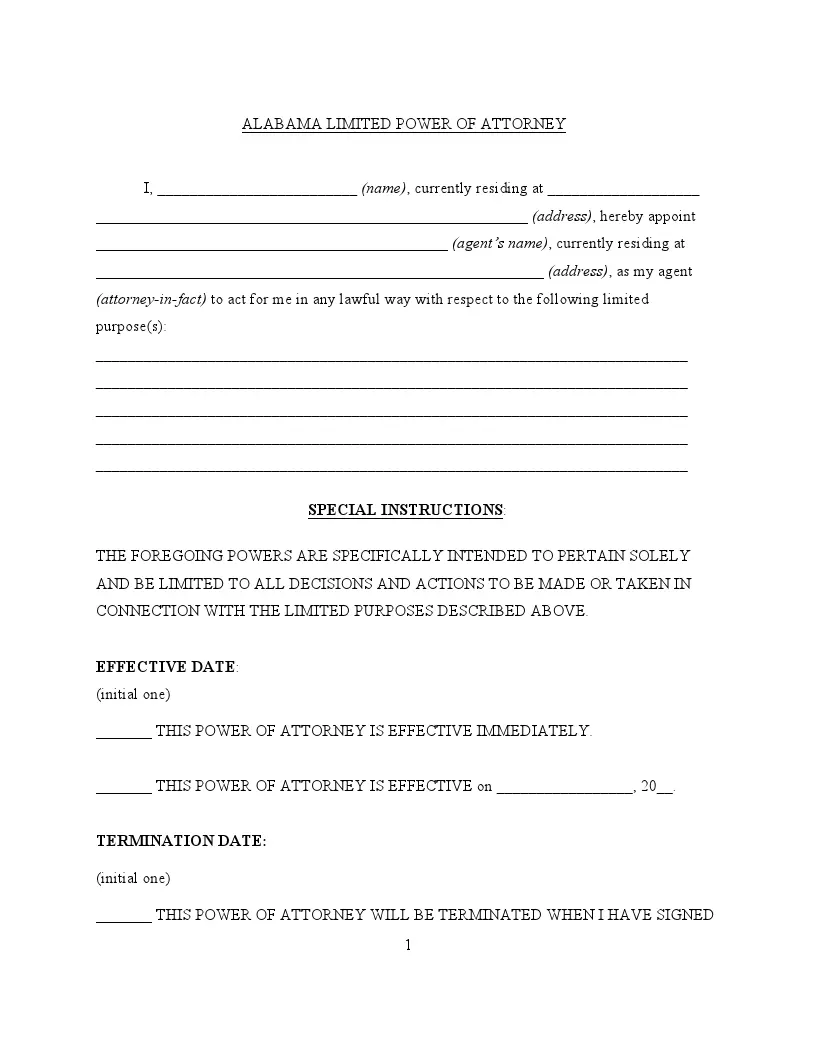
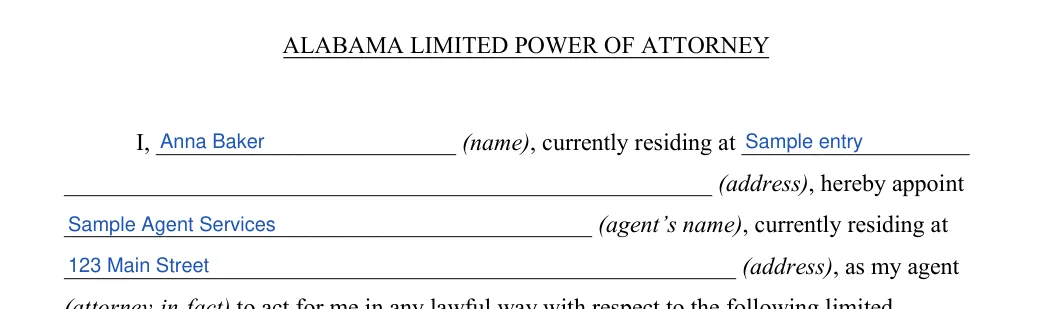
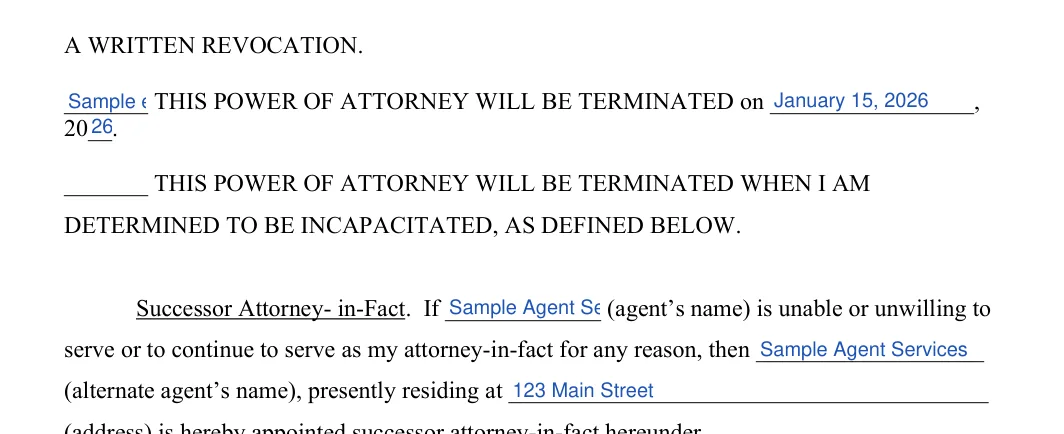
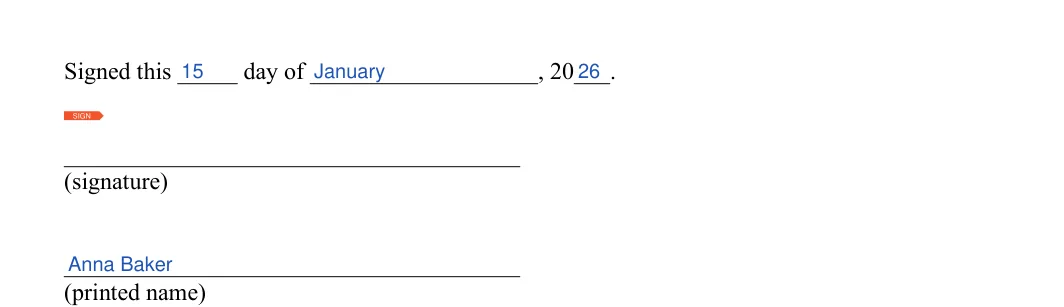
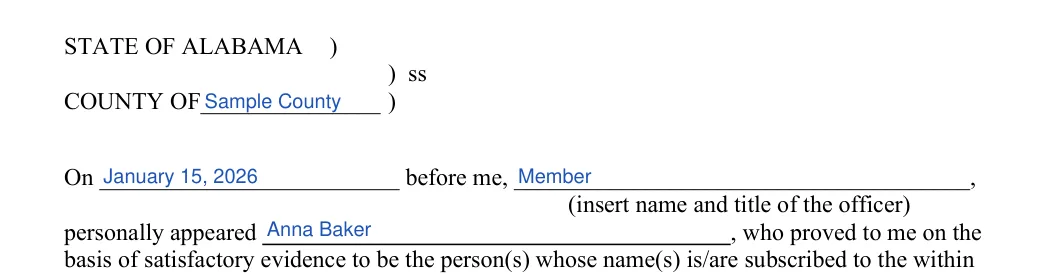
The FormsPal Alabama limited power of attorney template has three pages. Page 1 names you and your agent, lists the purposes, and sets the start date. Page 2 finishes the termination choices, names a successor agent, and holds your signature. Page 3 is the acknowledgment that a notary public or other officer completes.
The screenshots under each step show the FormsPal Alabama limited power of attorney template filled with sample entries in blue, so you can see where each answer goes. The names, addresses, dates and amounts are examples only.


After you fill in the form, review it, sign it, and have a notary public or other officer complete the acknowledgment. Then give your agent a copy and keep the original safe. These steps cover what happens around the form, not the entries on it.
Under Alabama's power of attorney law, a power of attorney terminates when the principal dies, when the principal revokes it, or when its purpose is accomplished. The agent's authority also terminates when the principal revokes that authority.[3]
The termination date section of the form lets you pick how yours ends: a signed written revocation, a date, or a determination that you are incapacitated.
No. A lapse of time since you signed does not end the agent's authority. Unless the power of attorney provides otherwise, the agent's authority is exercisable until it terminates under the statute, notwithstanding a lapse of time since the power of attorney was signed.[3]
A termination is not effective as to an agent who acts in good faith without actual knowledge of it. An act performed that way binds you and your successors in interest, unless the act is otherwise invalid or unenforceable.[3]
If your power of attorney is not durable, your incapacity does not revoke or terminate it as to an agent who acts in good faith without actual knowledge of the incapacity.[3]
The agent's authority terminates if the agent dies, becomes incapacitated, or resigns.[3]
General information, not legal or tax advice.
Unless noted otherwise, the sources below are from the Ala. Code.
