
A New York limited power of attorney (limited POA) is a legal document that lets another person, your agent, act for you on specific matters only, such as financial decisions. This designation involves a fiduciary duty, meaning your agent must act according to your instructions or, where there are none, in your best interest.[3] In New York, the signature must be notarized and witnessed by two people.[1] Fill out the New York limited power of attorney form online, or download the PDF version and print it.
Last Updated: October 2026. This guide is reviewed and updated regularly to reflect current New York law. If you notice an error or outdated information, please contact us.
Build Your Document
Answer a few simple questions to make your document in minutes
Save and Print
Save progress and finish on any device, download and print anytime
Sign and Use
Your valid, lawyer-approved document is ready
A limited power of attorney names an agent and lists the exact powers that agent has. Anything you leave off the list stays with you. The agent can use only those powers, and the form does not replace broader estate planning documents.
People often use a limited POA for a single task or a short stretch of time. Common examples include:
Each of these jobs needs its own wording in the powers section, so write down only what your agent really needs. Before you pick an agent, think about who you trust, which accounts or assets are involved and how long the task will take. A broad grant of authority gives an agent more control than most one-off tasks call for.
The FormsPal New York limited power of attorney form is a fillable PDF version with 32 fields. You can fill it out online or download the PDF and print it. The table below lists the details of the document and the New York laws that govern it.
| Document Name | New York Limited Power of Attorney Form |
| Other Name | New York Special Power of Attorney |
| Relevant Laws | N.Y. Gen. Oblig. Law § 5-1501b and § 5-1511 |
| Avg. Time to Fill Out | 8 minutes |
| # of Fillable Fields | 32 |
| Available Formats | Adobe PDF |
Check out the other New York power of attorney forms on FormsPal and choose the one that fits your needs.
A New York power of attorney must be signed, initialed and dated by a principal with capacity, or signed in the principal's name by another person at the principal's direction. The signature must be notarized and witnessed by two people. The agent signs too, and the agent's signature is notarized as well.[1]
Section 5-1501b of the N.Y. Gen. Oblig. Law sets these formalities:[1]
The statute also sets a minimum type size for the document:
Be typed or printed using letters which are legible or of clear type no less than twelve point in size, or, if in writing, a reasonable equivalent thereof.
In plain words, use clear type of at least twelve point. The document must also substantially conform to the statutory wording of the "Caution to the Principal" and the "Important Information for the Agent."[1]
As to an agent, the power of attorney takes effect on the date the agent's signature is acknowledged. If two or more agents are designated to act together, it takes effect when all of them have signed with their signatures acknowledged.[1]
A New York limited power of attorney ends when the principal dies, when the principal revokes it, when its purpose is accomplished, or when a court order revokes it. It also ends if the principal becomes incapacitated and the power of attorney is not durable.[2]
The agent's authority ends when the power of attorney ends. It also ends in these cases:[2]
Ending a power of attorney does not bind outsiders who do not know about it. Termination is not effective as to a third party who has not received actual notice of it and acts in good faith under the power of attorney.
An action taken that way binds the principal and the principal's successors in interest, unless it is otherwise invalid or unenforceable.[2]
A principal may revoke a New York power of attorney in the way the document itself provides. The principal can also deliver a revocation to the agent in person. Another option is to send a signed and dated revocation to the agent's last known address by mail, courier, electronic transmission or facsimile.[2]
If the power of attorney was recorded, the principal must also record the revocation in the office where the power of attorney is recorded.[2] In practice, give a copy of the revocation to every institution that holds the old document.
Download the PDF version of the New York limited power of attorney form or fill it out online, then work through its parts in order. This guide follows the form in 13 steps, from the names of the principal and agent to the agent's acknowledgments. You can also complete the downloaded PDF with the online PDF editor.
The screenshots under each step show the FormsPal New York limited power of attorney template filled with sample entries in blue, so you can see where each answer goes. The names, addresses, dates and amounts are examples only.
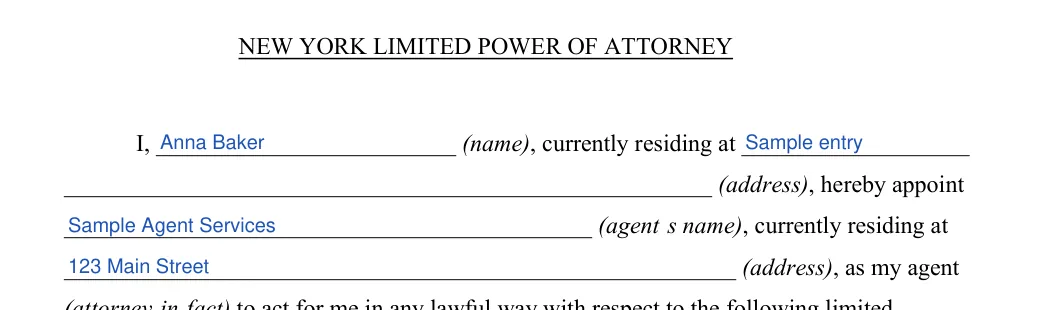
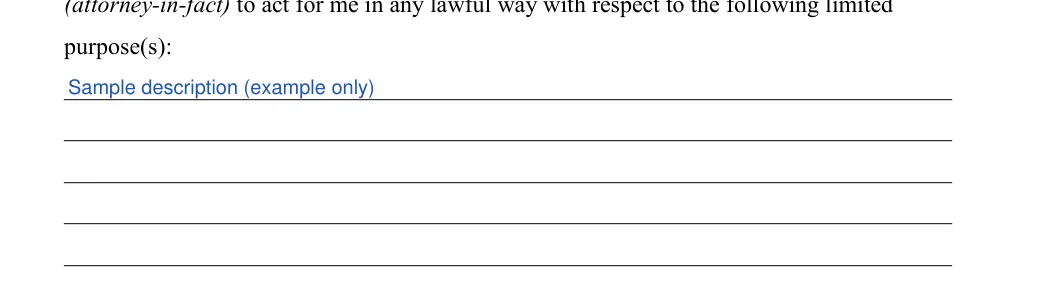
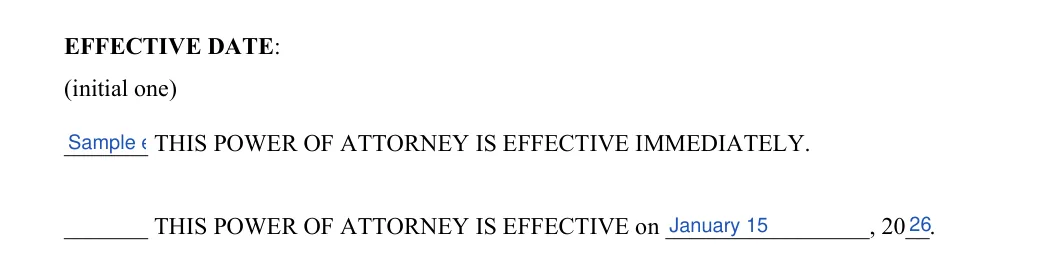

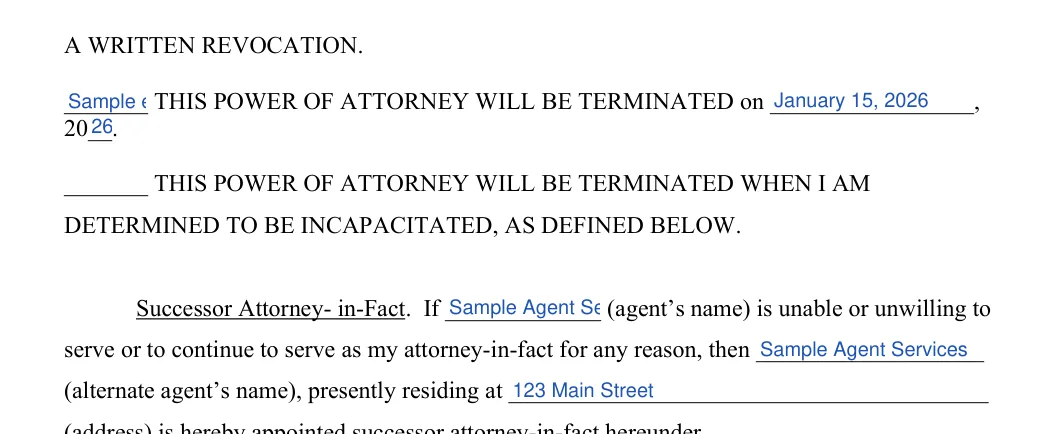
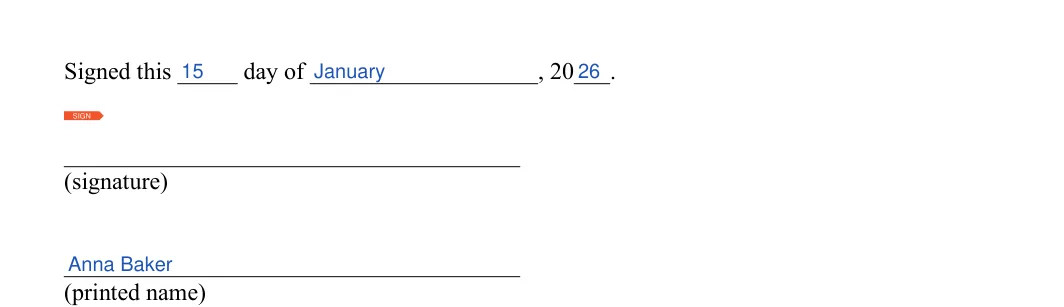
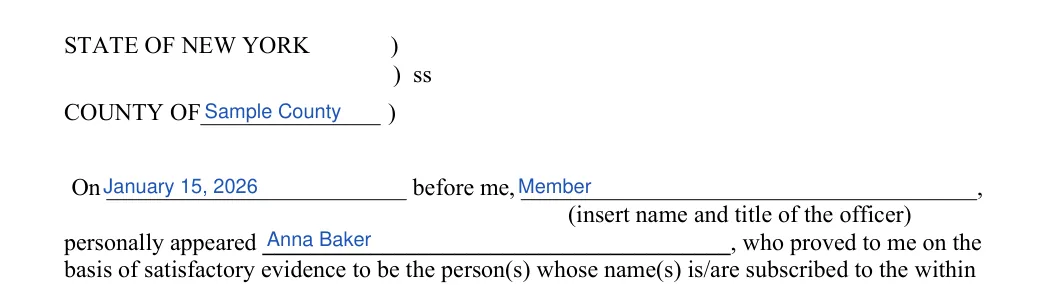

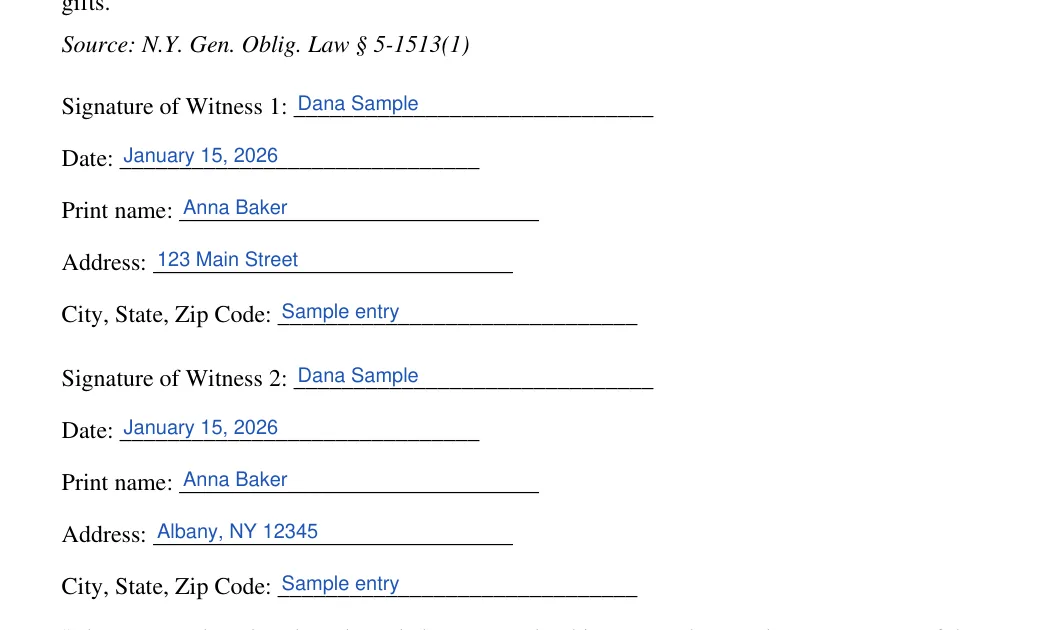
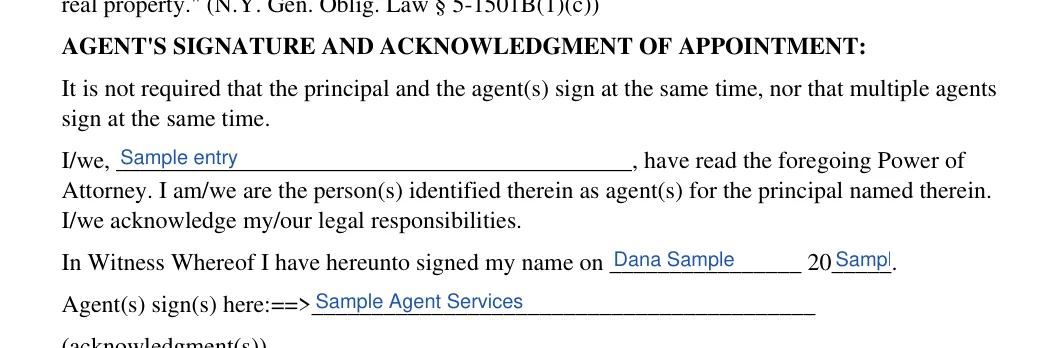
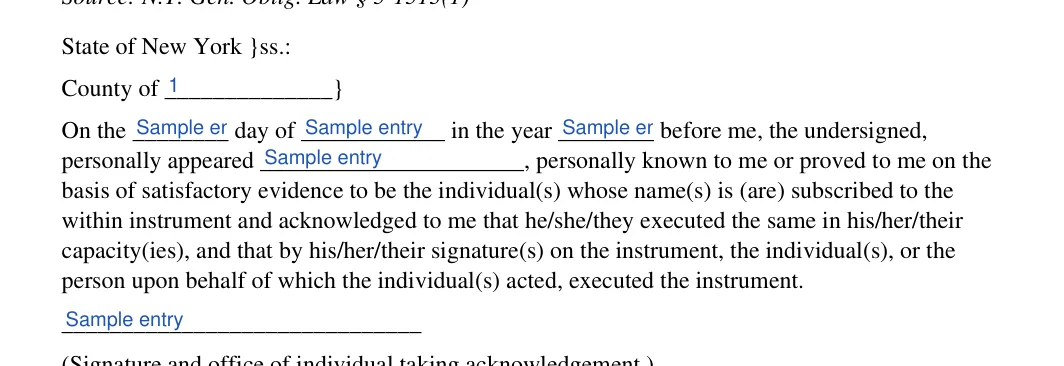
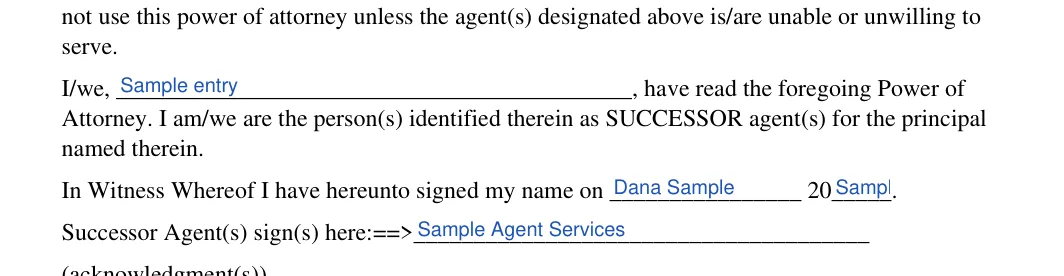
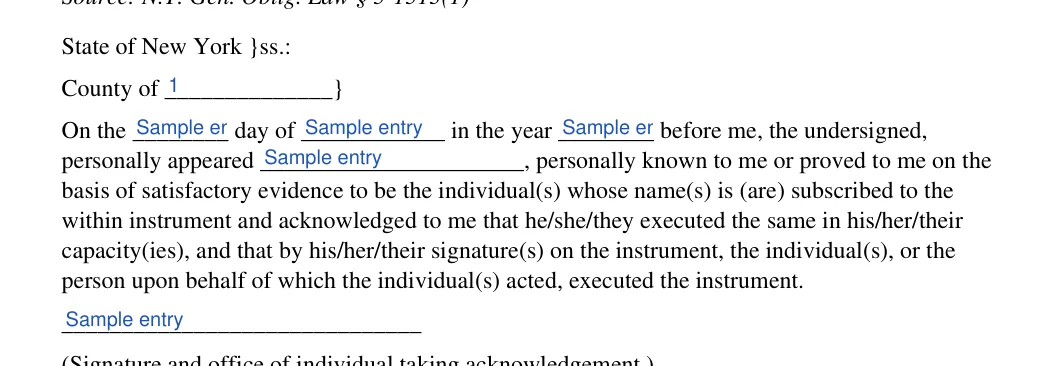
Once the form is filled out, sign it before a notary and two witnesses, then have the agent sign. After that, share copies with the people who will rely on it. These are the steps in order.
These short answers cover the questions people ask most about signing, witnessing, ending and revoking a New York limited power of attorney. Each answer comes from the New York General Obligations Law sections cited in the Sources below.
Yes. The signature of the person signing must be acknowledged in the way the law prescribes for the acknowledgment of a conveyance of real property, which means notarized.[1]
Two. The witnesses must watch the signing in the principal's presence, and they cannot be named in the document as agents or as permissible recipients of gifts.[1]
Yes, in one situation. Another person may sign the principal's name in the principal's presence and at the principal's direction. That person cannot be the agent or a successor agent.[1]
Yes, unless it is durable. A New York power of attorney terminates when the principal becomes incapacitated, if the power of attorney is not durable.[2]
The agent's authority ends if the agent dies, becomes incapacitated or resigns. If there is also no co-agent or successor agent, the power of attorney itself ends.[2]
You can revoke it in any of these ways:[2]
General information, not legal or tax advice.
Unless noted otherwise, the sources below are from the N.Y. Gen. Oblig. Law.
