
The non compete agreement Florida template below is a written contract in which a worker promises not to compete with an employer. Florida courts enforce these promises under Fla. Stat. § 542.335 when they are reasonable in time, area, and line of business.[1] The FormsPal template has seven numbered sections and a signature page for the worker and the company.
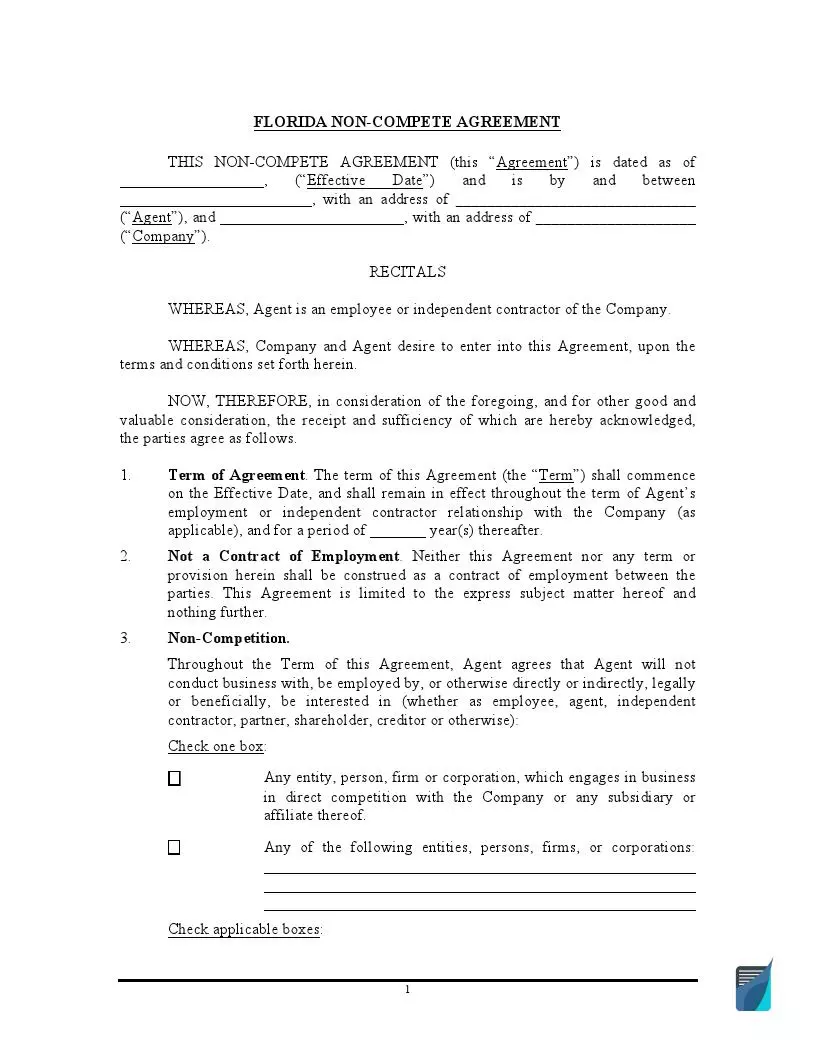
Last Updated: October 2026. This guide is reviewed and updated regularly to reflect current Florida law. If you notice an error or outdated information, please contact us.
Build Your Document
Answer a few simple questions to make your document in minutes
Save and Print
Save progress and finish on any device, download and print anytime
Sign and Use
Your valid, lawyer-approved document is ready
Fla. Stat. § 542.335 is Florida's restrictive covenant statute. A court enforces a non-compete only if it is set forth in a writing signed by the person it binds. The restriction must also be supported by a legitimate business interest and be reasonable in time, area, and line of business.[1]
The statute sets these rules for a court:
Any restrictive covenant not supported by a legitimate business interest is unlawful and is void and unenforceable.
The statute also reaches people who did not sign the contract. A court may not refuse enforcement because the person seeking it is a third-party beneficiary, an assignee, or a successor. A third-party beneficiary must be expressly identified in the covenant as a person it is meant to benefit. An assignee or successor needs the covenant to expressly authorize enforcement by an assignee or successor.[1]
Older agreements follow different rules. Fla. Stat. § 542.335 applies prospectively and does not apply in actions about the enforceability of restrictive covenants entered into before July 1, 1996.[1] Covenants entered into before that date are still governed by Fla. Stat. § 542.33, which Fla. Stat. § 542.331 keeps in force for them.[2]
The employer chooses the restrictions in section 3 of the form, and they must stay within what Florida allows. A restraint must be reasonable in time, area, and line of business, and it must protect a legitimate business interest.[1] The form lets the employer pick the restricted activity, an optional geographic area, and whether the ban reaches online business.
Popular Local NCA Forms
A lot of organizations often prefer to prohibit their staff from turning into the company’s competition after the employment concludes. Different US states have different rules and policies involving non-compete agreements. Here are some of the most common local non-competes looked up by the users of this site.
Section 3 asks the employer to check one of two boxes. The other choices add limits on top of it.
Section 1 sets how long the agreement lasts. It runs for the whole working relationship and for a number of years after it ends. The employer fills in that number of years. Florida courts use their own presumptions about length, covered in the next section.
Florida courts judge the length of a non-compete with presumptions, and the number depends on the situation. For a former employee, agent or independent contractor, when the covenant is not tied to the sale of a business, a court presumes a restraint of 6 months or less is reasonable and a restraint of more than 2 years is unreasonable.[1]
| Situation | Presumed reasonable | Presumed unreasonable |
|---|---|---|
| Former employee, agent or independent contractor, not based on trade secrets and not tied to the sale of a business | 6 months or less | More than 2 years |
| Restraint protecting trade secrets | 5 years or less | More than 10 years |
| Seller of a business, not based on trade secrets | 3 years or less | More than 7 years |
| Former distributor, dealer, franchisee, or trademark or service mark licensee, not based on trade secrets and not tied to the sale of a business | 1 year or less | More than 3 years |
A non-compete made in connection with the sale of a business has its own rule. A court presumes a restraint of 3 years or less reasonable. It presumes a restraint of more than 7 years unreasonable.[1] The form has one blank for the years after the relationship ends, so pick that number with the table in mind.
When a Florida non-compete is enforceable, a court enforces it by any appropriate and effective remedy, including temporary and permanent injunctions. If the restraint is overbroad, overlong, or not reasonably necessary, the court modifies it and grants only the relief reasonably necessary to protect the business interest.[1]
Section 5 of the form tells a court it may reform a covenant it finds unreasonable. Florida law already directs the court to modify an overbroad restraint.
Fill in the blanks in the order the form presents them, then have both sides sign. The form has seven numbered sections, and the blanks are in sections 1, 3, and 6.
Need a form for another state? Start from the main non-compete agreement template.
Most disputes over a non-compete trace back to a few drafting choices. The form leaves several of them to the parties, such as the number of years and the restricted activity. Avoid these four problems when you fill it out.
Florida law does not prohibit enforcing contracts that restrict competition during or after the term of a restrictive covenant. They must be reasonable in time, area, and line of business.[1]
A court construes the covenant in favor of reasonable protection of the legitimate business interests the party seeking enforcement establishes. It may not construe the covenant narrowly or against the drafter. That party must also plead and prove that the restraint is reasonably necessary.[1]
A Florida court enforces a non-compete when all of these are true:
A restrictive covenant that is not supported by a legitimate business interest is unlawful, void, and unenforceable.[1]
You can ask a court to enforce one. The court enforces a restrictive covenant by any appropriate and effective remedy, including temporary and permanent injunctions, but it enters no temporary injunction unless you give a proper bond.[1]
General information, not legal or tax advice.

