A Maryland small estate affidavit form is a written petition that starts the small estate procedure for a person who died owning $50,000 or less in Maryland property. The limit is $100,000 when the surviving spouse is the sole legatee or heir. This guide shows how Maryland values an estate and how to fill out each part of the form.[1]
Last Updated: October 2026. This guide is reviewed and updated regularly to reflect current Maryland law. If you notice an error or outdated information, please contact us.
Create a free high quality Maryland Small Estate Affidavit online now!
Build Your Document
Answer a few simple questions to make your document in minutes
Save and Print
Save progress and finish on any device, download and print anytime
Sign and Use
Your valid, lawyer-approved document is ready
... or download your Maryland Small Estate Affidavit Form as a PDF file
Maryland's small estate rules start at Md. Code, Est. & Trusts § 5-601 and cover a smaller group of estates. The limit is $50,000 of property subject to administration in Maryland, counted on the date of death. The limit is $100,000 when the surviving spouse is the sole legatee or heir.[1]
A legatee is a person named in a will to receive property. An heir is a person who inherits by law. The statute states the main limit this way:
If the property of the decedent subject to administration in Maryland is established to have a value of $50,000 or less as of the date of the death of the decedent, the estate may be administered in accordance with the provisions of §§ 5–602 through 5–607 of this subtitle.
For the $100,000 limit, the value must be established before an initial account is filed in the administration proceedings.[1] Two more rules shape how the limits work:
Value is the fair market value of the property on the date of death, minus debts of record secured by the property. The subtraction applies only to the extent that insurance benefits are not payable to the lienholder or secured party for the secured debt.[1]
A person appointed as personal representative, the person who manages the estate, may not be required to give bond if the estate's gross value is under $10,000 after expenses and allowances under § 5-603(a)(2). A bond is a guarantee that the estate will be handled properly.[2]
Maryland law does not call this filing an affidavit. Under Est. & Trusts § 5-602, it is a petition for administration of a small estate.[3]
The petition may be filed by any person entitled to administration under § 5-104, a priority list that runs from the personal representative named in the will through family members and creditors to any other person, so the petitioner does not have to be a relative.[3] Under § 5-105(c), a person cannot be appointed personal representative if under 18, if not a United States citizen (unless a permanent resident who is the decedent's spouse, ancestor, descendant or sibling), or if a nonresident of Maryland (unless a Maryland resident is designated on file with the register to receive service of process).[4]
Maryland Small Estate Affidavit Laws Details
Max. Estate
$50,000, or $100,000 if the surviving spouse is the sole legatee or heir[1]
Min. Time to Wait After Death
Maryland has no statute that sets one
Bond
Not required if the gross value is under $10,000 after expenses and allowances[2]
Other Maryland Forms
Different essential Maryland forms readily available for download on FormsPal and that can be personalized in our simple document builder.
Create a free high quality Maryland Small Estate Affidavit online now!
Filling Out the Maryland Small Estate Affidavit Form
The Maryland small estate affidavit PDF has three form pages: the petition on pages 1 and 2, and Schedule B on page 3. Fill it out in the 13 steps below, in the order the form shows them. Each step names the part of the form it covers.
The screenshots under each step show the FormsPal Maryland small estate affidavit template filled with sample entries in blue, so you can see where each answer goes. The names, addresses, dates and amounts are examples only.
County of the Orphans' Court. At the top of page 1, pick the county from the dropdown after "In the Orphans' Court for." This is the county of the court office where you file the petition.Step 1: sample entries, not a real document.
Estate name and estate number. Type the decedent's name after "In the Estate of." Leave "Estate No." empty unless the court has already given you a number.Step 2: sample entries, not a real document.
Check the Small Estate box. Under "For," tick the box headed "Small Estate - Petition for Administration." It is the one marked for an estate value of $50,000 or less. The other three boxes are for other cases.Step 3: sample entries, not a real document.
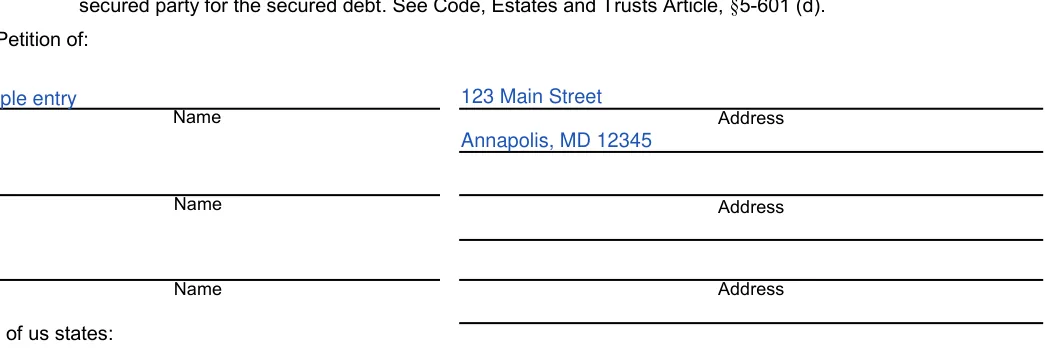
The Petition of: petitioner names and addresses. Enter each petitioner's name and address on the lines under "The Petition of." The form has room for three petitioners. Leave unused lines empty.Step 4: sample entries, not a real document.
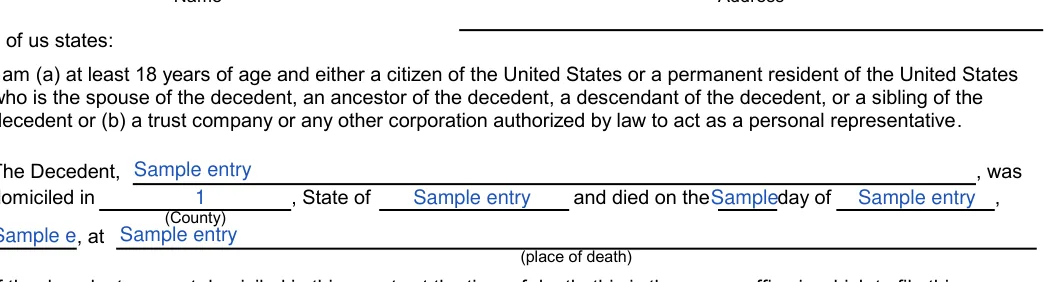
Item 2: the decedent. In item 2, enter the decedent's name, the county and state where the decedent lived, the date of death, and the place of death. Item 1 is a statement and has no blanks.Step 5: sample entries, not a real document.
Items 3 and 4: proper office and priority. Fill in item 3 only if the decedent did not live in the county of this office, and say why this office is the proper one. In item 4, state why you have priority to be appointed personal representative. Items 5 and 6 are statements you confirm by signing.Step 6: sample entries, not a real document.
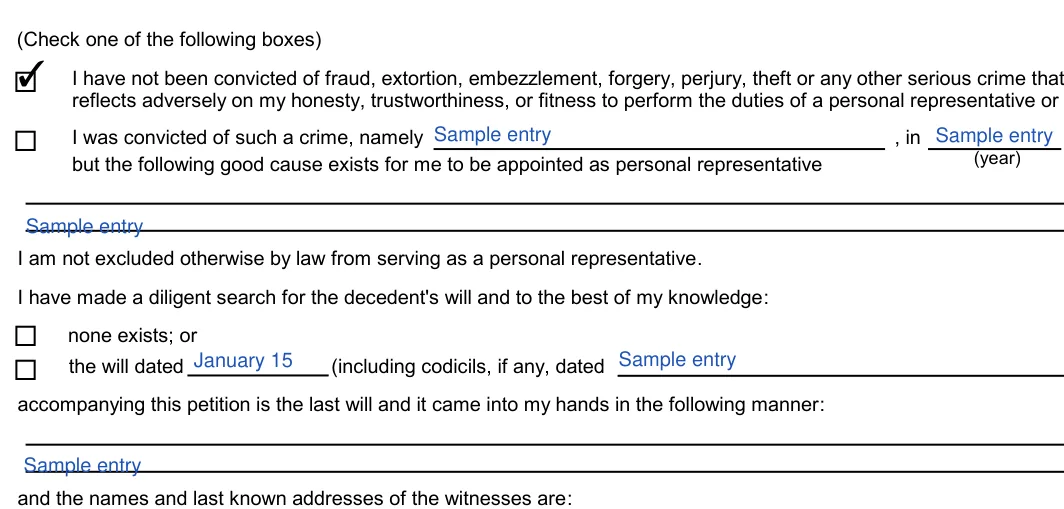
Items 7 to 9: conviction statement and will search. On page 2, check one box in item 7. Either you have not been convicted of a serious crime, or you were, and you fill in the crime, the year and the good cause. Item 8 is a statement. In item 9, check that no will exists, or enter the will date, any codicil dates and how the will came into your hands.Step 7: sample entries, not a real document.
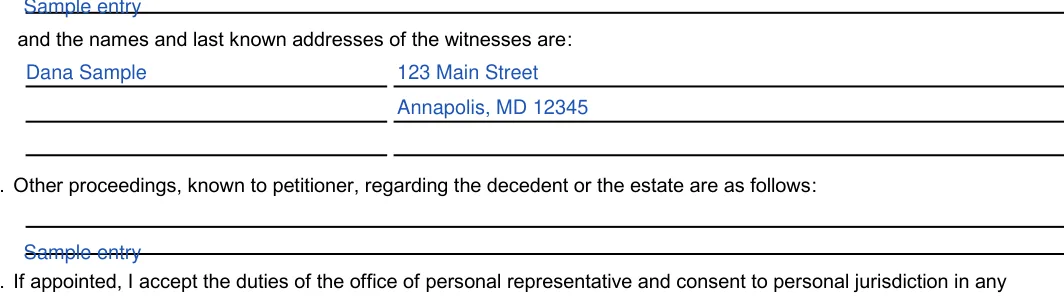
Item 9 witnesses and item 10 other proceedings. If you described a will, list the names and last known addresses of its witnesses. In item 10, describe any other proceedings you know of about the decedent or the estate.Step 8: sample entries, not a real document.
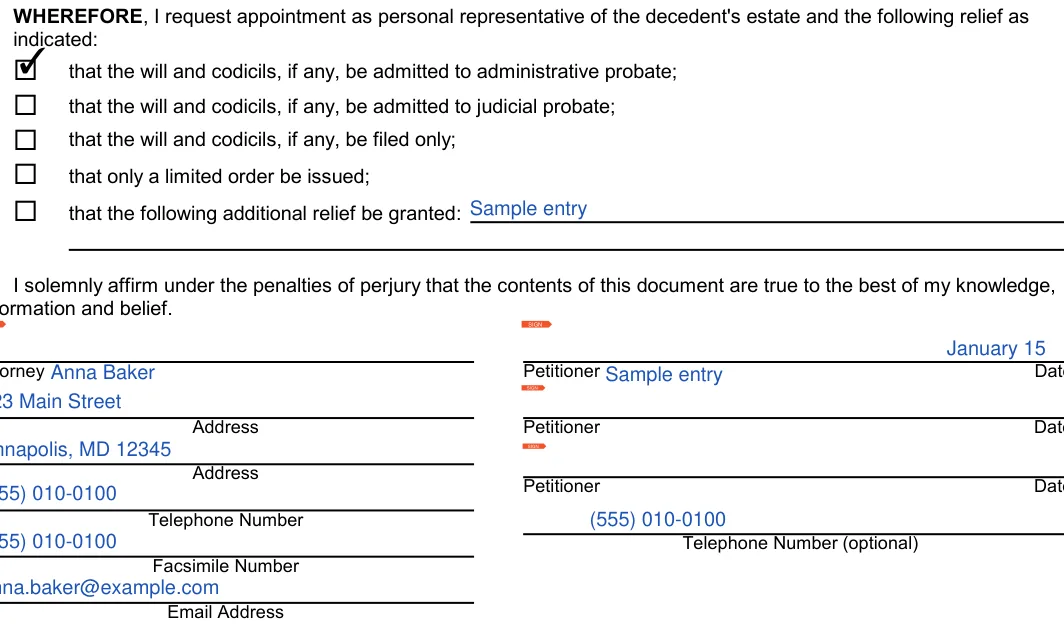
Item 11, relief requested and signatures. In item 11, the petitioner takes on the duties of personal representative. Under "Wherefore," tick the relief you request, such as administrative probate, judicial probate, filed only, or limited order. Each petitioner signs and dates the line under the perjury statement, then adds an address and phone number. The attorney line, fax and email are on the form too.Step 9: sample entries, not a real document.
Schedule B: county. On page 3, Schedule B is headed "Small Estate - Assets and Debts of the Decedent." Pick the same county as on page 1.Step 10: sample entries, not a real document.
Schedule B: estate name and number. Repeat the decedent's name and the estate number, if you have one, as on page 1.Step 11: sample entries, not a real document.
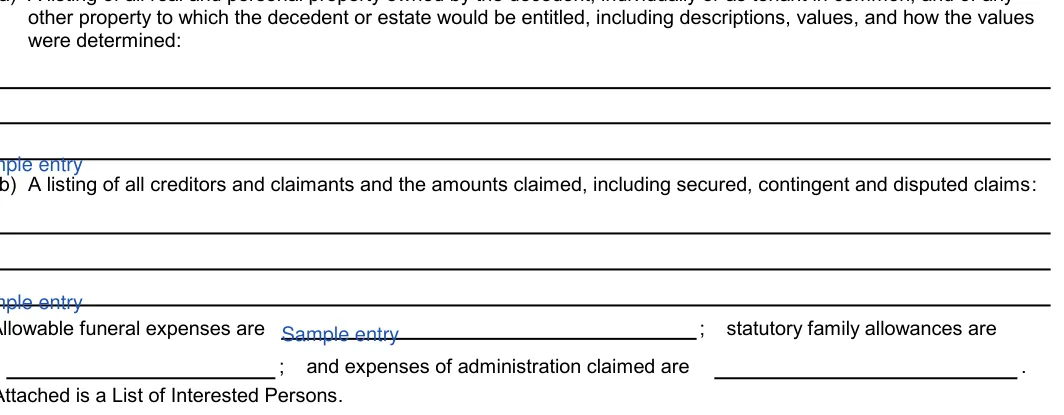
Schedule B items 1 and 2: assets, debts and expenses. In item 1(a), list the decedent's real and personal property with a description and value for each, and how you determined the value. In item 1(b), list creditors and claimants and the amounts claimed. In item 2, enter funeral expenses, family allowances and administration expenses. Item 3 says a List of Interested Persons is attached. Item 4 is a statement.Step 12: sample entries, not a real document.
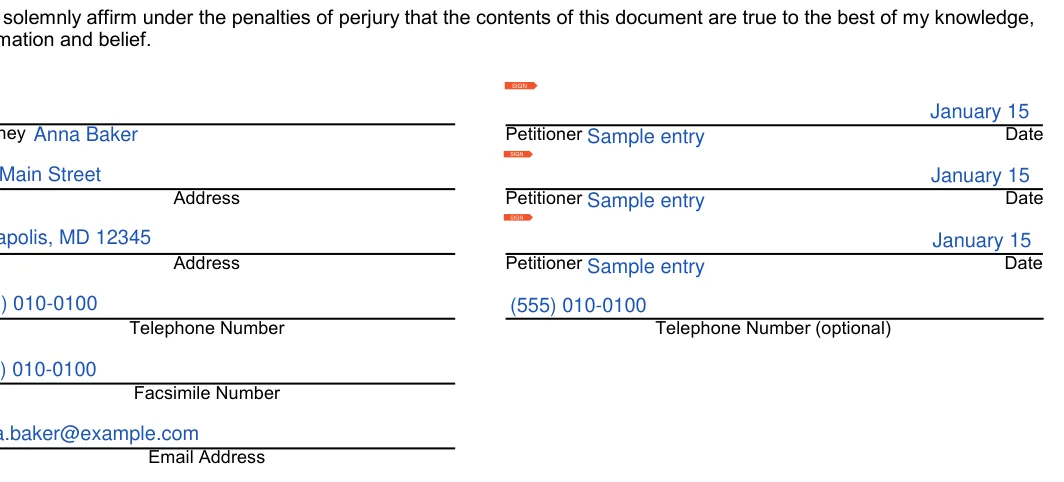
Schedule B signatures. Each petitioner signs and dates Schedule B under the same perjury statement, and adds an address, telephone number, fax and email as on page 2.Step 13: sample entries, not a real document.
Make a copy of the finished petition and Schedule B before you hand them in. The copy shows exactly what each petitioner signed.
The Register of Wills form for this filing is the Small Estate Petition for Administration (form RW1103). It tells you to complete and attach Schedule B (form RW1137), the list of the decedent's assets and debts.[5]
Frequently Asked Questions
These short answers cover whether a small estate needs probate, what counts as a small estate in Maryland, and where the affidavit limit sits. Each answer is kept short, so you can scan the three questions and move on to the form.
For other Maryland estate planning documents, see:
Maryland has special provisions for small estates. If the property subject to administration in Maryland is worth $50,000 or less on the date of death, the estate may be administered under §§ 5-602 through 5-607.[1]
What is considered a small estate in MD?
A small estate in Maryland is one worth $50,000 or less on the date of death. The limit is $100,000 if the surviving spouse is the sole legatee or heir. Value is the fair market value of the property less the debts of record secured by it.[1]
What is the limit for a small estate affidavit in Maryland?
The limit is $50,000 of property subject to administration in Maryland. The limit is $100,000 when the surviving spouse is the sole legatee or heir and the value is established before an initial account is filed in the administration proceedings.[1]
General information, not legal or tax advice.
Sources
Unless noted otherwise, the sources below are from the Md. Code, Est. & Trusts.
Mara has been practicing estate planning and trust law in California since 2003, taking pride in helping clients of all backgrounds and asset profiles form a complete and customized estate plan. Her specialties are: estate planning, wills and trusts, trust and probate administration.