
A Maryland vehicle bill of sale is a written record of a private vehicle sale between a buyer and a seller. It lists the vehicle’s description, the sale price, and the date of sale, and it serves as proof of ownership when the title alone does not.
Last Updated: September 2026. This guide is reviewed and updated regularly to reflect current Maryland law. If you notice an error or outdated information, please contact us.
Build Your Document
Answer a few simple questions to make your document in minutes
Save and Print
Save progress and finish on any device, download and print anytime
Sign and Use
Your valid, lawyer-approved document is ready
The Maryland MVA does not always require a bill of sale. It asks for one when the purchase price is left blank on the certificate of title, and most sellers and buyers keep one anyway as their record of the deal.
FormsPal offers a free Maryland vehicle bill of sale template and an online builder that creates a document in minutes. Separate official forms also exist for vehicles (Form VR-181) and boats (Form B-118), available to download below.
| Document Name | Maryland Vehicle Bill of Sale Form |
| Other Names | Maryland Car Bill of Sale, Maryland Automobile Bill of Sale |
| DMV | Maryland Motor Vehicle Administration |
| Vehicle Registration Fee | Varies, check the MVA fee schedule |
| Bill of Sale Required? | Recommended (required if the price is left blank on the title) |
| Avg. Time to Fill Out | 7 minutes |
| # of Fillable Fields | 38 |
Depending on the circumstances and types of transactions, there are different types of bills of sale that you can use in MD. You may wish to choose the appropriate bill of sale template below based on the transaction you’re conducting.
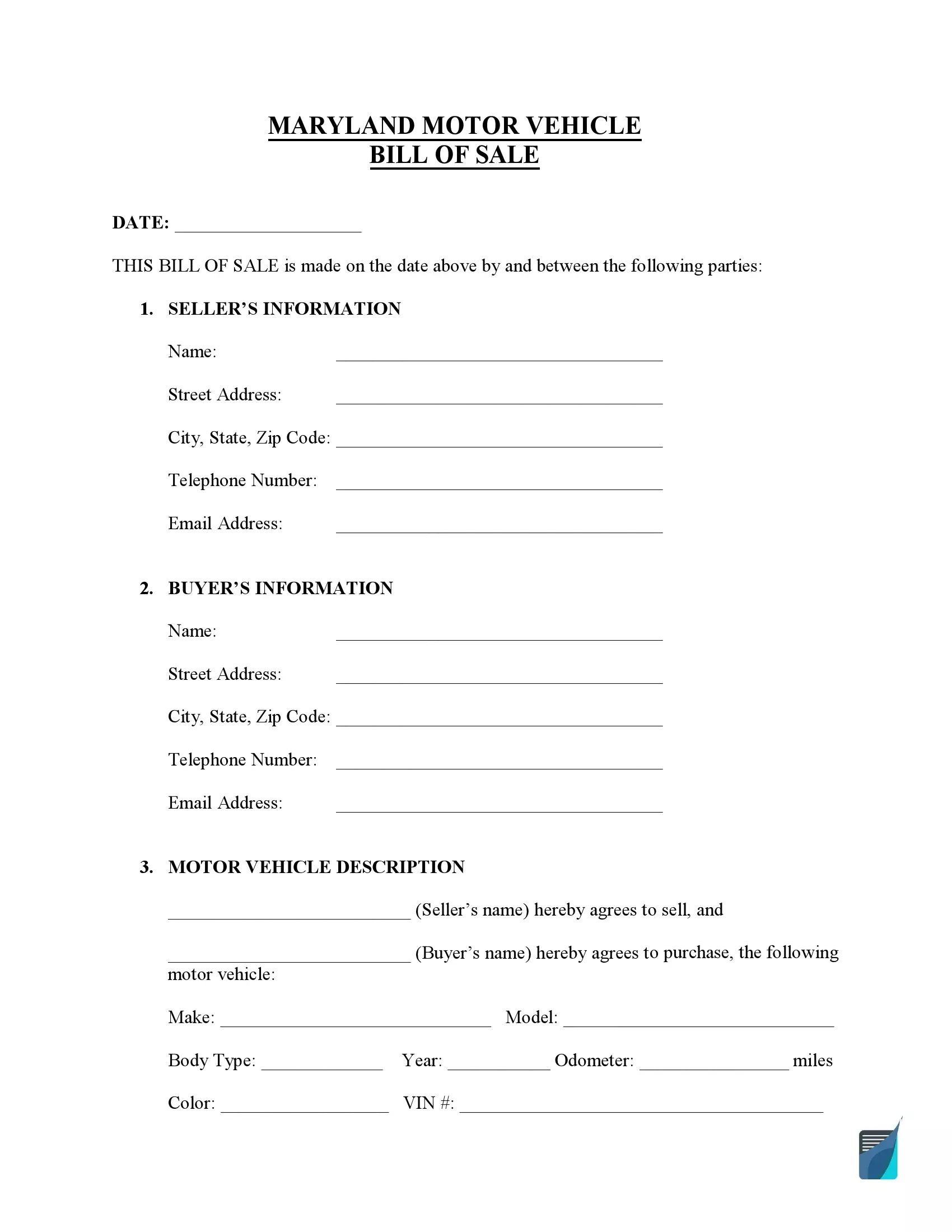
Maryland motor vehicle bill of sale is used for private vehicle sales and is asked for at titling when the purchase price on the title is left blank. The form only needs notarization in one case: a used vehicle less than seven model years old bought from someone other than a licensed dealer, when the excise tax is to be based on a price at least $500 below the book value. The seller also signs the title over to you when the vehicle is delivered.
| Alternative Name | Car Bill of Sale |
| Seller’s Signature | Required |
| Buyer’s Signature | Required |
| Notarization | Required |
| Download | PDF Template |

Maryland boat bill of sale form records the information of a watercraft being sold to another party and has legal proof of the deal completion. Commercial and recreational vessels with any mechanical propulsion that are used mainly in Maryland must be registered with the Maryland DNR within 30 days of purchase, and the two-year registration decal is valid through December 31 of the year after it is issued.[6]
| Alternative Name | Vessel Bill of Sale |
| Seller’s Signature | Required |
| Buyer’s Signature | Optional |
| Notarization | Optional |
| Download | PDF Template |

Use this gun bill of sale template to document the essential details of a firearm transfer. In practice, both parties keep a copy as their record of the transfer. Private sales of handguns and other regulated firearms must go through a licensed dealer or a designated law enforcement agency (Public Safety Section 5-124).[7]
| Alternative Name | Gun Bill of Sale |
| Seller’s Signature | Required |
| Buyer’s Signature | Optional |
| Notarization | Optional |
| Download | PDF Template |

A general bill of sale may be applied for nearly any property type. Ensure the description of what is being offered for sale and the purchase terms are carefully detailed, as this form is less customized.
| Alternative Name | Generic Bill of Sale |
| Seller’s Signature | Required |
| Buyer’s Signature | Optional |
| Notarization | Optional |
| Download | PDF Template |
You can benefit from the official bill of sale template, also called Form VR-181. This is an essential document in the legal process of operating vehicles, as stated by the Motor Vehicle Administration (MVA). Maryland official vehicle bill of sale is evidence of ownership and is usually needed for registration or title change.
The bill of sale form asks for the buyer’s and the seller’s information, and car details such as the VIN, make, and model. Follow the steps below to complete it correctly.


When purchasing from a third-party provider, buyers typically gather documentation and receipts of paid fees to present to the MVA. The list of documents includes the vehicle’s title (which must be signed and dated by the seller), and the vehicle bill of sale, signed by both parties. The buyer should also file an Application for a Certificate of Title by completing Form VR-005 to receive a new title for the acquired vehicle.
Buyers are responsible for all fees, including taxes on purchase and registration fees, which vary by the weight and type of vehicle. Additional documentation presented at the time of registration includes:
Motor vehicle registration fees depend on the type of motor vehicle and its weight. Passenger cars and multi-purpose vehicles pay a fee that depends on whether their shipping weight is over or under 3,700 pounds, plus a surcharge, so check the current fees with the MVA. All registrations last for two years.
Taxes on the purchase take the vehicle’s Blue Book value into account for motor vehicles no older than seven years. Older vehicles are taxed based on the purchase price instead, and the state sets a minimum tax. Check the current rate and minimum with the MVA.
In either case, taxes are generally due at the time of registration unless the buyer qualifies for an exemption. If the vehicle was purchased out of state, buyers typically show proof that taxes were paid, using a bill of sale or a tax receipt. Other exemptions include disabled or military veterans, exempt from paying taxes to register their motor vehicles.
Application for a Certificate of Title – used to apply for vehicle title and must be handed in-person in your local MVA office.

Odometer Disclosure Statement – a mandatory form used to disclose the actual mileage of a vehicle.

Limited motor vehicle power of attorney – assign another person to act on your behalf in vehicle-related matters.

A sample of the form you fill out when applying for a firearm permit (with questions asked by the MDSP). Provided only for informational purposes and should not be filed or submitted in any way.


Other Maryland Forms
Maryland does not always require a bill of sale for a car, but the MVA strongly recommends keeping one. The MVA will ask for a bill of sale when the purchase price on the certificate of title is left blank and the buyer cannot otherwise produce one, since it will not issue a title without that proof.[1] Most buyers and sellers use one anyway as their record of the sale.
A Maryland vehicle bill of sale is also called a car bill of sale or an automobile bill of sale. It is not the same as the MVA title application and does not replace it.
Maryland’s MVA bill of sale form, Form VR-181, asks for the same core details as most private car sales: the sale price, the date of sale, and the signatures of both parties. Federal law also requires a written odometer disclosure whenever the law requires one for the vehicle, since a mileage reading known to be wrong may never be listed as the vehicle’s actual mileage.[2]
When a car titled in Maryland changes hands, the seller must sign the title over to the buyer as an assignment of ownership and hand over the certificate of title at the time the vehicle is delivered.[4] If the vehicle currently has no Maryland certificate of title, its owner must apply for one, with narrow exemptions such as certain farm equipment and small trailers.[3]
"If an owner transfers his interest in a vehicle, other than by the creation of a security interest, the owner shall, at the time of the delivery of the vehicle, execute an assignment and warranty of title to the transferee, with a statement of each security interest, lien, or other encumbrance on the vehicle, in the space provided for that purpose on the certificate."
See our guide on getting a vehicle title with a bill of sale for more on this process.
General information, not legal or tax advice.


