
A Maryland lease agreement is a written contract between a landlord and a tenant that sets the terms for renting a residential property in the state. It records the rent amount, the length of the tenancy, the security deposit, and the responsibilities of each party, sometimes called the lessor and the lessee or leaseholder. A clear lease agreement helps prevent disputes over damages or unpaid rent by giving both sides a shared reference for what was agreed.
Last Updated: September 2026. This guide is reviewed and updated regularly to reflect current Maryland law. If you notice an error or outdated information, please contact us.
Build Your Document
Answer a few simple questions to make your document in minutes
Save and Print
Save progress and finish on any device, download and print anytime
Sign and Use
Your valid, lawyer-approved document is ready
Disputes over damages or rent are common, so a lease that clearly states the rules benefits everyone and supports a fair process if a disagreement comes up. Both parties should read the lease carefully before signing it. If there is more than one tenant, every co-tenant should review and sign the agreement. Verbal leases of one year or less can be valid in Maryland (Real Property Sections 5-101 and 5-102), but a landlord offering 5 or more dwelling units for rent must use a written lease agreement (Section 8-208(a)).[3]
Certain rules and obligations of the lessor and the lessee have to be outlined in a rental agreement. While others are highly recommended to be included in one, a few are optional.
A security deposit, sometimes called a damage deposit, is money the tenant pays the landlord at the start of the tenancy to cover unpaid rent or property damage. In Maryland, a security deposit may not exceed the equivalent of one month’s rent per dwelling unit, regardless of how many tenants share the unit.[1]
Maryland law sets several other rules for how a security deposit must be handled:[1]
Tip: Because Maryland ties deposit interest to the annual U.S. Treasury one-year yield rate, the exact percentage changes every year. Check the current rate before calculating what is owed at move-out.
When the tenancy ends, the landlord must return the deposit, together with any interest owed, within 45 days, minus any damages rightfully withheld.[1]
If the landlord withholds any part of the deposit, Maryland law requires a written, itemized list of the damages and costs. That list must be mailed to the tenant’s last known address within that same 45-day window. If the landlord’s actual repair costs turn out to be less than an earlier estimate given to the tenant, the landlord owes the tenant the difference, due within 30 days of finishing the repairs.[1]
If the tenant gives the landlord notice of the planned move-out date, that notice must be mailed at least 15 days before the move. The landlord’s move-out inspection must then take place within five days before or five days after that date.[1]
Instead of a cash deposit, or alongside a smaller one, a tenant may purchase a surety bond. State law caps a surety bond alone at two months’ rent per dwelling unit. If a tenant provides both a bond and a deposit, the combined total may not exceed two months’ rent per dwelling unit either.[1]
The bond must come from an admitted carrier licensed by the Maryland Insurance Administration. Before making a claim against the bond, the landlord must send the tenant a written list of the damages and an itemized statement of costs. That notice goes by first-class mail, at least 10 days in advance.[1]
None of these security deposit protections can be waived in a lease.[1]
The landlord may withhold the deposit, or part of it, only for unpaid rent, damage due to a breach of the lease, or damage by the tenant or the tenant's family, agents, employees, guests or invitees in excess of ordinary wear and tear (Section 8-203(f)(1)(i)).[1]
Maryland law also sets minimum notice periods for ending a tenancy. For a written lease longer than one week, or for a month-to-month tenancy, either party must give at least 60 days’ notice before the lease or tenancy ends. For a year-to-year tenancy, the required notice is 90 days before the end of the current year of the tenancy.[2]
Separately, when a tenant gives notice of an intent to move out, that notice must be given at least 30 days before the lease or tenancy expires in most cases. A year-to-year tenancy needs 90 days’ notice from the tenant, and a farm tenancy needs 180 days.[2]
Maryland rental arrangements generally take one of a few forms, and the lease agreement should say which one applies.
A fixed-term lease gives both sides certainty about the rent and the length of the tenancy, while a month-to-month tenancy offers more flexibility for a tenant or landlord who may need to move or re-rent the property on shorter notice.
A lease agreement puts several rights and responsibilities in writing for both sides.
The landlord’s responsibilities typically include:
The tenant’s responsibilities typically include:
Many Maryland leases include a late fee for rent that is not paid by the due date. Under Real Property Section 8-208(d)(3), a lease may not set a late fee above 5% of the unpaid rent due for the rental period, and for rent paid weekly the cap is $3 per week and no more than $12 per month.[4]
The amount and timing of a late fee is set by the lease, within the cap Maryland law places on late fees. Read this section of your Maryland lease agreement closely before you sign.
Maryland law (Real Property Section 8-221) requires the landlord to give the tenant written notice at least 24 hours in advance stating the date, approximate time and purpose of the entry, and to enter only between 7:00 a.m. and 7:00 p.m. Monday through Saturday unless the tenant agrees in writing to another time. No notice is needed in an emergency.[5]
If rent goes unpaid, Maryland landlords can file an eviction case in court. Before filing, the landlord must give the tenant a written notice of intent to file and 10 days to cure (Section 8-401(c)). The court sets the trial on the fifth day after the complaint is filed, and a judgment for the landlord orders possession within 4 days after the trial. The tenant can still stay by paying all past-due amounts set by the court plus court-awarded costs and fees before the eviction is carried out, unless three rent judgments were entered against the tenant in the prior 12 months (Section 8-401).[6]
A well-written Maryland lease agreement should clearly outline the basics so both sides know what they agreed to. For housing built before 1978, federal law (42 U.S.C. 4852d) requires the landlord to disclose any known lead-based paint or lead hazards, give the tenant the EPA lead hazard pamphlet, and include a Lead Warning Statement in or attached to the lease before the tenant is bound.[7]
At a minimum, a lease should cover:
It also helps to address:
A few recurring mistakes make a Maryland lease agreement harder to enforce or lead to disputes later:
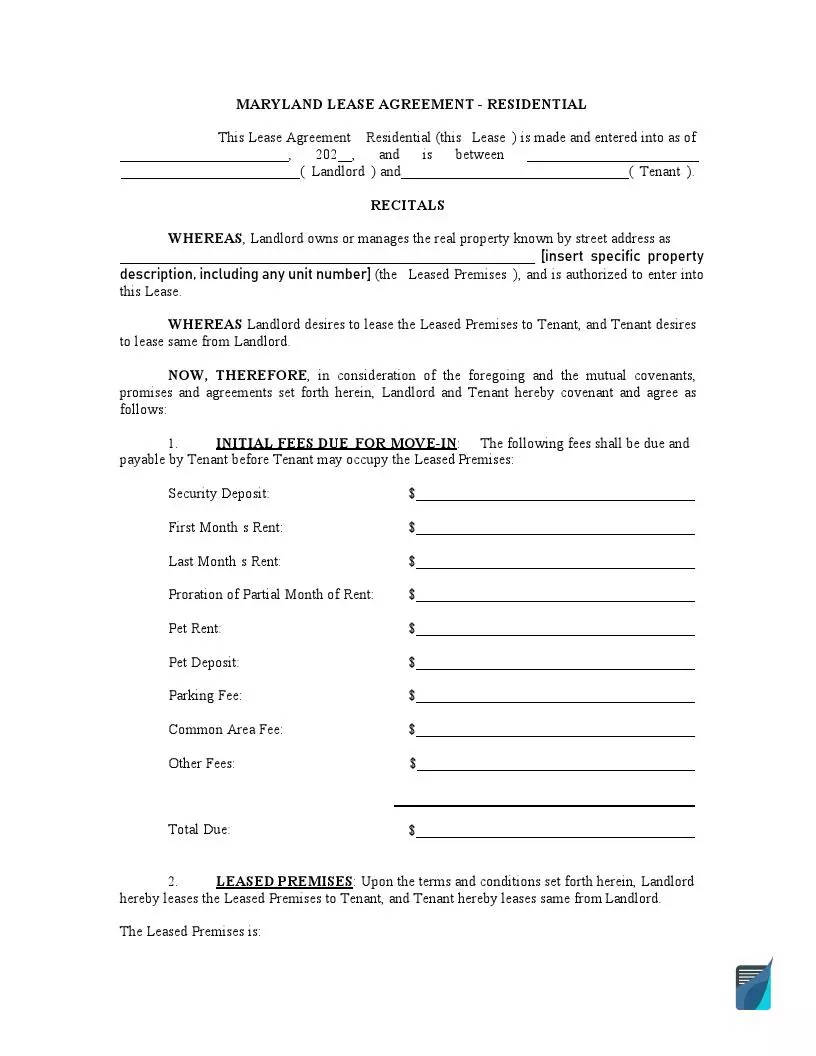
FormsPal’s builder walks a landlord through a Maryland lease agreement step by step, so the finished document reflects the property, the rent, and the terms both sides agreed to.
The lease should say how and when the tenant pays rent, and what happens if a payment is late.
| Document Name | Maryland Rental Lease Agreement Form |
| Other Names | MD Rental Lease, Maryland Residential Lease Agreement |
| Relevant Laws | Maryland Annotated Code, Real Property, Title 8 |
| Security Deposit Amount | Two months’ rent |
| Security Deposit Return | Forty-five (45) days from termination date |
| Avg. Time to Fill Out | 18 minutes |
| # of Fillable Fields | 119 |
| Available Formats | Adobe PDF |
These are quick answers to the most common questions about a Maryland lease agreement, covering the security deposit limit, the deposit return timeline, and the notice a tenant or landlord must give before a tenancy ends. Each answer links to the section of Maryland law that supports it.
Within 45 days after the tenancy ends, the landlord must return the security deposit, together with any interest owed, minus any damages rightfully withheld.[1]
A Maryland landlord may not charge more than the equivalent of one month’s rent per dwelling unit as a security deposit, no matter how many tenants share the unit.[1]
No. Maryland law requires advance notice before a tenancy ends. For most written leases and month-to-month tenancies, that is 60 days, and for a year-to-year tenancy it is 90 days.[2]
A tenant who wants to end a tenancy must give proper notice. In most cases that is at least 30 days before the lease or tenancy expires, 90 days for a year-to-year tenancy, or 180 days for a farm tenancy. Giving this notice on time is how a tenant avoids liability for breaking the lease.[2]
General information, not legal or tax advice.
Unless noted otherwise, the sources below are from the Md. Code, Real Prop.

Other Rental Lease Agreement Forms by State
