
An Ohio lease agreement is a written contract between a landlord and a tenant renting residential property. It sets the rent, the term, and the duties of each side under Ohio Revised Code Chapter 5321. It applies to apartments, houses, and single rooms, whether the tenancy runs for a fixed term or month to month. FormsPal’s builder below creates a ready-to-sign Ohio lease agreement in minutes.
Last Updated: September 2026. This guide is reviewed and updated regularly to reflect current Ohio law. If you notice an error or outdated information, please contact us.
Build Your Document
Answer a few simple questions to make your document in minutes
Save and Print
Save progress and finish on any device, download and print anytime
Sign and Use
Your valid, lawyer-approved document is ready
Ohio’s landlord-tenant rules are in Chapter 5321 of the Ohio Revised Code. They cover security deposits, notice to end a tenancy, and the duties of each side of the rental property. The landlord is the person or company that owns and rents out the property, and the tenant is the person who lives there and pays rent. The sections below explain what applies once both sides sign an Ohio lease agreement.
This document goes by several names: Ohio Residential Lease Agreement, OH Rental Lease, or simply an Ohio lease agreement. They all mean the same form.
Section 5321.16 of the Ohio Revised Code sets out what the landlord and the tenant must do about the security deposit once the lease ends.
Tenants often skip this step: if you do not give the landlord a forwarding address in writing, there may be nowhere for the deposit notice to go.
Ohio sets separate notice periods for ending a week-to-week or a month-to-month tenancy under Ohio Rev. Code § 5321.17. A lease with a fixed end date is different. Section 5321.17 sets no notice period for it, so it simply ends on that date unless the lease itself requires notice.[2]
There is no single residential lease agreement template used across the United States, because the rules vary by state and by the type of property being leased. A lease for an apartment looks different from one for an office.
Ohio offers several versions of the form. You can find at least seven of them below:
When you complete a lease agreement in Ohio, first, make sure that you have chosen the right template.
Whichever template you pick, an Ohio lease agreement is a contract, so it should cover the same basics that let both sides know what they agreed to:
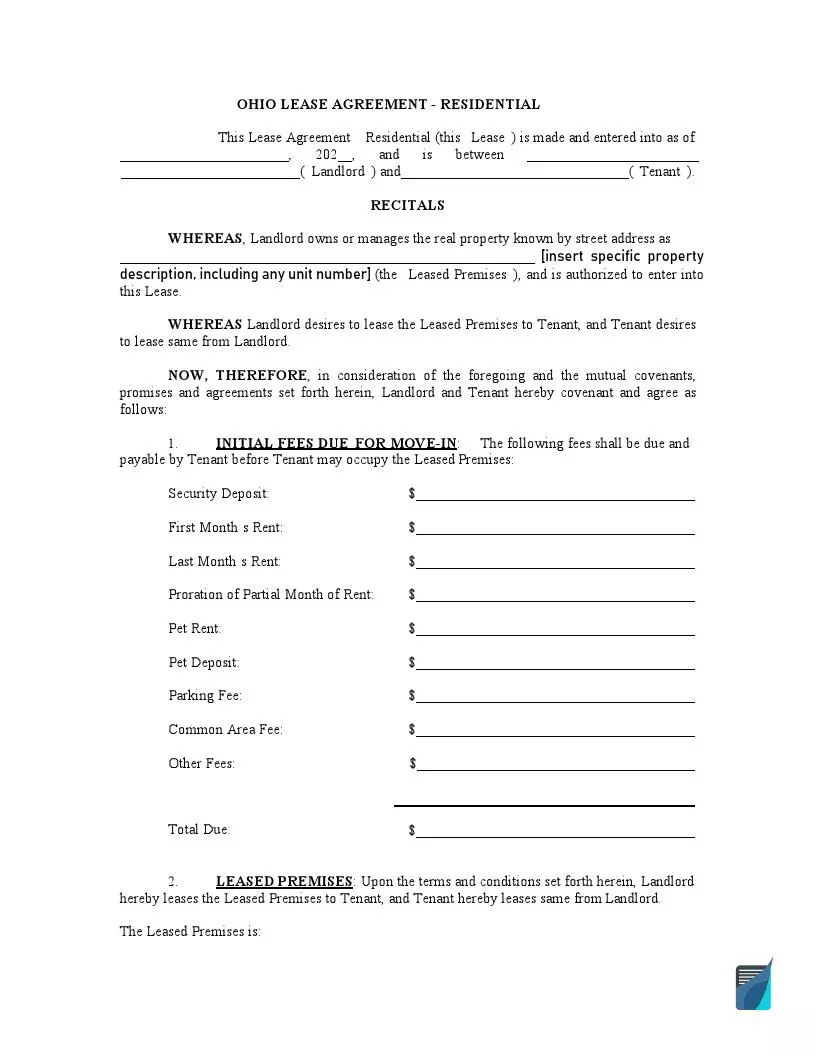
FormsPal’s builder fills in a PDF version of this contract for you, with each field ready for the landlord’s and tenants’ details.
The table below summarizes this Ohio lease agreement PDF form, including how the security deposit rule above applies to it.
| Document Name | Ohio Rental Lease Agreement Form |
| Other Names | OH Rental Lease, Ohio Residential Lease Agreement |
| Relevant Laws | Ohio Revised Code, Chapter 5321 |
| Security Deposit Return | Thirty (30) days from termination date |
| Avg. Time to Fill Out | 18 minutes |
| # of Fillable Fields | 119 |
| Available Formats | Adobe PDF |
These are the questions landlords and tenants ask most about an Ohio lease agreement. They cover the security deposit deadline, whether thirty days’ notice is required, and how to end a tenancy. Each answer names the Ohio Revised Code section it comes from.
A landlord has thirty days after the lease ends and the tenant moves out to return the security deposit. If the landlord keeps any part of it, that amount must be itemized in a written notice sent to the tenant within that same thirty days.[1]
It depends on the tenancy type:
These are the periods set by Ohio Rev. Code § 5321.17.[2]
How you end a lease in Ohio depends on its type. A month-to-month tenancy needs at least thirty days’ written notice before the next rental date. A week-to-week tenancy needs only seven days’ notice before the date named in it. A fixed-term lease simply ends on the date it names, since Section 5321.17 sets no notice period for it, unless the lease itself requires notice.[2]

Other Rental Lease Agreement Forms by State
General information, not legal or tax advice.
