
An Ohio living will is a written document that lets you record your wishes about life-sustaining treatment in advance, in case illness or injury leaves you unable to speak for yourself.[1] It is also known as the State of Ohio Living Will Declaration.
Last Updated: September 2026. This guide is reviewed and updated regularly to reflect current Ohio law. If you notice an error or outdated information, please contact us.
The document gives your physicians clear instructions when you cannot give them in person, and it can be created alongside a Medical Power of Attorney that names someone you trust to make health care decisions for you.
Once you sign it, give a copy to your physician and to family or friends you trust, so they know where to find it and what it says.
Ohio law sets specific rules for signing and witnessing your living will form, sometimes called an advance directive. You, or someone signing at your direction, must sign and date the declaration, and then either have it witnessed by two qualifying adults or acknowledged before a notary.[1] If you have two witnesses who meet the requirements below, a notary is not needed.
You do not need both. Ohio law lets you pick whichever of the two options above is easier to arrange, not both.[1]
If you choose witnesses instead of a notary, they must be present when you, or someone signing at your direction, sign the declaration.[1] Each witness must be:
The living will portion of the form covers your treatment wishes. The Medical Power of Attorney portion, further along in the same form, lets you name someone to make health care decisions for you on topics the living will does not cover. You can complete either part on its own, or both together.
After signing, give a copy to your physician and to relatives or friends you trust, so they are aware of your wishes.
If you are pregnant, life-sustaining treatment may not be withheld or withdrawn under your declaration where that would end the pregnancy, unless your attending physician and one other examining physician determine that the fetus would not be born alive (R.C. 2133.06(B)).[2]
Your declaration applies when you are in a terminal condition, a permanently unconscious state, or either, as the declaration itself specifies (R.C. 2133.02(A)(2)).[1]
| Document Name | Ohio Living Will Form |
| State Form Name | Ohio Living Will Declaration |
| Signing Requirements | Two Witnesses or a Notary |
| Validity Requirements | Section 2133.02(A)(1) |
| Specific Powers | Section 2133.02 |
| Avg. Time to Fill Out | 13 minutes |
| # of Fillable Fields | 48 |
| Available Formats | Adobe PDF; Microsoft Word |
| State Laws: Ohio Revised Code, Chapter 2133 | |
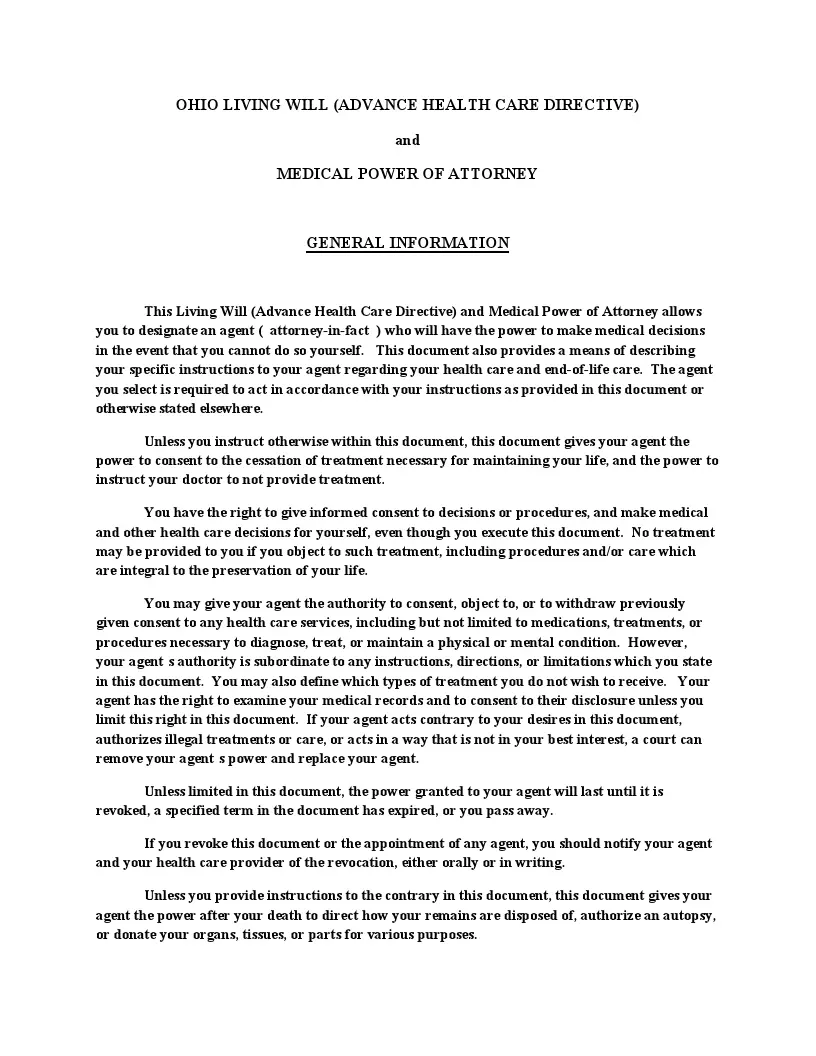
This Ohio living will form is combined with a Medical Power of Attorney, so the steps below cover both parts. Complete the declaration first, initial your treatment choices, then name a health care agent before you sign in front of two witnesses. Each step below names the part of the form it covers.
You can download the form as a PDF file or open it in your browser to start filling it out immediately. For more efficiency, use our convenient Online Forms Building Software to fill out the Ohio Living Will form.


If you have both a valid durable power of attorney for health care and a valid declaration, the declaration controls to the extent they conflict while you are in a terminal condition or permanently unconscious (R.C. 2133.03(B)(2)).[3]
Most problems with an Ohio living will are avoidable with a careful review before you sign. Watch for these common issues, which can leave your wishes unclear or the document technically invalid.

You create a valid Ohio living will by signing the declaration yourself, or having another person sign it at your direction, and then either having it witnessed by two adults or acknowledged before a notary public. By signing, each witness confirms that you appeared to be of sound mind and signing willingly, free from duress, fraud, or undue influence.[1]
General information, not legal or tax advice.
