
A New York living will is a written document that lets a competent adult name a health care agent and give end-of-life care instructions.[1] It is often prepared alongside a Medical Power of Attorney.
Last Updated: September 2026. This guide is reviewed and updated regularly to reflect current New York law. If you notice an error or outdated information, please contact us.
New York law keeps a health care proxy and a power of attorney as separate documents. It does not allow you to execute both on the same form.[1] The document lets you decide in advance how life-sustaining treatment, pain relief, and organ donation should be handled if you become unable to speak for yourself.
As long as it is clear and convincing, health care providers will honor it. We recommend you consult an attorney, and talk with your family and the people you trust, to make sure the document is ready for whatever may come.
A New York living will can be part of, or paired with, other documents that cover similar ground:
Only a competent adult can create a New York living will and appoint a health care agent.[1] A New York Health Care Proxy form is optional, but we recommend appointing someone you trust to speak on your behalf if you cannot.
A living will and a Health Care Proxy work together. The proxy names your agent, and the living will spells out what you want that agent, your medical team, and your family to do.
New York law sets these signing and witnessing rules for the health care proxy:
New York law also keeps the health care proxy separate from a power of attorney: you cannot execute both on the same form or document.[1]
New York’s proxy law also covers witnesses who join by audio-video conference rather than in person. If a remote witness does not personally know you, you must show that witness valid photo identification during the audio-video conference. The remote witness must then receive a legible copy of the proxy, sent by fax or electronic means, within twenty-four hours of you signing it. The remote witness signs that copy and transmits it back to you to complete the process.[1]
A New York living will covers the following issues:
| Document Name | New York Living Will Form |
| State Form Name | New York Health Care Proxy and Living Will |
| Signing Requirements | Signed and dated by the declarant in the presence of two adult witnesses, who must also sign[1] |
| Validity Requirements | New York Consolidated Laws, Section 2981 |
| Powers Limitation | Not specified |
| Avg. Time to Fill Out | 13 minutes |
| # of Fillable Fields | 48 |
| Available Formats | Adobe PDF; Microsoft Word |
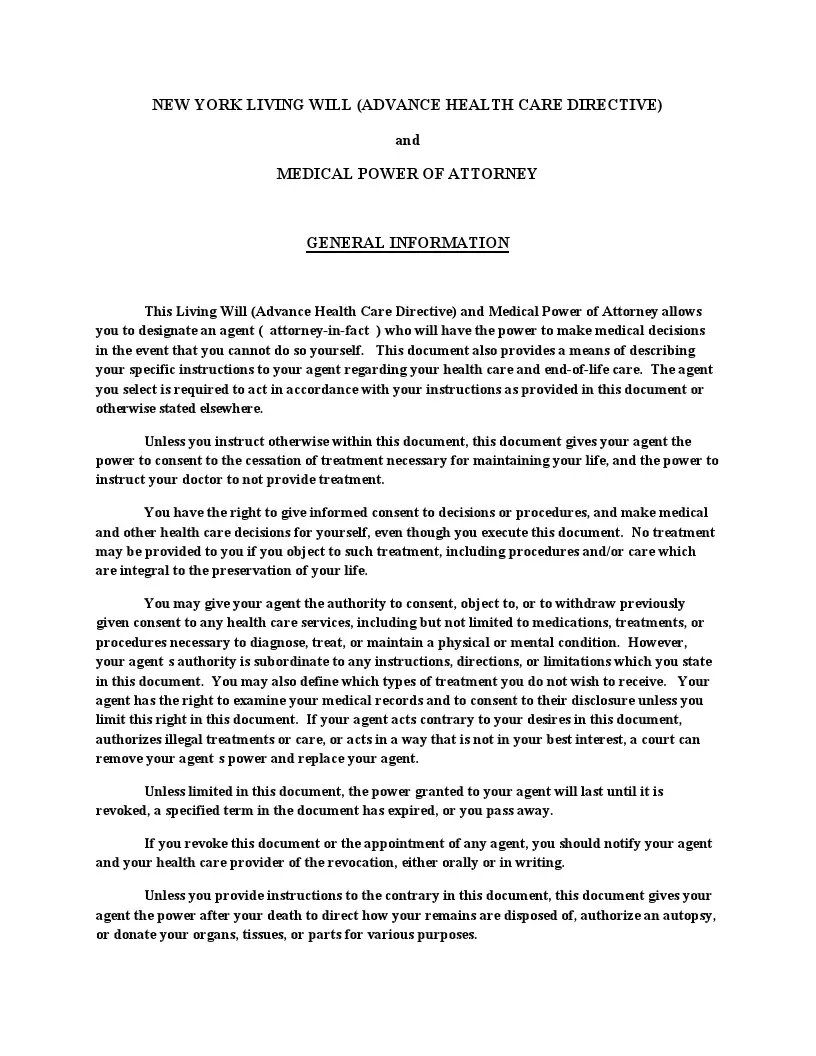
To fill out your New York living will, follow the form in order: complete your declaration, record your health care choices, and finish the Medical Power of Attorney section before you sign. Each step below tells you which page of the form it covers and what to do there.
If you download the form as a PDF, you can fill it in online with our PDF editor. For more efficiency, you can also use our Online Forms Building Software to build the document from scratch.


You complete a living will in New York by signing the health care proxy in the presence of two adult witnesses, who must also sign it. By signing, the witnesses state that you appeared to sign willingly and free from duress. The person you name as your agent cannot serve as one of the witnesses.[1] The sections below walk through the signing rules and the steps for filling out the form.
Your witnesses must be adults, and the individual you name as your health care agent cannot serve as one of them. If you live in a mental hygiene facility, at least one witness must not work for the facility, and if the facility is also a hospital, one witness must be a qualified psychiatrist or psychiatric nurse practitioner.[1] Witnesses can also join by audio-video conference under the rules described above.
General information, not legal or tax advice.
