
Updated:
A Georgia bill of sale is a signed record of a private sale. Georgia DOR Form T-7 asks for the sale date, the odometer reading, and the seller’s printed name and signature.[2] The form serves Georgia buyers and sellers, especially in a private car sale.
This page covers the five Georgia bill of sale types, when Georgia asks for one, what it must include, the title rules that go with a vehicle sale, and each part of the vehicle form.
Key facts
Build Your Document
Answer a few simple questions to make your document in minutes
Save and Print
Save progress and finish on any device, download and print anytime
Sign and Use
Your valid, lawyer-approved document is ready
| Document Name | Georgia Vehicle Bill of Sale Form |
| Other Names | Georgia Car Bill of Sale, Georgia Automobile Bill of Sale |
| DMV | Georgia Department of Revenue |
| Bill of Sale Required? | Georgia DOR asks for one if the vehicle is 1985 or older and does not require a title (Ga. DOR MVD; Title and Register a Vehicle Purchased in a Casual Sale)[1] |
| Title Law | O.C.G.A. § 40-3-32(a): the seller assigns the title when the vehicle is delivered[3] |
| Avg. Time to Fill Out | 7 minutes |
| # of Fillable Fields | 25 |
A Georgia bill of sale comes in five types: vehicle, trailer, boat, firearm and general. Each type lists the details its item needs, such as the vehicle identification number (VIN) of a car or the Hull Identification Number (HIN) of a boat. The general form covers an item with no form of its own, such as equipment or tools. All of our bill of sale forms are listed by type and state.
Georgia bill of sale for a motor vehicle records the sale of a car, truck or other vehicle. A signed copy gives both sides a record of the price and the date. In practice, the buyer usually pays taxes, registration fees and other charges.
| Alternative Name | Car Bill of Sale |
| Seller’s Signature | Signature line |
| Buyer’s Signature | Signature line |
| Notarization | Optional |
| Download | PDF Template |

Georgia trailer bill of sale is signed by the parties to record the sale of a trailer. Many buyers bring a copy when they register the trailer, along with paperwork such as a photo ID, proof of insurance and the title application.
| Alternative Name | Utility Trailer Bill of Sale |
| Seller’s Signature | Signature line |
| Buyer’s Signature | Signature line |
| Notarization | Optional |
| Download | PDF Template |

Georgia boat bill of sale records the details of a boat sale. Along with the Hull Identification Number (HIN), list the boat’s model, make, year and condition in your document.
| Alternative Name | Vessel Bill of Sale |
| Seller’s Signature | Signature line |
| Buyer’s Signature | Signature line |
| Notarization | Optional |
| Download | PDF Template |

Georgia bill of sale for a firearm records the date and terms of a firearm sale. It usually lists the firearm’s caliber, model and make, the details of both parties (including driver’s license numbers) and the price of the gun.
| Alternative Name | Gun Bill of Sale |
| Seller’s Signature | Signature line |
| Buyer’s Signature | Signature line |
| Notarization | Optional |
| Download | PDF Template |

Georgia general bill of sale is a flexible form for private sales that have no dedicated template. If a specific form fits your sale, use that one instead. A general form works well for large equipment, machinery or tools.
| Alternative Name | Generic Bill of Sale |
| Seller’s Signature | Signature line |
| Buyer’s Signature | Signature line |
| Notarization | Optional |
| Download | PDF Template |
A Georgia vehicle bill of sale is what Georgia DOR asks for if the vehicle is 1985 or older and does not require a title, according to the Georgia Department of Revenue page Ga. DOR MVD; Title and Register a Vehicle Purchased in a Casual Sale.[1] For a titled vehicle, the certificate of title transfers ownership, according to Georgia DOR Form T-7.[2]
The document still gives a titled sale a dated paper trail: the price, the parties, the vehicle and the payment terms. The official sources this page cites set no bill of sale rule for trailers, boats, firearms or general goods. For those items, the document serves as the buyer’s proof of purchase and the seller’s proof of who took the item.
The certificate of title and the sale record do different jobs in a Georgia vehicle sale. The title is the ownership document: under O.C.G.A. § 40-3-32(a), the seller signs its assignment and warranty to the buyer when the vehicle is delivered.[3] The sale record sets out the terms of the deal, such as the price, the payment method and the date.
The title transfer asks for four entries in a Georgia motor vehicle sale, according to the Georgia DOR Form T-7 guidance, listed below; they belong to the title's assignment section.[2]
Georgia DOR Form T-7 guidance also says all recorded liens and security interests against the previous owner must be released in the spaces provided on the title.[2]
The vehicle form also records the parties’ addresses and phone numbers, the vehicle’s make, model, body type, year and color, and its VIN. It states the purchase price, how the price is paid, and whether taxes are part of the price. These fields come from the form’s own layout, not from a Georgia rule.
O.C.G.A. § 40-3-32(a) sets the seller’s duty when an owner transfers a vehicle other than by creating a security interest: at delivery, the seller signs an assignment and warranty of title and delivers the title to the buyer.[3] The statute reads:
If an owner transfers his interest in a vehicle other than by the creation of a security interest, he shall, at the time of delivery of the vehicle, execute an assignment and warranty of title to the transferee in the space provided therefor on the certificate of title or as the commissioner prescribes and cause the certificate and assignment to be delivered to the transferee.
In plain words, the “transferee” is the buyer, and to “execute” an assignment is to sign it. The seller signs in the space on the title and makes sure the buyer receives the certificate and the assignment.
An as-is bill of sale states that the buyer takes the vehicle in its present condition, with no promise from the seller about its mechanical state or repairs. The Georgia vehicle form prints its as-is terms in the Miscellaneous Provisions, next to the seller’s statement of ownership and of no liens. The official sources this page cites set no Georgia rule on as-is wording.
The as-is terms cover the vehicle’s condition, not its ownership. The title assignment and warranty is a separate step that the seller signs on the certificate of title.
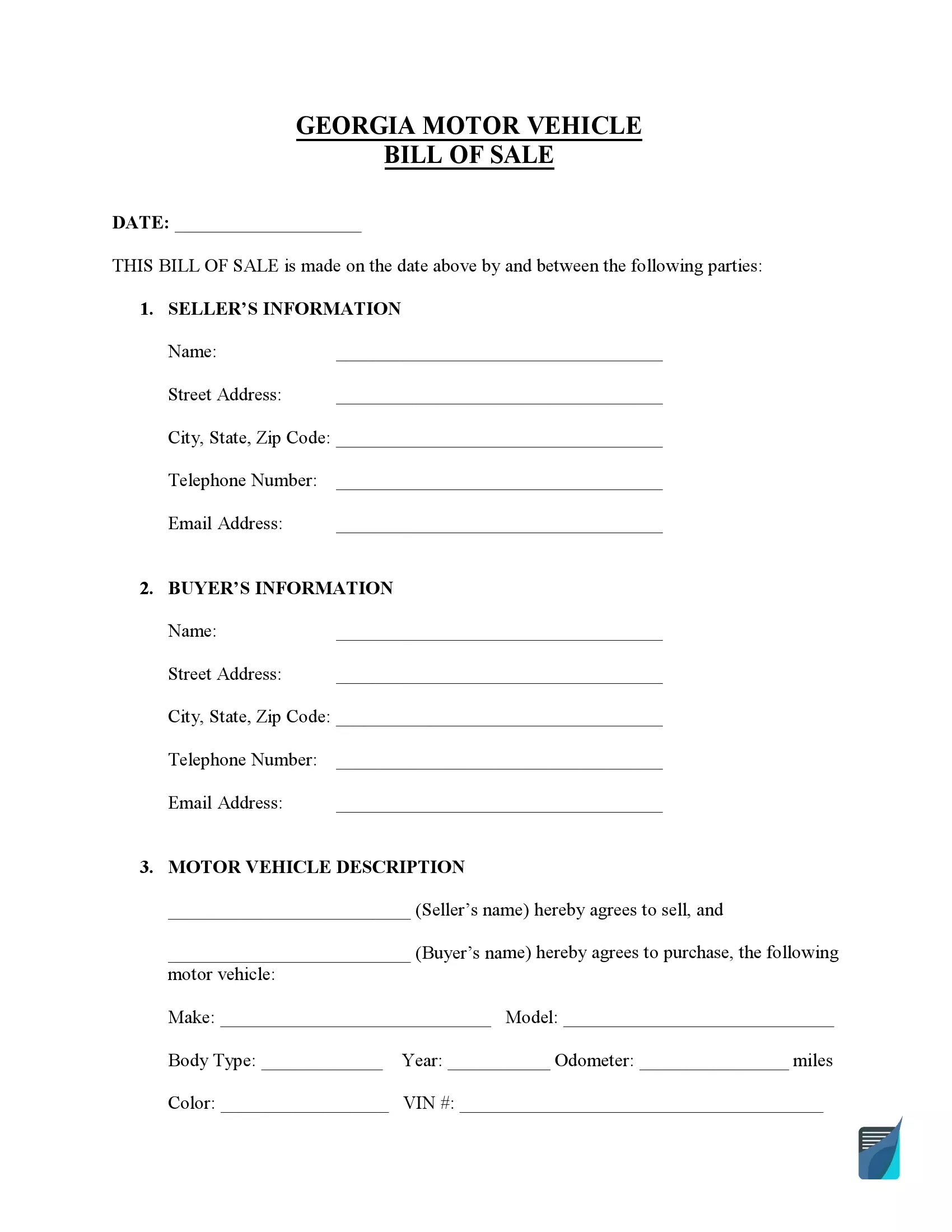
The Georgia motor vehicle bill of sale has ten parts, filled in order from the date on page 1 to the notary block on page 4. The page numbers below refer to the PDF form, which our online PDF editor also fills in.
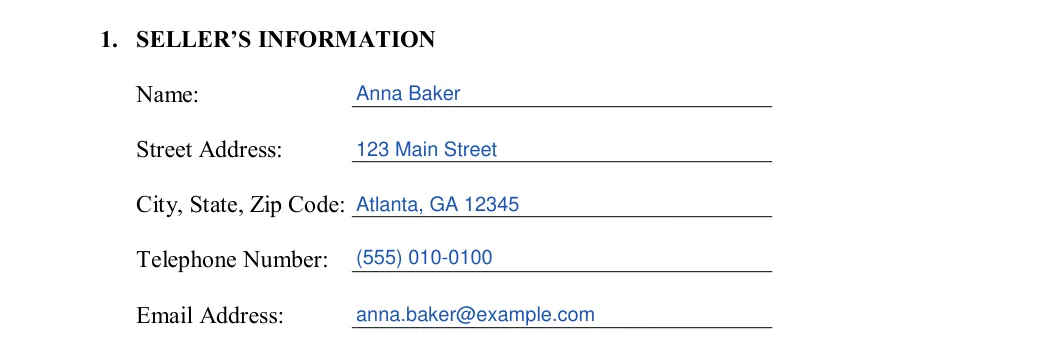
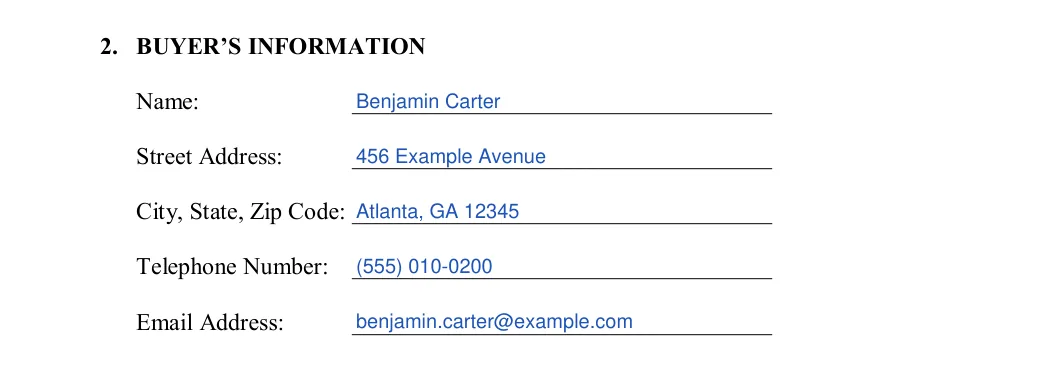
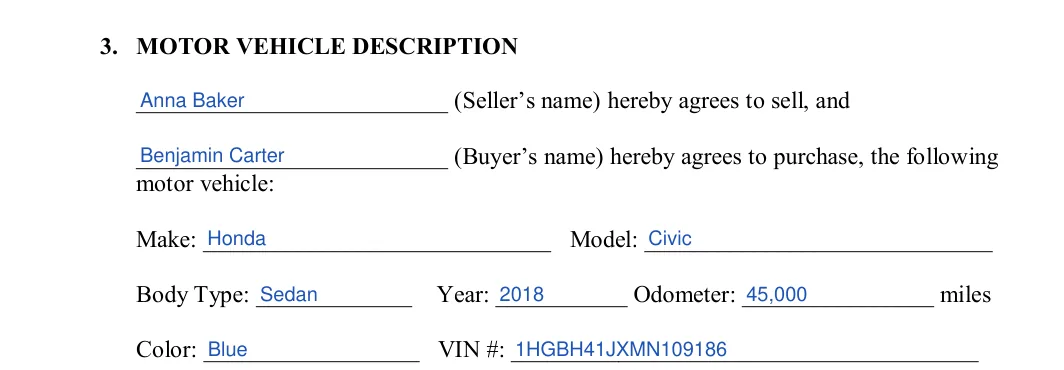
The screenshots under each step show the FormsPal Georgia motor vehicle bill of sale template filled with sample entries in blue, so you can see where each answer goes. The names, addresses, dates and amounts are examples only.
Write the date of the bill of sale on the DATE line at the top of page 1.

Enter the seller’s name, street address, city, state and zip code, telephone number and email address.
Enter the same five items for the buyer: name, street address, city, state and zip code, telephone number and email address.
Write the seller’s and buyer’s names in the opening sentence, then fill in the vehicle details:
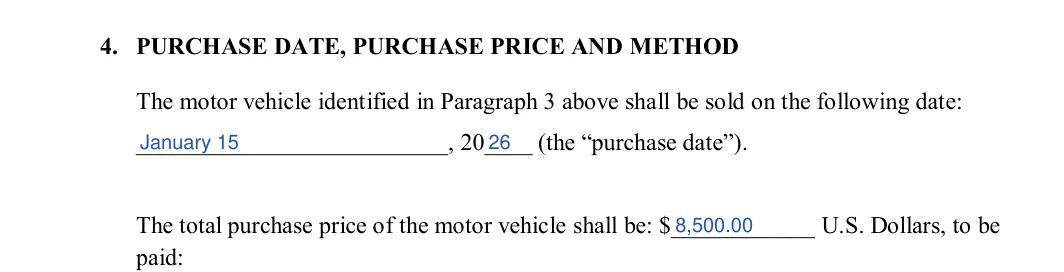
Enter the purchase date and the total purchase price in U.S. dollars.
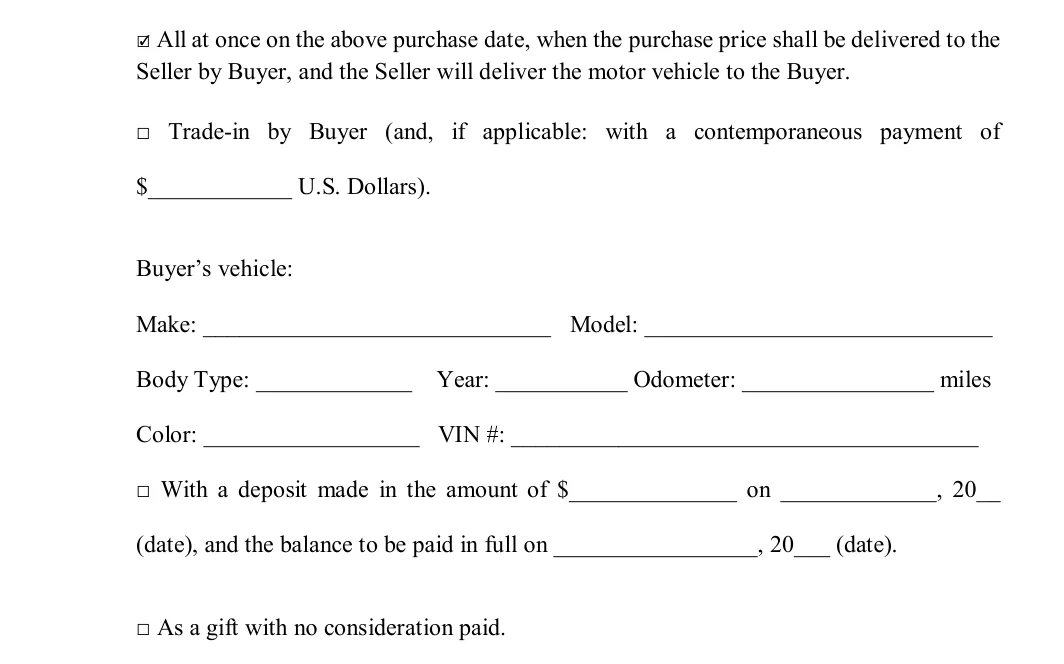
Check one option: payment in full on the purchase date, a trade-in, a deposit with the date of the balance, or a gift with no payment. A trade-in asks for the buyer’s vehicle details and any added payment.
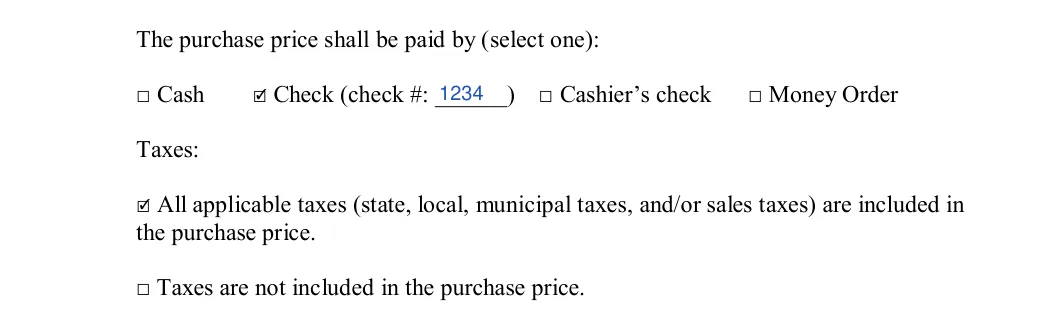
Select one payment method: cash, check (with the check number), cashier’s check or money order. Then check whether taxes are included in the price or not.
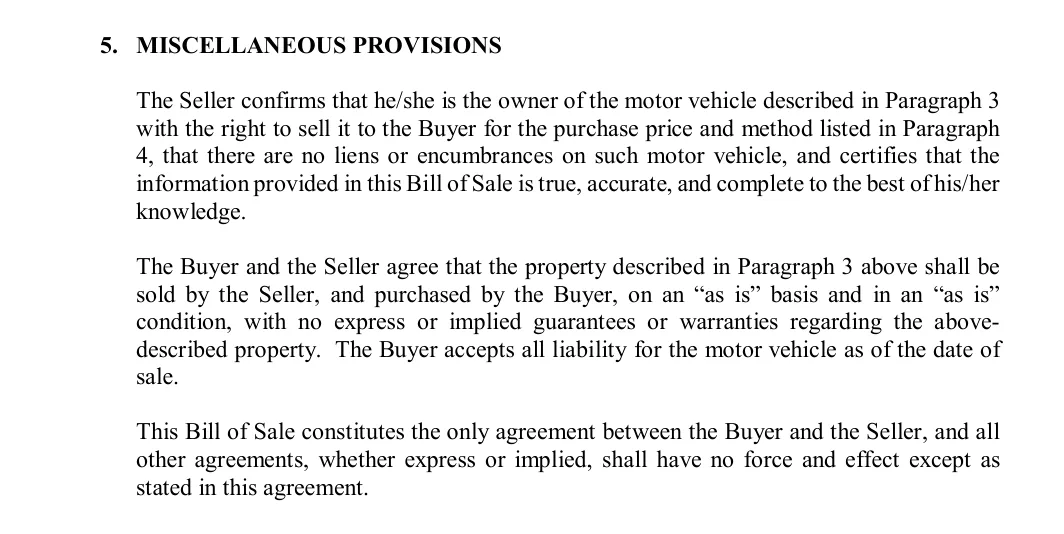
Read this section before signing. It holds the seller’s confirmation of ownership and of no liens, the as-is terms and the entire-agreement clause. There is nothing to fill in.
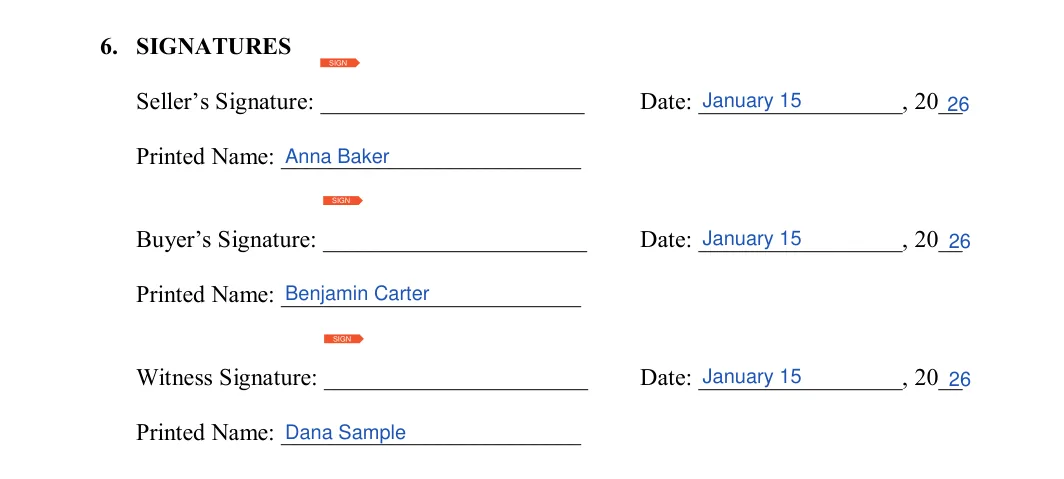
The seller, the buyer and a witness each sign, add the date and print their name on their own line.
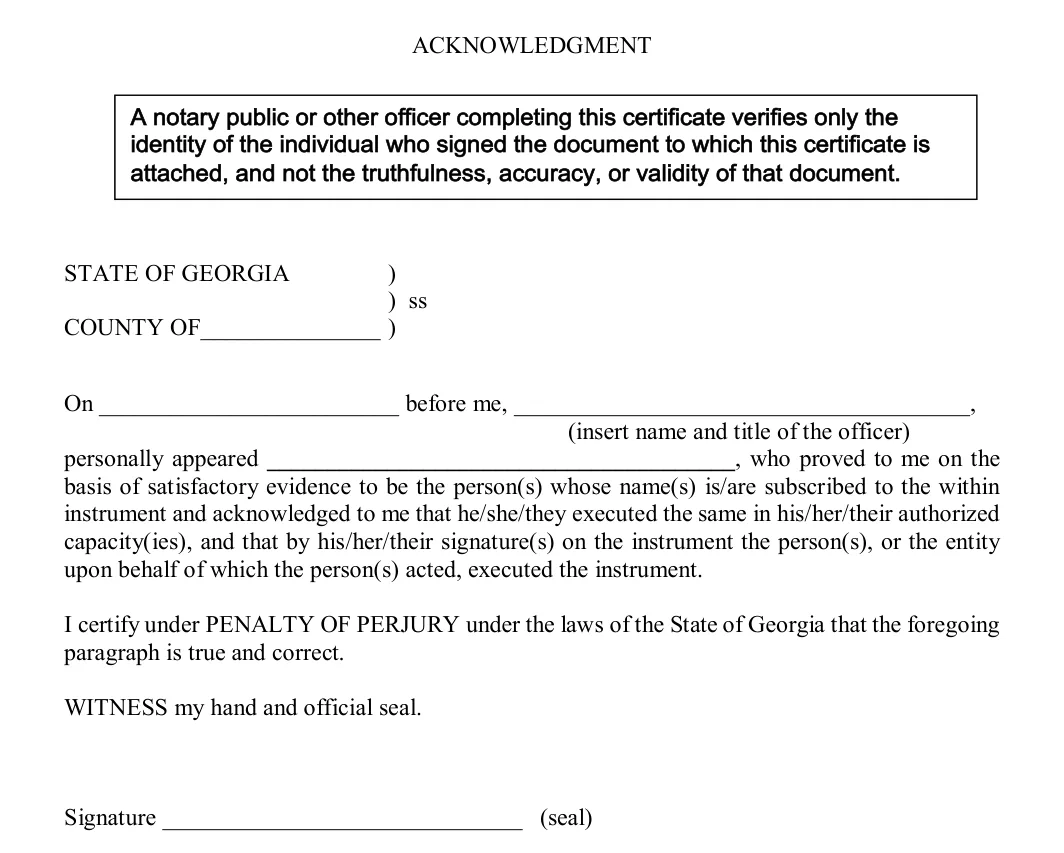
Page 4 is a notary acknowledgment. If you use it, sign before the notary, who completes the county, date, officer name, the name of the person appearing, and the signature and seal.
A Georgia bill of sale is signed by the seller and the buyer on the signature lines the form provides. The title’s assignment section has its own signing rules, set out in Georgia DOR Form T-7.[2] The signing takes these steps:
A notary appears nowhere in the Georgia sale rules this page cites, which cover the title, the date, the odometer reading and the signatures. Georgia has no statute that requires a bill of sale to be notarized. The vehicle form has an optional acknowledgment block on page 4 for parties who want a notary to witness the signatures.
The buyer has 30 days from the date the vehicle was purchased or transferred to apply for a Georgia title at the buyer’s County Tag Office, according to Ga. DOR MVD; Motor Vehicles Fees, Fines, and Penalties.[4] Fees and requirements change, so confirm the current steps with the office before you go.
Buyers commonly bring the items below.
A signed GA bill of sale gives the seller a dated record of who bought the vehicle and for how much. It gives the buyer proof of what they paid. The form also lists the vehicle’s year, make, model and color.
Certification of Inspection is used to inspect the vehicle registered in another state or country that does not issue titles.

Application for Voluntary Registration Cancellation is used to cancel your registration if your vehicle is stolen, junked, or sold to a dealer.

Used to apply for a firearm carry license in Georgia.

A private car sale in Georgia needs the certificate of title, signed over by the seller, and the odometer reading at the time of the transfer, according to Georgia DOR Form T-7.[2] Georgia DOR asks for a bill of sale if the vehicle is 1985 or older and does not require a title (Ga. DOR MVD; Title and Register a Vehicle Purchased in a Casual Sale).[1]
The seller needs the certificate of title and the odometer reading at the time of the transfer, according to Georgia DOR Form T-7.[2] The seller signs the title over to the buyer and delivers it when the vehicle is delivered (O.C.G.A. § 40-3-32(a)).[3] All recorded liens and security interests against the previous owner must be released, according to Georgia DOR Form T-7.[2]
Form T-7 is the bill of sale the Georgia Department of Revenue publishes for motor vehicle sales, as a PDF on its T-7 Bill of Sale page. Our Georgia vehicle form asks for the same core entries: the date, the parties, the vehicle, the odometer reading and the signatures.
For a vehicle that is 1985 or older and does not require a title, Georgia DOR asks for a bill of sale (Ga. DOR MVD; Title and Register a Vehicle Purchased in a Casual Sale).[1] A titled vehicle changes owner with the certificate of title (Georgia DOR Form T-7).[2] If you only have a bill of sale, read how to get a vehicle title with a bill of sale.
The buyer has 30 days from the date the vehicle was purchased or transferred to apply for a title at the buyer’s County Tag Office (Ga. DOR MVD; Motor Vehicles Fees, Fines, and Penalties).[4]
The seller and the buyer each keep a signed copy of the document. The seller’s copy shows who took the vehicle and when; the buyer’s copy shows the price paid and the vehicle bought.

Other Georgia Forms
General information, not legal or tax advice.


