Online Divorce in Michigan, From Complaint to Judgment
Answer a few guided questions and get the complete set of Michigan divorce papers, prepared from your answers for one flat price. In an agreed case your spouse files a short Answer, and the judge signs your Judgment of Divorce after a brief hearing.
Check my eligibility: free- ✓ Michigan-specific court forms
- ✓ Prepared from your answers
- ✓ One flat price
- ✓ 30-day money-back guarantee

How Uncontested Divorce Works in Michigan
An uncontested divorce in Michigan is one where you and your spouse agree on everything the court has to decide: how you divide property and debts, spousal support, and, if you have children together, custody, parenting time, and child support. Michigan is a pure no-fault state: the only ground is a breakdown of the marriage relationship, pleaded in the exact words the statute requires, and the law forbids adding any other explanation. There is no separation period, but there is a waiting period after filing. The court cannot take testimony until 60 days after you file, or six months after you file when there are dependent minor children under 18, and the court may shorten the six months to 60 days for unusual hardship.
FormsPal is a self-help document-preparation service, not a law firm. Where Michigan's court rules require the state's approved forms, your packet uses those official forms, filled from your answers. Michigan publishes no form for the documents that carry the substance of a divorce, so five are drafted for your case: your Complaint, your spouse's Answer, the Judgment of Divorce with or without minor children, and the Motion for Entry of Default Judgment if your spouse does not respond. You review every document, sign it and file it yourself. We don't give legal advice or tell you what to agree to. If your case is contested, involves safety concerns, or you're unsure what's fair, talk to a licensed Michigan attorney first.
Michigan's filing fees are set by statute: $175 to open a divorce, which is the $150 filing fee plus the $25 electronic filing system fee, and $80 more when the case decides custody or parenting time. The court waives or suspends that $80 when a consent judgment is submitted with your initial filing. Depending on your circuit, you file through the state's MiFILE system, through the court's own electronic system or on paper, and every Michigan divorce finishes with testimony in open court, so plan on one short hearing.
Start my free eligibility check
What Michigan Requires to Divorce
The rules your court applies to every uncontested Michigan divorce. The questionnaire checks each one for you.

Is an online divorce right for you?
Online divorce fits uncontested cases: where you and your spouse agree on property, debts, support, and any parenting arrangements. If your case is contested, involves safety concerns, or your spouse can't be located, we recommend speaking with a licensed Michigan attorney first.
Three Steps to a Finalized Michigan Divorce
From your first question to a signed decree, here's exactly what to expect.
Answer questions
about 5 minutesTell us about your marriage, your agreement, and the Michigan county you'll file in.
We build your court forms
ready right awayThe exact Michigan court documents your case needs, completed with your information. Review every page and edit anything before you sign.
Sign your papers
guided, at your paceSign where Michigan requires it, under penalty of perjury on nearly every form. The exceptions, sworn before a notary or deputy clerk, are the custody jurisdiction affidavit when custody is decided and the default request if your spouse files nothing. Our signing flow lists every signature.
The waiting period runs from the day you file. After it ends, a short hearing takes testimony in open court, and in an agreed case the judge enters the Judgment of Divorce signed by both of you. We track your case and remind you at each milestone.
The Court Forms You'll Receive
These are the Michigan documents we prepare, the court's official forms and the pleadings we draft where Michigan publishes none, for an uncontested divorce. Which forms you actually get depends on your answers: with children or without, property or none, name restoration, or a fee waiver.
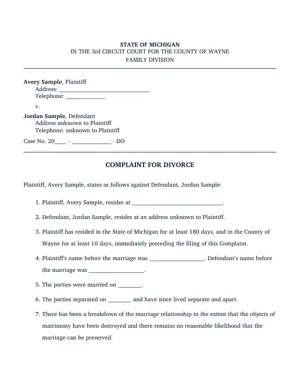
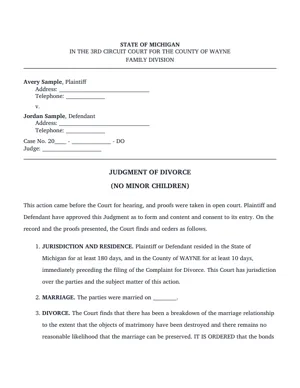
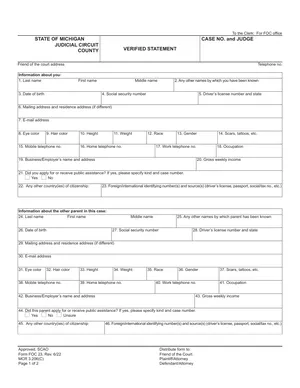
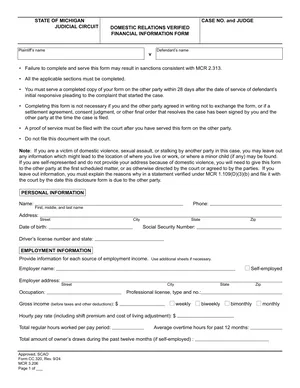
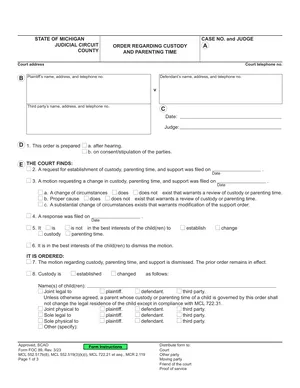
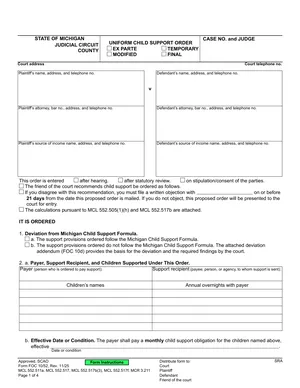
These 6 are highlights, not the whole package. Behind them sits our catalog of 21 Michigan documents: 16 official court forms and 5 drafted by FormsPal where Michigan publishes no form, and your package includes every one your answers call for, from the first filing through the final judgment.
Completed with your information
Michigan's official forms where the state publishes them: the summons, verified statement, judgment information, custody and support orders, and fee waiver. Five more are drafted for your case because Michigan publishes none: the Complaint, your spouse's Answer, the Judgment of Divorce with or without minor children, and the default judgment motion.
See my form package
How Long a Michigan Divorce Takes
Preparing your papers takes a session or two. Once you file, the waiting period runs, 60 days or six months with minor children unless the court shortens it for unusual hardship, and the court schedules a short hearing after it ends.
-
1
Prepare & review: a day or two
Answer the questionnaire, review your completed forms, and make any edits.
-
2
File your petition: day 0
File the complaint and its companion forms with the family division of the circuit court in your county or your spouse's county, electronically or on paper as your court directs, and pay the statutory filing fee or file a fee waiver request with your papers.
-
3
Service and the waiting period
The summons is served on your spouse, who in an agreed case accepts service and files a short Answer. The waiting period runs from filing. It is 60 days, or six months when there are dependent minor children under 18, and the court may shorten the six months to 60 days for unusual hardship.
-
4
Brief testimony and judgment
The court sets a short hearing after the waiting period. Testimony is taken in open court, and the judge signs the Judgment of Divorce. Ask the clerk what your court expects from each of you.
Estimate Your Divorce Costs
See what a typical uncontested divorce costs with an attorney in your state, and what you'd pay with FormsPal instead.
Filing in Your Michigan County
You file in the circuit court's family division for your county. Here are three of Michigan's largest, and we cover all 83 counties.
Wayne County
Oakland County
Kent County
Filing elsewhere in Michigan? Every circuit takes the same state forms, and your package includes a filing guide with the steps in order. Electronic-filing rules are set court by court, so confirm yours with the clerk.
Why Michiganders Choose FormsPal for an Online Divorce
- ✓The official state forms where Michigan publishes them: the summons, verified statement, judgment information, custody and support orders, and fee waiver, each filled from your answers in the mandatory format.
- ✓The Complaint and Judgment drafted for your case: Michigan publishes neither, so ours are prepared from your answers, with the ground pleaded in the statute's exact words.
- ✓The cooperative route built in: your spouse accepts service on the summons and files a short Answer, which keeps the case out of default.
- ✓Guided plain-language interviews with warnings whenever an answer would take your case off the agreed path.
- ✓One property list, everywhere: the assets and debts you enter once flow into the complaint, the financial information form when it applies, and the judgment, so nothing has to be typed twice or can disagree.
- ✓One flat price instead of attorney hourly rates, with the court's filing fee always paid separately and stated up front.
Michigan Online Divorce FAQ
How much does an online divorce in Michigan cost?
How long does a Michigan divorce take?
Do we have to be separated before filing?
Do we have to go to court?
How does my spouse get served?
Do I qualify to file in Michigan?
What if my spouse stops agreeing partway through?
We have children. What does Michigan require?
Which documents need a notary?
Why are the Complaint and Judgment drafted instead of official?
Online Divorce in Other States
Start Your Michigan Divorce Today
Free eligibility check. See your exact form package before you pay anything.
Reviewed and updated October 28, 2026. Court fees and procedures change, so always confirm the current details with your own court before you file.