
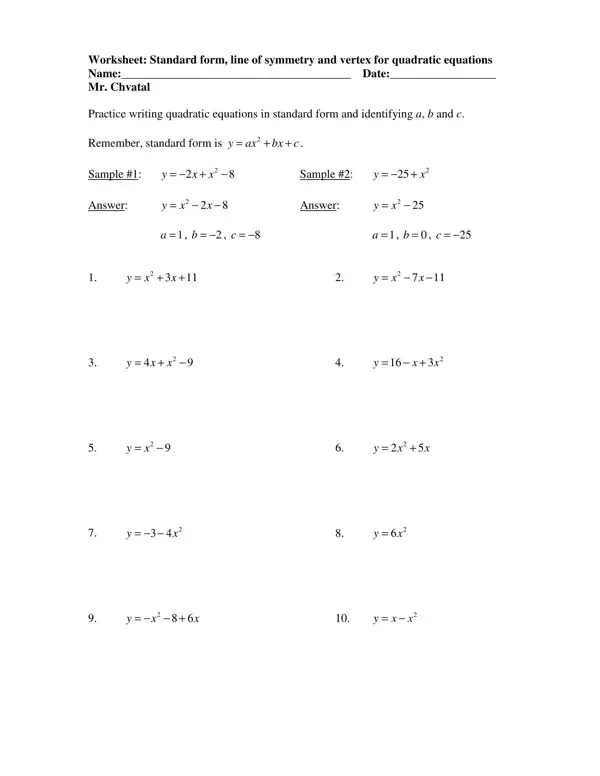
The Advanced Math Worksheet is a printable practice tool for students learning quadratic equations. It covers writing equations in standard form (y = ax² + bx + c), identifying coefficients a, b, and c, and determining whether a parabola opens upward or downward. Students also find the line of symmetry using x = -b / (2a), then calculate vertex coordinates. Created by Mr. Chvatal, this worksheet provides sample problems and step-by-step answers to reinforce core algebra skills.
Students working through quadratic equations will benefit from related practice materials on FormsPal. The Advanced Math Vertex Form worksheet covers converting between vertex and standard form. For foundational skills, the Algebra 1 Slope-Intercept Form worksheet builds linear equation fluency, and the Algebra Ax2 Factoring worksheet develops factoring skills needed for solving quadratic equations. Students working with graphs may also find the Linear-Quadratic Regression Worksheet helpful for connecting algebra to data analysis.
| Question | Answer |
|---|---|
| Form Name | Advanced Math Worksheet Form |
| Form Length | 4 pages |
| Fillable? | No |
| Fillable fields | 0 |
| Avg. time to fill out | 1 min |
| Other names | standard form line of symmetry and vertex for quadratic equations answer key, advanced math vertex form to standard form answers, vertex to standard form worksheet, vertex form to standard form worksheet |